



Hiring visibility is usually manageable when organizations operate at smaller hiring volumes.
A limited number of recruiters manage a relatively small number of open roles.
The situation changes once organizations begin scaling hiring across:
- Multiple business units
- Locations
- Recruiters
- Hiring managers
- Parallel pipelines
At this stage, hiring starts becoming operationally distributed.
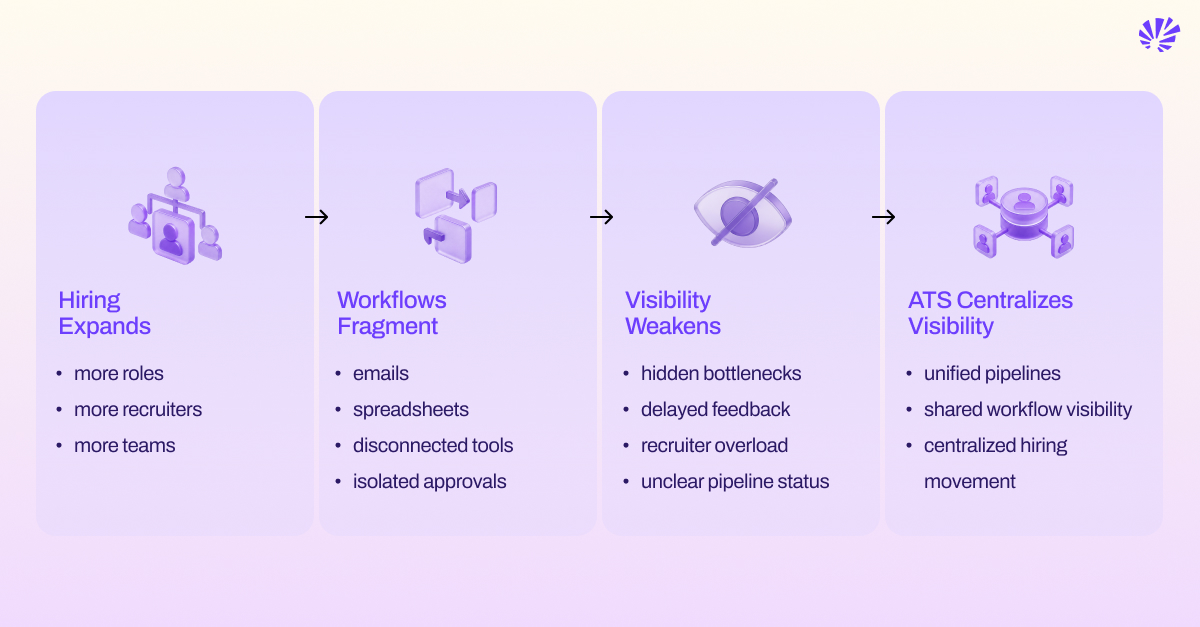
Different teams begin operating simultaneously across separate workflows. There is a drastic increase in the candidate inflow. Stakeholders end up coordinating more interviews, and there are more panel members, as a result, approvals take longer. Recruitment activity starts spreading across systems, communication channels, and business functions.
As complexity increases:
- Hiring bottlenecks become harder to identify
- Recruiter workload becomes uneven
- Pipeline movement slows down
- Coordination gaps increase
- Delays begin compounding silently across stages
Most organizations initially respond by increasing activity.
They:
- Add more recruiters
- Introduce additional recruitment tools
- Increase reporting layers
- Expand sourcing efforts
However, visibility problems often persist because hiring activity itself remains fragmented.
This is why Applicant Tracking Systems have become increasingly important in enterprise hiring environments.
They no longer function only as candidate tracking platforms. Modern ATS platforms act as the visibility infrastructure layer that helps organizations centralize hiring operations, monitor recruitment movement, and maintain coordination across distributed hiring workflows.
Why Hiring Visibility Matters in Enterprise Recruitment
Hiring visibility is not simply about tracking candidate status updates.
In enterprise environments, visibility directly affects:
- Workforce planning
- Hiring predictability
- Recruitment efficiency
- Business continuity
- Hiring quality
When leadership lacks visibility into recruitment movement, hiring decisions become reactive.
Hiring visibility has become increasingly important as recruitment operations scale across teams and geographies. In fact, 72% of HR leaders now rely on workforce analytics to guide hiring and talent allocation decisions, reflecting how central operational visibility has become in enterprise hiring environments.
Organizations struggle to identify:
- Where hiring delays originate
- Which pipelines are unstable
- Which roles remain understaffed
- Where recruiter capacity is stretched
- How hiring performance varies across teams
Without visibility, operational inefficiencies continue expanding quietly across the hiring system.
Enterprise Hiring Creates Distributed Workflows
As organizations scale, recruitment activity spreads across multiple operational layers.
Different teams hire simultaneously for:
- Operations
- Technology
- Sales
- Customer support
- Leadership roles
Each hiring stream introduces:
- Sourcing workflows
- Screening processes
- Interview coordination
- Evaluation cycles
- Approvals
- Stakeholder communication
These workflows often move independently across business units and geographies.
Without centralized visibility, leadership loses a clear understanding of how hiring activity behaves across the organization.
Where Hiring Visibility Typically Breaks Down
1. Fragmented Recruitment Systems
Many organizations still manage recruitment activity across disconnected systems.
Recruiters switch between:
- Spreadsheets
- Email threads
- Interview scheduling tools
- Sourcing platforms
- Evaluation documents
- Communication systems
Hiring information becomes fragmented across stages and stakeholders.
Context captured during screening may not travel effectively into interviews. Feedback loops become inconsistent. Hiring managers operate with partial pipeline visibility.
Over time, fragmented workflows reduce operational clarity across the hiring process. Hiring visibility weakens significantly when recruitment workflows remain fragmented across disconnected systems. 48% of organizations report integration gaps between hiring tools as a major recruitment challenge, making it harder for teams to maintain consistent visibility across the hiring lifecycle
2. Limited Pipeline Visibility
Organizations frequently struggle to answer operational questions such as:
- Which roles are delayed?
- Where are candidates dropping off?
- Which teams are overloaded?
- Which recruiters require additional support?
- Which pipelines are moving efficiently?
- Where are approvals slowing down?
Without centralized visibility, these issues often surface only after hiring timelines are already affected.
3. Delayed Hiring Insights
Hiring problems rarely emerge all at once.
Small operational delays accumulate gradually across:
- Screening
- Interviews
- Evaluations
- Stakeholder coordination
- Approvals
When organizations operate without real-time hiring visibility, these issues remain hidden until:
- Hiring timelines expand significantly
- Candidate experience weakens
- Recruitment targets are missed
- Business teams experience staffing gaps
Reactive visibility creates operational instability.
How Applicant Tracking Systems Improve Hiring Visibility
1. Centralized Candidate and Workflow Visibility
An ATS centralizes recruitment activity within a shared operational system.
Candidate pipelines, evaluations, communication, scheduling, and approvals become visible within a single environment.
This creates shared visibility across:
- Recruiters
- Hiring managers
- Interviewers
- Business stakeholders
Instead of operating across disconnected systems, hiring teams gain a unified view of recruitment movement.
2. Real-Time Pipeline Monitoring
Modern ATS platforms help organizations monitor:
- Candidate progression
- Stage-level conversion
- Recruiter workload
- Hiring velocity
- Drop-off patterns
- Sourcing performance
This improves operational awareness across recruitment workflows.
Leadership teams can identify instability earlier instead of reacting after delays compound.
3. Structured Hiring Coordination
Hiring visibility improves when workflows become structured.
ATS platforms create visibility into:
- Pending actions
- Interview scheduling
- Delayed feedback
- Stakeholder responsibilities
- Approval status
This reduces dependency on manual follow-ups and fragmented communication.
Candidate movement becomes easier to monitor across the recruitment lifecycle.
4. Recruitment Analytics and Reporting
Enterprise hiring increasingly depends on recruitment analytics for operational planning.
Modern ATS platforms provide visibility into:
- Hiring performance trends
- Recruiter productivity
- Sourcing effectiveness
- Pipeline health
- Hiring efficiency
- Workforce demand patterns
These insights help organizations align hiring execution with business growth requirements.
Visibility Challenges in High-Volume Hiring
1. Hiring Scale Reduces Operational Transparency
High-volume hiring environments create simultaneous movement across multiple recruitment streams.
Recruiters manage:
- Larger candidate pipelines
- More interview coordination
- Parallel requisitions
- Distributed stakeholder workflows
As hiring activity expands, maintaining visibility manually becomes increasingly difficult.
Operational blind spots grow rapidly once hiring scale exceeds coordination capacity.
2. High-Volume Hiring Creates Coordination Blind Spot
Many hiring delays occur between stages rather than within stages themselves.
For example:
- Candidates wait for interview scheduling
- Evaluations remain pending
- Approvals slow down unexpectedly
- Hiring managers delay feedback
- Recruiter follow-ups increase
These execution gaps often remain hidden without centralized hiring visibility.
Organizations continue increasing hiring efforts while operational inefficiencies continue compounding underneath.
Example — How Lack of Visibility Slows Enterprise Hiring
Consider a mid-enterprise technology company hiring aggressively across:
- Engineering
- Product
- Customer success
- Operations
Recruitment activity is managed across:
- Spreadsheets
- Email threads
- Separate scheduling tools
- Fragmented evaluation systems
Leadership receives weekly hiring updates, but visibility into actual recruitment movement remains limited.
Over time:
- Pipeline bottlenecks become difficult to identify
- Recruiter workload becomes uneven
- Hiring managers experience delayed feedback cycles
- Candidate drop-offs increase silently
- Interview coordination slows across teams
The organization continues increasing recruitment effort, yet hiring timelines remain inconsistent.
The issue is not recruiter effort alone.
Leadership lacks operational visibility into how hiring workflows behave across the system.
Introducing a centralized ATS creates:
- Unified pipeline visibility
- Structured hiring coordination
- Real-time recruitment analytics
- Stage-level recruitment insights
This allows leadership teams to identify instability earlier and improve execution consistency across the hiring process.
What Modern ATS Platforms Need Beyond Basic Reporting
1. Visibility Alone Is No Longer Enough
Traditional ATS platforms focused primarily on:
- Workflow tracking
- Reporting dashboards
- Candidate storage
Modern enterprise hiring environments require deeper operational intelligence.
Organizations increasingly need:
- Pipeline intelligence
- Recruiter productivity visibility
- Workflow orchestration
- Hiring analytics
- AI-assisted decision support
- Execution continuity across workflows
The ATS is evolving from a reporting tool into a hiring operations infrastructure layer.
2. Why AI-Native ATS Platforms Improve Visibility Further
Many traditional ATS platforms provide static reporting after recruitment activity has already occurred.
AI-native systems improve visibility continuously through:
- Real-time hiring insights
- Intelligent pipeline monitoring
- Recruiter workload analysis
- Candidate movement tracking
- Proactive bottleneck identification
This allows organizations to operate more proactively rather than reactively. Organizations are increasingly embedding AI directly into recruitment operations to improve visibility, coordination, and execution efficiency. 64% of organizations using AI for HR activities already apply it within recruitment, interviewing, and hiring workflows, reflecting the growing shift toward AI-assisted hiring systems.
Visibility becomes continuous instead of retrospective.
Metrics CHROs Should Monitor for Hiring Visibility
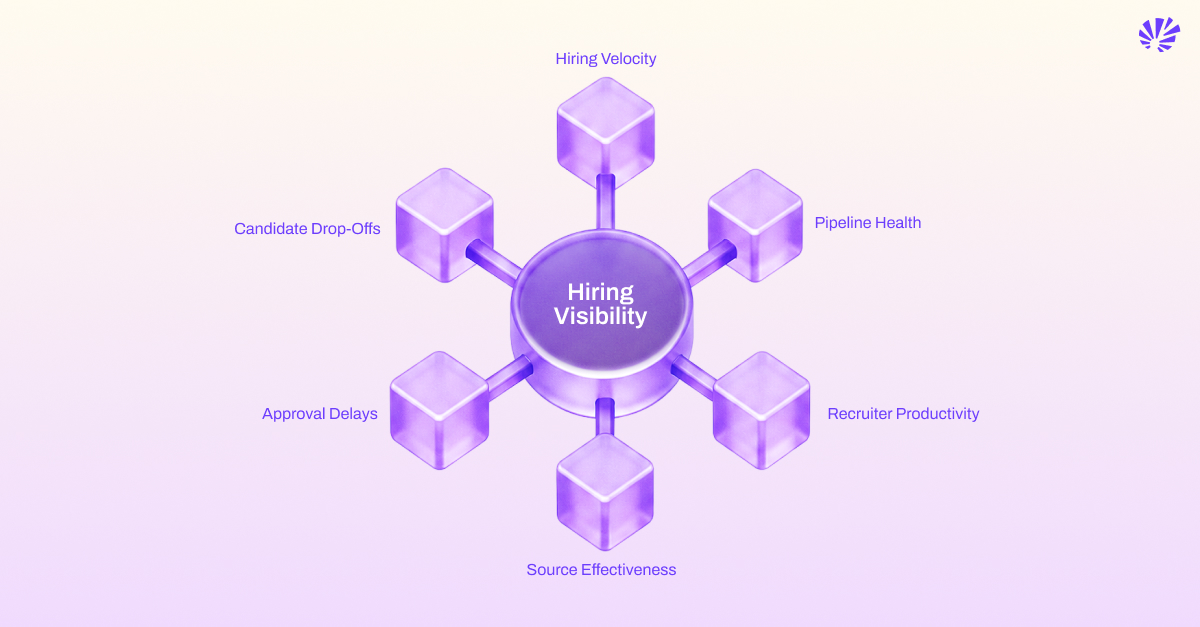
1. Hiring Velocity
How efficiently candidates move across recruitment stages.
2. Pipeline Conversion Rates
Where candidate progression slows, weakens, or drops off.
3. Recruiter Productivity
Operational workload distribution and hiring throughput across recruitment teams.
4. Source Effectiveness
Which sourcing channels consistently generate strong candidates.
5. Candidate Drop-Off Rates
Where candidate engagement weakens during the hiring process.
These metrics help leadership teams improve recruitment visibility, operational efficiency, and hiring predictability over time.
Common Mistakes Organizations Make While Improving Hiring Visibility
1. Treating Visibility as Reporting Alone
Visibility should support operational decision-making, not only dashboard creation.
2. Operating Across Fragmented Systems
Disconnected tools weaken visibility and continuity across hiring workflows.
3. Measuring Activity Instead of Movement
Large hiring volume does not automatically indicate healthy recruitment execution.
4. Delayed Visibility Into Bottlenecks
Reactive reporting often surfaces hiring problems too late to prevent operational instability.
How TurboHire Improves Visibility Across Enterprise Hiring
TurboHire combines Applicant Tracking System capabilities with AI-native hiring intelligence to help organizations maintain visibility across complex hiring environments.
At the center of this system is SuperAgent, TurboHire’s orchestration and execution layer designed for enterprise-scale hiring.
Instead of functioning only as a workflow tracking system, SuperAgent continuously monitors and coordinates hiring movement across the recruitment lifecycle.
| Enterprise Hiring Visibility Challenge | Traditional Hiring Systems | TurboHire with SuperAgent |
| Visibility across recruiters and hiring teams | Hiring activity remains fragmented across teams and tools | Centralized visibility across recruiters, hiring managers, business units, and locations |
| Pipeline monitoring | Limited visibility into candidate movement and stage-level bottlenecks | Real-time pipeline tracking with visibility into hiring velocity, conversion rates, and delays |
| Recruiter workload visibility | Difficult to identify overloaded recruiters or uneven workload distribution | Recruiter productivity and workload visibility across hiring pipelines |
| Hiring bottleneck identification | Delays often surface only after timelines are affected | AI-assisted pipeline intelligence identifies workflow delays and execution gaps earlier |
| Coordination visibility | Feedback loops, approvals, and scheduling remain difficult to track consistently | Structured workflow visibility across interviews, evaluations, approvals, and stakeholder actions |
| Cross-system visibility | Hiring activity remains disconnected across ATS, HRMS, BGV, and assessment systems | SuperAgent connects ATS workflows with HRMS, background verification, assessment, and communication systems |
| Reporting and analytics | Reporting is often retrospective and static | Real-time recruitment analytics and operational visibility across hiring workflows |
| Candidate movement visibility | Candidate progression becomes difficult to monitor at scale | Continuous visibility into candidate movement across the recruitment lifecycle |
| Hiring execution continuity | Workflow movement depends heavily on manual follow-ups | Event-driven orchestration helps maintain workflow continuity across hiring stages |
| Enterprise-scale hiring visibility | Visibility weakens as hiring volume and complexity increase | SuperAgent maintains connected visibility across distributed high-volume hiring operations |
1. Unified Hiring Visibility
TurboHire provides centralized visibility across:
- Recruiters
- Hiring managers
- Business units
- Locations
- Candidate pipelines
This allows leadership teams to monitor recruitment activity across distributed hiring operations without relying on fragmented reporting.
2. Real-Time Recruitment Analytics
Organizations gain visibility into:
- Hiring velocity
- Recruiter productivity
- Stage-level bottlenecks
- Candidate drop-offs
- Pipeline conversion rates
- Sourcing effectiveness
These insights help organizations identify operational instability before it affects hiring outcomes significantly.
3. AI-Assisted Pipeline Intelligence
SuperAgent continuously analyzes:
- Candidate movement
- Workflow delays
- Recruiter workload
- Hiring progression patterns
- Pipeline health
This improves visibility into execution gaps before they begin slowing recruitment movement.
4. Connected Hiring Workflows Across Enterprise Systems
TurboHire extends visibility across:
- ATS workflows
- HRMS platforms
- Background verification systems
- Assessment platforms
- Communication tools
This reduces operational fragmentation and improves continuity across the hiring lifecycle.
Instead of visibility remaining isolated within recruitment stages, SuperAgent helps organizations maintain connected visibility across hiring execution workflows.
Conclusion — ATS Platforms Have Become Visibility Infrastructure for Enterprise Hiring
Enterprise hiring becomes increasingly difficult to govern once visibility weakens across teams, workflows, and recruitment pipelines.
As organizations scale hiring activity:
- Coordination complexity increases
- Workflows distribute across teams
- Operational blind spots expand
- Recruitment movement becomes harder to monitor consistently
Applicant Tracking Systems now function as the visibility infrastructure layer that helps organizations:
- Centralize hiring operations
- Improve recruitment coordination
- Monitor hiring performance
- Identify bottlenecks earlier
- Maintain operational stability at scale
Organizations that build structured hiring visibility into recruitment operations are better positioned to maintain hiring efficiency, predictability, and workforce alignment as hiring complexity continues increasing.
Frequently Asked Questions (FAQs)
1. How do Applicant Tracking Systems improve hiring visibility?
Applicant Tracking Systems improve hiring visibility by centralizing candidate pipelines, workflow movement, interview coordination, evaluations, and recruitment analytics within a single system. This allows hiring teams and leadership to monitor hiring progress, identify bottlenecks earlier, and maintain visibility across distributed recruitment operations.
2. Why does hiring visibility become difficult in enterprise recruitment?
Hiring visibility becomes difficult as organizations scale hiring across multiple teams, roles, and locations simultaneously. Recruitment workflows become fragmented across recruiters, hiring managers, approvals, interviews, and communication systems. Without centralized visibility, organizations struggle to monitor hiring movement consistently and identify operational delays early.
3. How does TurboHire improve visibility across enterprise hiring workflows?
TurboHire combines Applicant Tracking System capabilities with AI-native hiring intelligence to help organizations maintain visibility across complex hiring environments. Its SuperAgent orchestration layer continuously monitors candidate movement, recruiter workload, workflow delays, pipeline conversion, and connected hiring workflows across systems such as HRMS, background verification, assessments, and communication platforms.