


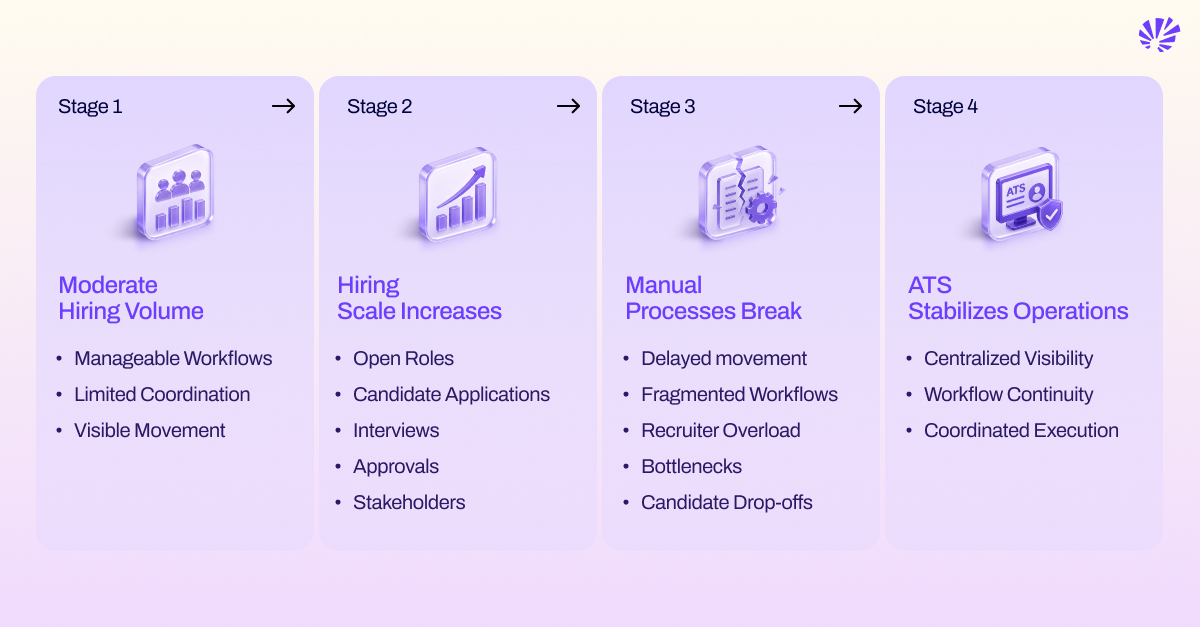
Applicant Tracking Systems (ATS) are often viewed simply as recruitment workflow tools or candidate tracking platforms. But before understanding what an ATS does, it is important to understand why organizations start needing these systems in the first place. Hiring processes usually appear manageable in the early stages of organizational growth, when teams hire for a limited number of roles and coordination remains relatively simple.
It seems like child’s play for a few recruiters to manage a handful of roles. Hiring managers are simply a click away from the recruiting teams, and there is no problem in tracking the candidate movement as the number of concurrent workflows is low.
The situation changes once hiring begins scaling across:
- Multiple business units
- Parallel hiring pipelines
- Distributed teams
- Different geographies
- Large candidate volumes
At this stage, hiring stops behaving like a simple sequence of tasks. Recruiters have to coordinate across several teams simultaneously. The hiring managers are juggling multiple open roles. Naturally, the candidate pipelines bloat, and the numbers of steps for approvals and feedback skyrocket.
Most organizations initially respond by increasing activity.
They:
- Add more recruiters
- Introduce additional tools
- Expand sourcing channels
- Create more workflow steps
However, these changes often increase operational effort without improving coordination.
As hiring complexity grows:
- Candidate movement slows down
- Visibility reduces
- Manual coordination increases
- Recruiter workload expands
- Hiring timelines become less predictable
This is where Applicant Tracking Systems become critical.
Modern hiring environments require systems capable of coordinating hiring activity at scale while maintaining visibility across the recruitment process.
What Is an Applicant Tracking System?
An Applicant Tracking System (ATS) is the operational system organizations use to manage recruitment workflows, candidate pipelines, and hiring coordination across the recruitment lifecycle.
Traditionally, ATS platforms were viewed primarily as candidate tracking tools. Their primary role was storing applications and organizing recruitment activity within a centralized system.
That role has evolved significantly.
In high-volume hiring environments, the ATS now functions as:
- a centralized hiring infrastructure layer
- a workflow coordination system
- a visibility and execution platform
The system no longer supports only candidate tracking. It supports how hiring itself operates.
Core Functions of an Applicant Tracking System
1. Candidate Pipeline Management
An ATS centralizes candidate movement across hiring stages.
Recruiters can track:
- Applications
- Screening progress
- Interviews
- Evaluations
- Approvals
- Offers
within a single system.
This improves visibility across parallel hiring workflows.
2. Workflow Coordination
Hiring involves coordination across recruiters, hiring managers, interviewers, and business stakeholders.
An ATS structures how work moves between these participants.
This includes:
- Interview scheduling
- Evaluation collection
- Approvals
- Stage progression
- Stakeholder notifications
Structured workflows reduce dependency on manual follow-ups and disconnected communication.
3. Communication Management
Candidate communication often becomes fragmented when managed manually across email threads and multiple tools.
ATS platforms centralize:
- Outreach
- Interview communication
- Reminders
- Follow-ups
- Engagement tracking
This improves consistency across the candidate experience.
4. Recruitment Analytics and Visibility
Modern ATS platforms increasingly provide visibility into recruitment performance.
Organizations can monitor:
- Hiring velocity
- Stage conversion rates
- Recruiter workload
- Pipeline health
- Source effectiveness
- Candidate drop-offs
This allows teams to identify delays and execution gaps earlier.
Why Traditional Hiring Processes Break in High-Volume Hiring
As hiring complexity increases, coordination delays begin compounding across screening, interviews, approvals, and candidate communication. Industry benchmarks show that the average time-to-fill already reaches 54 days for nonexecutive roles and 62 days for executive hiring, highlighting how quickly hiring timelines expand when workflows are not structured for scale.
1. Hiring Complexity Expands Faster Than Coordination Capacity
High-volume hiring introduces simultaneous movement across multiple pipelines.
Organizations may hire for:
- Engineering
- Operations
- Sales
- Customer support
- Leadership roles
all at the same time.
Each role introduces:
- Sourcing activity
- Interview coordination
- Evaluation workflows
- Stakeholder alignment
As these activities expand in parallel, manual coordination becomes increasingly difficult to sustain.
2. Fragmented Tools Create Execution Gaps
Many organizations still manage recruitment across disconnected systems.
Recruiters switch between:
- Spreadsheets
- Email threads
- Scheduling tools
- Sourcing platforms
- Evaluation documents
Context becomes fragmented across stages and stakeholders.
Information captured during screening may not reach interviewers consistently. Feedback loops slow down. Approvals become disconnected from the upstream hiring context.
Over time, these small execution gaps compound across the hiring process.
3. Visibility Reduces Across the Hiring Process
As hiring scales, organizations often lose visibility into how candidates move through the system.
Teams struggle to answer questions such as:
- Where are candidates slowing down?
- Which roles are delayed?
- Which pipelines are unstable?
- Where are candidate drop-offs increasing?
- Which recruiters are overloaded?
Without visibility:
- Delays compound silently
- Hiring teams operate reactively
- Candidate experience weakens
- Hiring outcomes become inconsistent
What an Applicant Tracking System Solves
1. Centralizes Hiring Activity
An ATS creates a shared operational system for:
- Candidate tracking
- Evaluations
- Communication
- Approvals
- Workflow progression
This reduces fragmentation across recruitment activity.
Teams operate within a connected hiring environment rather than across disconnected tools.
2. Improves Hiring Visibility
Modern ATS platforms create visibility into:
- Candidate movement
- Stage-level bottlenecks
- Pipeline conversion
- Recruiter productivity
- Hiring velocity
This allows recruitment teams to identify execution gaps before they destabilize the hiring process.
3. Creates More Structured Hiring Workflows
Structured workflows improve consistency across hiring stages.
Candidate movement becomes:
- Easier to monitor
- Easier to coordinate
- Less dependent on manual intervention
This reduces operational instability as hiring volumes increase.
4. Improves Collaboration Across Stakeholders
Recruiters, hiring managers, interviewers, and business stakeholders operate within a shared system.
This improves:
- Evaluation alignment
- Interview coordination
- Feedback consistency
- Decision visibility
Collaboration becomes more structured instead of reactive.
How Applicant Tracking Systems Support High-Volume Hiring
1. Managing Large Candidate Volumes
High-volume hiring creates significant screening and coordination pressure.
Large application inflow often overwhelms recruiters when workflows remain manual.
ATS platforms help organizations:
- Segment pipelines
- Structure screening
- Prioritize candidates
- Centralize candidate movement
This improves operational control across large-scale recruitment environments.
2. Reducing Administrative Work
Recruiters spend substantial time on:
- Scheduling
- Coordination
- Status tracking
- Communication follow-ups
ATS platforms reduce manual operational effort by centralizing workflow execution and communication.
This allows recruiters to focus more on evaluation and candidate engagement. Administrative coordination continues to consume a large portion of recruiter bandwidth in high-volume hiring environments. 90% of organizations using AI in recruitment say it improves efficiency and saves time, allowing hiring teams to focus more on candidate evaluation and hiring decisions instead of repetitive operational tasks.
3. Maintaining Hiring Consistency Across Roles
As organizations scale hiring, maintaining consistency becomes increasingly difficult.
Structured ATS workflows improve:
- Evaluation consistency
- Process standardization
- Candidate movement alignment
This becomes especially important in distributed hiring environments.
4. Supporting Faster Hiring Decisions
When candidate visibility improves:
- Interviews stay aligned
- Approvals move faster
- Feedback cycles shorten
- Hiring managers gain better context
Hiring decisions become more predictable without sacrificing process quality.
ATS vs Traditional Recruitment Systems
| Traditional Hiring Processes | Applicant Tracking System |
| Candidate information is spread across multiple tools | Centralized candidate visibility |
| Manual coordination across teams | Structured workflow execution |
| Delayed interview scheduling | Integrated scheduling workflows |
| Limited recruitment visibility | Real-time pipeline tracking |
| Fragmented evaluations | Standardized hiring workflows |
| Reactive hiring operations | Structured hiring coordination |
Example — When Hiring Volume Outgrows the Process
Consider a mid-enterprise retail organization preparing for a large seasonal hiring cycle.
The company begins hiring simultaneously across:
- Warehouse operations
- Customer support
- Regional sales teams
Initially, the recruitment process is managed manually through:
- Spreadsheets
- Email coordination
- Separate scheduling tools
As application volume increases:
- Candidate screening slows down
- Interview coordination becomes inconsistent
- Hiring managers lose visibility into pipeline status
- approvals begin stacking up
- Candidate response times increase
Recruiters spend more time coordinating workflows than evaluating candidates.
The issue is not effort.
The process itself no longer supports the scale of hiring activity.
Introducing a structured ATS centralizes candidate movement, improves visibility across teams, and stabilizes workflow execution across roles and locations.
What Modern Applicant Tracking Systems Need Beyond Workflow Tracking
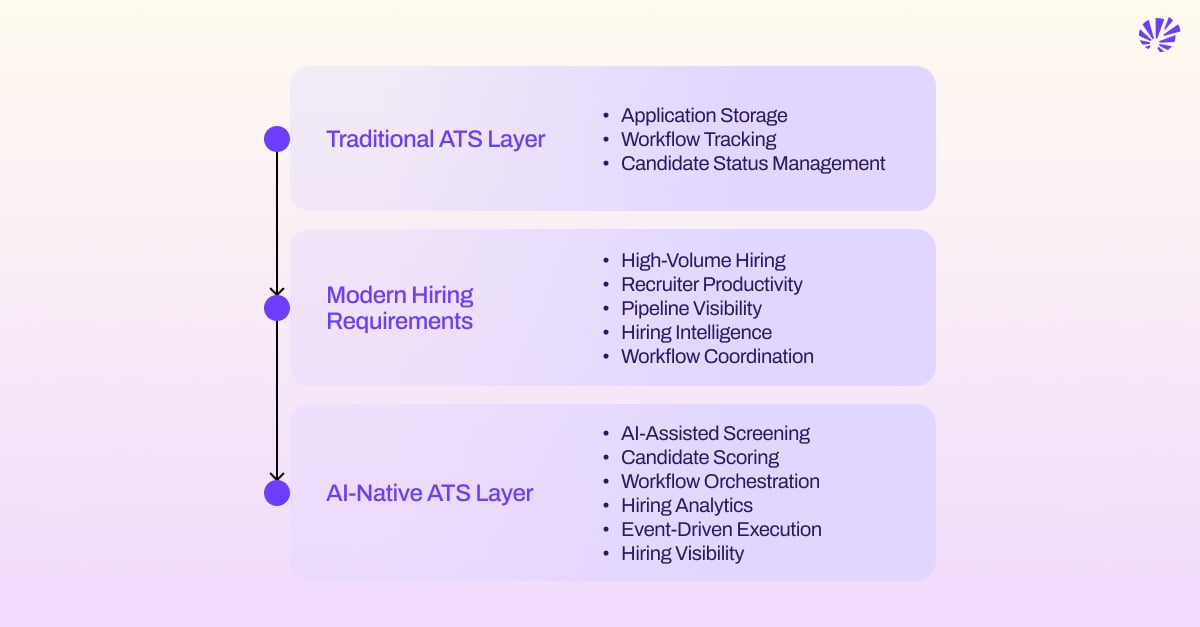
Modern hiring complexity requires more than:
- Application storage
- Candidate tracking
- Basic workflow management
Organizations increasingly require:
- Hiring intelligence
- AI-assisted screening
- Recruiter productivity support
- Workflow orchestration
- Pipeline visibility
- Structured decision support
The ATS is evolving from a tracking system into a hiring operations system.
Why AI-Native ATS Platforms Matter
Many traditional ATS platforms were designed primarily as workflow systems.
AI capabilities were later added as separate layers.
AI-native ATS platforms operate differently.
Intelligence is embedded directly into:
- Candidate evaluation
- Matching systems
- Workflow orchestration
- Hiring analytics
- Pipeline movement
Organizations are increasingly embedding AI directly into recruitment operations to improve execution speed and hiring visibility. SHRM research shows that 64% of organizations using AI for HR activities already apply it within recruitment, interviewing, and hiring workflows, reflecting the growing shift toward AI-assisted hiring systems.
This allows hiring systems to continuously improve execution and visibility at scale.
How TurboHire Supports High-Volume Hiring at Enterprise Scale
TurboHire combines Applicant Tracking System capabilities with AI-native hiring intelligence to help organizations manage high-volume hiring more effectively.
At the center of this system is SuperAgent — TurboHire’s orchestration and execution layer designed for enterprise-scale hiring environments.
Instead of functioning as a traditional ATS that only tracks workflows, SuperAgent continuously coordinates hiring movement across the recruitment lifecycle.
| Hiring Challenge | Traditional ATS Systems | TurboHire with SuperAgent |
| Candidate screening | Recruiters manually review and filter large application volumes | AI-assisted screening and candidate scoring prioritize relevant candidates automatically |
| Workflow progression | Candidate movement depends heavily on manual recruiter intervention | SuperAgent orchestrates workflow movement across stages through event-driven execution |
| Hiring visibility | Limited visibility into pipeline bottlenecks and execution delays | Real-time visibility into pipeline movement, hiring velocity, and conversion trends |
| Interview coordination | Scheduling and follow-ups are managed across multiple tools and stakeholders | Centralized interview coordination and automated stakeholder workflows |
| Recruiter workload | Recruiters spend significant time on administrative coordination | Automation reduces repetitive operational effort and improves recruiter productivity |
| Pipeline management | Large candidate pipelines become difficult to monitor consistently | Structured pipeline visibility across roles, locations, and hiring teams |
| Hiring collaboration | Feedback and approvals often remain fragmented across teams | Unified collaboration across recruiters, hiring managers, and interviewers |
| Integrations and system connectivity | Hiring workflows often remain fragmented across ATS, HRMS, BGV, and assessment tools | SuperAgent connects with HRMS, BGV, assessment platforms, communication systems, and onboarding workflows to maintain connected hiring execution |
| Hiring scalability | Processes become unstable as hiring volumes increase | SuperAgent maintains execution continuity across high-volume hiring environments |
| Decision support | Hiring decisions rely heavily on fragmented information | AI-native hiring intelligence improves candidate evaluation and decision visibility |
| Execution continuity | Workflow delays compound when stakeholders fail to act on time | Event-driven orchestration helps pipelines continue moving without constant manual intervention |
1. Centralized Hiring Visibility
TurboHire provides unified pipeline visibility across:
- Recruiters
- Hiring managers
- Business units
- Geographies
This allows teams to monitor hiring movement and execution status across large-scale recruitment environments.
2. AI-Assisted Candidate Screening
TurboHire supports:
- Resume parsing
- AI-assisted candidate scoring
- Intelligent candidate-role matching
- Structured screening workflows
This helps recruiters prioritize relevant candidates consistently across large candidate pipelines.
3. Workflow Automation and Execution Orchestration
SuperAgent coordinates workflow execution across:
- Screening
- Scheduling
- Stakeholder follow-ups
- Approvals
- Candidate communication
This reduces dependency on manual coordination and helps hiring pipelines continue moving without constant recruiter intervention.
4. Recruitment Analytics and Pipeline Intelligence
TurboHire provides real-time visibility into:
- Hiring velocity
- Recruiter workload
- Pipeline bottlenecks
- Conversion trends
- Candidate movement patterns
This allows organizations to identify instability earlier and continuously improve hiring execution.
5. Structured Hiring Collaboration
Recruiters, hiring managers, and interviewers operate within a connected hiring system.
This improves:
- Feedback alignment
- Interview coordination
- Evaluation consistency
- Stakeholder visibility
6. Event-Driven Hiring Movement
SuperAgent operates through event-driven execution rather than manual workflow progression.
For example:
- Interview completion can trigger downstream evaluations
- Candidate movement can activate recruiter workflows automatically
- Approval delays can surface proactively before they slow the pipeline
This helps maintain execution continuity in high-volume hiring environments where multiple workflows operate simultaneously.
These capabilities help organizations move from fragmented recruitment operations toward connected, touchless, and scalable hiring systems.
Common Mistakes Organizations Make While Implementing an ATS
1. Treating the ATS as Only a Tracking Tool
Modern ATS platforms should support:
- Visibility
- Coordination
- Automation
- Hiring intelligence
not simply application storage.
2. Over-Customizing Workflows
Highly fragmented workflows reduce consistency and operational visibility.
3. Ignoring Hiring Manager Adoption
Hiring systems weaken when collaboration continues outside the platform.
4. Focusing Only on Automation
Automation improves execution, but hiring visibility and system intelligence remain equally important.
Conclusion: Applicant Tracking Systems Have Become Hiring Infrastructure
Applicant Tracking Systems are no longer simple recruitment administration tools.
In high-volume hiring environments, they function as the operational backbone of the hiring system.
As hiring complexity increases, the ATS becomes critical for:
- Visibility
- Workflow continuity
- Recruiter productivity
- Hiring coordination
- structured decision-making
Organizations that treat the ATS as hiring infrastructure rather than administrative software are better positioned to maintain hiring consistency, visibility, and execution stability at enterprise scale. TurboHire is always up for providing a tailormade demo to showcase how its SuperAgent will help you with high-volume hiring across industries and hiring scenarios.
Frequently Asked Questions (FAQs)
1. What is an Applicant Tracking System in high-volume hiring?
An Applicant Tracking System (ATS) is a centralized hiring platform that helps organizations manage candidate pipelines, recruitment workflows, communication, evaluations, and hiring coordination at scale. In high-volume hiring environments, ATS platforms improve visibility, reduce manual coordination, and help maintain consistent hiring execution across multiple roles and teams.
2. How does an ATS improve hiring visibility?
An ATS improves hiring visibility by centralizing recruitment activity within a single system. Hiring teams can monitor candidate movement, stage-level delays, recruiter workload, pipeline conversion rates, and hiring velocity in real time. This helps organizations identify bottlenecks earlier and improve coordination across the hiring process.
3. How does TurboHire support high-volume hiring?
TurboHire combines Applicant Tracking System capabilities with AI-native hiring intelligence to help organizations manage enterprise-scale hiring environments. Its SuperAgent orchestration layer supports AI-assisted screening, workflow execution, pipeline visibility, recruiter coordination, and event-driven hiring movement to help organizations maintain hiring continuity at scale.
4. Why do traditional hiring processes struggle at enterprise scale?
Traditional hiring processes struggle at scale because coordination complexity increases rapidly as candidate volumes, hiring teams, and parallel workflows expand. Manual tracking, fragmented tools, delayed feedback loops, and limited visibility create execution gaps that slow down hiring movement and reduce hiring consistency.
5. What should organizations look for in a modern ATS platform?
Organizations should look for ATS platforms that provide more than candidate tracking. Modern hiring environments increasingly require capabilities such as workflow automation, recruitment analytics, AI-assisted screening, hiring visibility, structured collaboration, and intelligent workflow orchestration. Platforms like TurboHire help organizations move from fragmented recruitment operations toward connected and scalable hiring systems.