

Hiring velocity is not how fast recruiters work. It is how well the hiring system moves. Velocity of hiring is an integral part of the talent acquisition process.
The damage caused by a slow hiring process cannot be overstated. One prime example is how 42% candidates leave the recruitment process when it takes too long to schedule an interview.
Roles stay open longer than expected. Candidates disengage mid-process. Business leaders push talent teams to move faster. The candidate experience goes for a toss. In response, recruiters work harder, interviews get compressed, and new tools are added to the stack.
Activity increases. Outcomes do not.
The issue is not speed. The issue is hiring velocity.
Hiring velocity reflects how smoothly candidates move through the entire talent acquisition system. At low volume, inefficiencies remain hidden. At scale, those inefficiencies compound. What once felt like minor friction becomes a structural bottleneck.
What Is Hiring Velocity
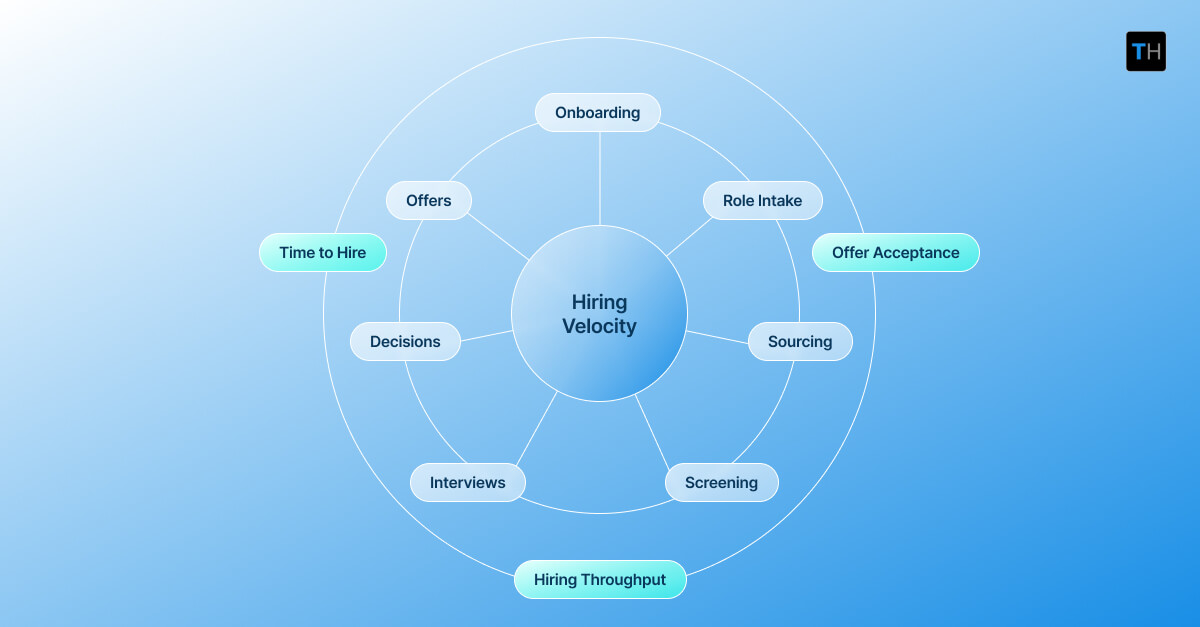
Hiring velocity is the rate at which qualified candidates move through the hiring system from intake to closure.
It is not a single metric. It is a system outcome.
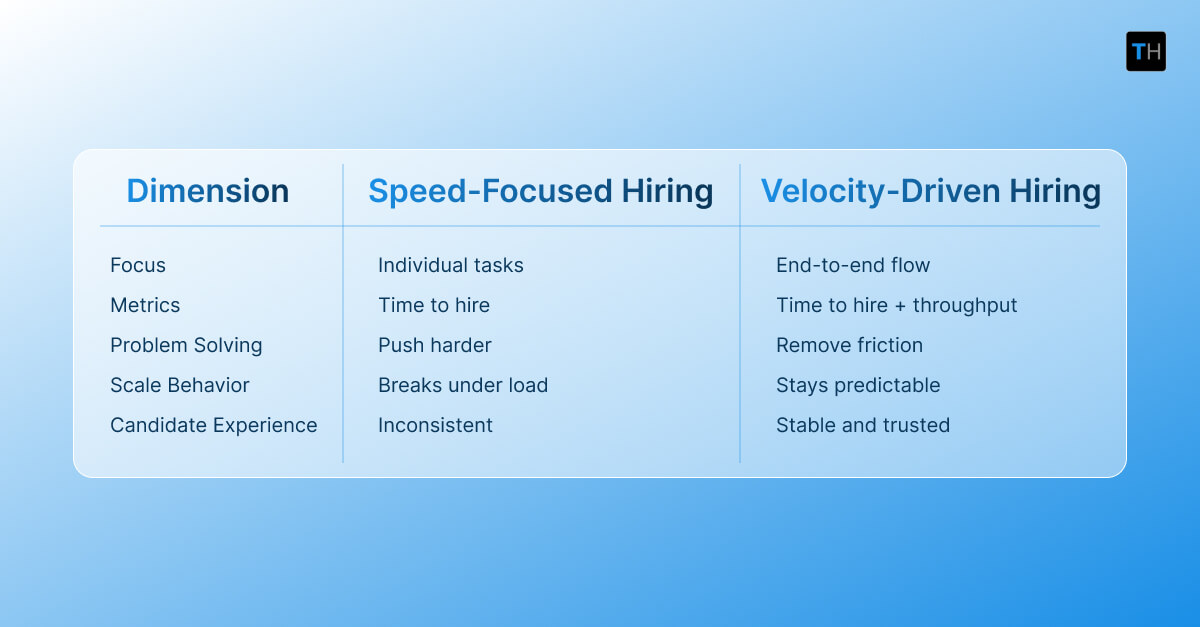
A team can move quickly at individual steps and still have poor hiring velocity. Another team can move steadily and close roles consistently at scale. The difference lies in flow, not effort.
Speed measures how fast a task is completed. Velocity reflects whether work moves forward without interruption. When hiring velocity is strong, handoffs are clear, decisions are timely, and momentum is preserved. When velocity breaks, work stalls between stages even though people remain busy.
How to Calculate Hiring Velocity
Hiring velocity is not a single number. It is a way to understand whether the hiring system can keep up with demand as volume increases.
Instead of relying on one formula, hiring velocity should be calculated and observed using two complementary views.
1. Net Hiring Velocity (Capacity Indicator)
At a high level, hiring velocity can be measured by comparing how many roles are opened versus how many are filled in a given period.
A simple calculation looks like this:
Net Hiring Velocity = Hires Closed − Roles Opened
For example, if 12 new roles are opened in a week and 15 roles are filled, net hiring velocity is +3. This means the hiring team is reducing backlog and keeping ahead of demand.
This metric is useful for senior leaders because it answers a straightforward question:
Are we keeping up with hiring demand, or is inventory growing?
However, this number only shows output. It does not explain how the system is performing internally.
2. System Velocity Signals (Flow Indicators)
To understand whether hiring velocity is sustainable, net hiring velocity must be viewed alongside system-level signals.
Key signals include:
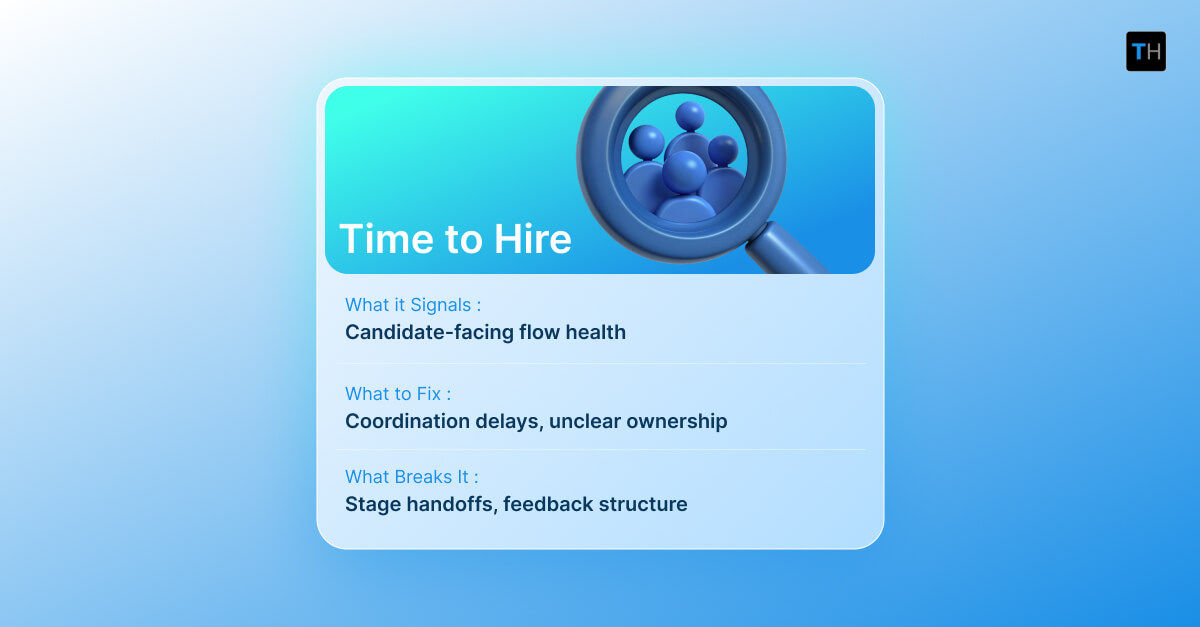
- Time to Hire, which reflects the candidate-facing flow once candidates enter the system
- Hiring Throughput, which shows how many roles the system can close consistently over time
- Offer Acceptance Rate, which acts as a guardrail for candidate trust and decision quality
If net hiring velocity is positive but time to hire is rising or offer acceptance is falling, velocity is being forced rather than designed.
How to Read Hiring Velocity Correctly
Hiring velocity is improving when:
- Hiring throughput increases with demand
- Time to hire remains stable or decreases
- Guardrail metrics hold steady
Hiring velocity is breaking down when:
- Hiring demand outpaces closed roles
- Time to hire increases across stages
- Candidate drop-off or offer rejection rises
What Not to Do
- Do not reduce hiring velocity to a single KPI.
- Do not push teams to “go faster” without fixing coordination and ownership gaps.
- Do not celebrate short-term gains that create long-term instability.
Hiring velocity reflects whether the hiring system can consistently meet demand without breaking. It is calculated by combining net hiring output with flow and trust signals across the talent acquisition system.
Why Hiring Velocity Matters in Talent Acquisition Systems
Hiring velocity directly constrains execution.
When velocity drops, teams cannot scale on time. Critical roles remain open. Product delivery slows. Sales capacity is constrained. Growth plans slip.
Here’s how Hanu reduced its Time to hire by 77%.
Velocity also shapes candidate trust. Long gaps between stages create uncertainty. Uncertainty leads to disengagement. In competitive markets, candidates move on before offers are made.
For recruiters, poor velocity creates unsustainable workloads. Instead of evaluating and advising, they spend time coordinating calendars, chasing feedback, and reopening stalled pipelines.
At scale, hiring velocity becomes a strategic capability. It determines how quickly the organization can respond to an opportunity or recover from a disruption.
Time to Hire and Time to Fill as Velocity Signals
Time to hire and time to fill are often discussed interchangeably. They signal different parts of the system.
Time to hire measures how long a candidate takes to move from entry into the hiring process to offer acceptance. It reflects candidate-facing flow and exposes coordination delays between stages.
Learn how to Calculate Time to Hire
Time to fill measures how long it takes to close a role from requisition approval to offer acceptance. It reflects organizational readiness and highlights intake friction, approval delays, and workforce planning gaps.
Learn how to calculate Time to Fill
Neither metric should be treated as a goal. Both should be treated as signals. Improving them requires fixing how the system works, not pressuring people to move faster.
Diagnosing Hiring Velocity Using Metrics
Metrics do not improve hiring velocity on their own. They help leaders see where flow breaks across the talent acquisition system.
The goal of these metrics is not performance tracking. It is a system diagnosis.
| Metric | What It Measures | Why It Matters for Hiring Velocity |
| Time to Hire by Department | How quickly candidates move through the hiring system for specific teams such as Engineering, Sales, or Operations. | Highlights where coordination, interview design, or decision ownership is slowing flow. Differences usually reflect system design, not recruiter effort. |
| Time to Hire by Role or Seniority | The hiring speed for entry-level, mid-level, and leadership roles. | Reveals where complexity, stakeholder alignment, or interview loops increase decision latency. |
| Time in Stage | The number of days candidates spend in each step of the hiring pipeline. | Pinpoints exact bottlenecks where ownership is unclear or handoffs are poorly designed. |
| Hiring Throughput | The number of roles closed within a given period relative to hiring demand. | Indicates whether the system can sustain volume without breaking down as hiring scales. |
| Offer Acceptance Rate | The percentage of candidates who accept offers once extended. | Acts as a guardrail metric. A low rate often signals candidate trust erosion caused by slow cycles or unclear communication earlier in the process. 80% of hiring managers say they ghost candidates |
Metrics should guide investigation, not justify activity. Patterns across stages matter more than point values.
Why Hiring Velocity Breaks Down at Scale
Hiring velocity rarely collapses because of one obvious failure. It collapses because friction accumulates across the system.
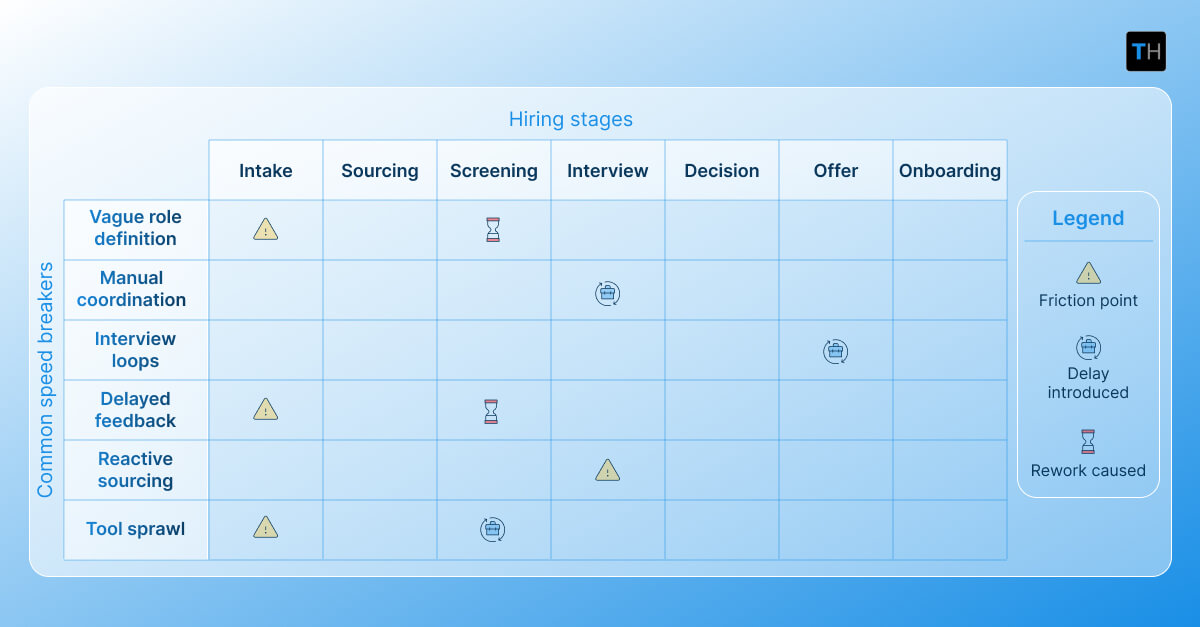
1. Weak Role Definition at Intake
Velocity begins to break when roles are not clearly defined at the start.
When success criteria, scope, or priorities are vague, misalignment travels downstream. Recruiters screen against incomplete signals. Interviewers evaluate different expectations. Decisions take longer because alignment happens late.
At scale, this rework repeats across dozens of roles and slows the system before candidates even reach interviews. 57% of candidates lose interest in lengthy hiring processes.
2. Manual Coordination Across Multiple Stakeholders
Manual coordination does not scale.
When scheduling, approvals, and handoffs rely on emails, messages, or follow-ups, every transition introduces delay. Recruiters spend time coordinating instead of evaluating. Candidates wait while calendars align.
As volume increases, coordination overhead grows faster than hiring output. Velocity drops even though effort increases.
3. Interview Loops Without Clear Decision Ownership
Velocity slows when interviews generate opinions instead of decisions.
Without clear ownership, interview loops expand. Candidates meet more stakeholders, but no one is accountable for moving the process forward. Feedback accumulates, but decisions stall.
At scale, these loops increase latency across every role and create inconsistent candidate experiences.
4. Feedback That Is Optional or Unstructured
Feedback is a hidden speedbreaker.
When feedback is optional or loosely structured, candidates pause in the system. Recruiters chase responses. Decisions wait on incomplete inputs.
As volume increases, these small delays stack and slow the entire hiring system.
5. Reactive Sourcing Instead of Anticipation
Reactive sourcing inherently increases time to hire..
When pipelines are built only after roles open, sourcing starts from zero. Recruiters scramble under time pressure. Quality suffers. Cycle time increases.
Velocity stabilizes only when sourcing becomes continuous and proactive.
6. Tool Sprawl That Fragments Context and Visibility
Fragmented tools fragment velocity.
When sourcing, screening, scheduling, and feedback live in disconnected systems, context is lost at every handoff. Recruiters reconcile information manually. Decisions are revisited because data is incomplete or outdated.
At scale, these inefficiencies compound and slow the system further.
How High-Velocity Organizations Design for Flow
Organizations that hire consistently faster do not push harder. They design systems that allow work to move without resistance. Hiring velocity is created upstream through deliberate system choices.
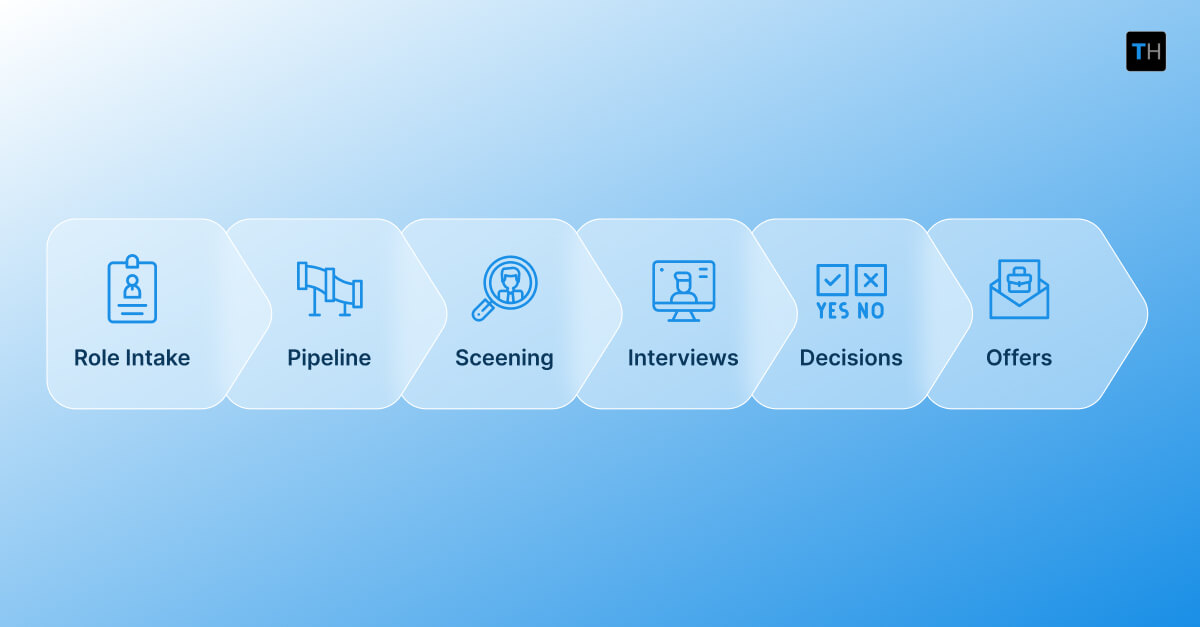
Stage 1: Standardized Intake and Role Clarity
High-velocity organizations begin with clear role definition. Success criteria, scope, and priorities are aligned before hiring starts. This prevents rework later and allows candidates to move through the system without repeated realignment.
Stage 2: Clear Ownership Across the Hiring Flow
Ownership is defined at every transition. Each stage has a clear decision-maker and a clear next step. Progress does not depend on follow-ups or escalation because accountability is designed into the system.
Stage 3: Interview Structures That Drive Decisions
Interviews are designed to enable decisions, not gather opinions. Each round has a purpose, clear evaluation criteria, and an expected outcome. This reduces loop expansion and decision latency.
Stage 4: Proactive Pipeline Design
Pipelines are built ahead of demand. Internal mobility, lateral hiring, and external talent pools are maintained continuously. This reduces sourcing latency and prevents every role from starting at zero.
Stage 5: Employer Pull That Reduces Friction
A strong employer reputation attracts qualified candidates without excessive outreach. When employer pull is high, candidate engagement increases and time spent convincing candidates decreases.
Why Upstream Design Matters
Velocity is created before hiring begins. Once candidates enter the system, poor design cannot be fixed through urgency or effort. High-velocity organizations design for flow early and protect it throughout the hiring lifecycle.
Recruitment Automation and Hiring Velocity
Recruitment automation improves hiring velocity only when it strengthens the talent acquisition system as a whole. Applied incorrectly, it increases activity without restoring flow.
Principle 1: Reduce Coordination Overhead
High-volume hiring creates coordination work across recruiters, hiring managers, interviewers, and candidates. Automation improves velocity when it removes manual handoffs such as scheduling, approvals, and follow-ups. When coordination is automated, recruiters spend less time chasing progress and more time enabling decisions.
Principle 2: Orchestrate Handoffs Across Stages
Hiring velocity breaks at transitions. Automation must connect stages so context, ownership, and expectations move forward together. Orchestration ensures that candidates do not stall between steps and that responsibility is clear at every handoff.
Principle 3: Preserve Context End to End
Automation supports velocity when candidate data, feedback, and decision rationale remain visible throughout the hiring lifecycle. When context is preserved, teams move forward without revisiting earlier decisions or revalidating information.
Principle 4: Support Judgment, Not Replace It
Automation should accelerate execution, not automate judgment. Decisions, feedback, and candidate conversations remain human. Velocity improves when automation frees teams to focus on evaluation rather than logistics.
Principle 5: Apply Automation Systemically
Isolated task automation creates local efficiency but global slowdown. High-velocity organizations apply automation across the system, not as disconnected tools. Used systemically, automation restores flow. Used in fragments, it increases activity without improving velocity.
Building Hiring Velocity Into Talent Acquisition Systems
Hiring velocity improves when the hiring system is designed to move work predictably rather than reactively. Organizations with high hiring velocity do not rely on heroics or urgency. They rely on system design.
High-velocity talent acquisition systems share a few foundational traits.
1. End-to-End Orchestration Across Stages
Hiring velocity breaks when stages operate in isolation.
In low-velocity systems, requisition intake, sourcing, interviews, decisions, and offers function as separate workflows. Progress stalls at every handoff because context does not travel with the candidate.
End-to-end orchestration connects each stage into a single flow. Information, expectations, and ownership move forward together. Recruiters do not need to reset context at every step, and candidates do not experience unnecessary pauses.
When orchestration exists, the system maintains momentum even as volume increases.
2. Clear Accountability for Decisions and Handoffs
Velocity slows when no one owns the next step.
In many organizations, delays occur not because people are unavailable, but because responsibility is unclear. Feedback is optional. Approvals are ambiguous. Decisions wait on a consensus that never arrives.
High-velocity systems define ownership at every transition. Who reviews. Who decides. Who moves the candidate forward? These roles are explicit, not assumed.
Clear accountability reduces decision latency. It ensures that progress does not depend on follow-ups or escalation.
3. Integrated Tools That Preserve Context
Fragmented tools fragment velocity.
When candidate data lives across disconnected systems, recruiters spend time reconciling information instead of moving work forward. Context gets lost. Decisions get revisited. Errors increase.
Integrated tools preserve context across the hiring lifecycle. Candidate history, evaluation feedback, and decision rationale remain visible at every stage.
This continuity allows teams to move faster without sacrificing judgment or consistency.
4. Real-Time Visibility Into Bottlenecks
You cannot fix what you cannot see.
Low-velocity systems rely on lagging indicators and anecdotal feedback. By the time delays are noticed, candidates have already dropped off.
High-velocity systems provide real-time visibility into where work is slowing down. Stage-level delays, stalled approvals, and overloaded interview loops become visible early.
This allows teams to intervene before bottlenecks harden into systemic failures.
5. Metrics Used for Diagnosis, Not Pressure
Metrics should inform decisions, not drive anxiety.
In low-maturity systems, time-based metrics are used to apply pressure. Recruiters are pushed to move faster without fixing the underlying causes of delay.
High-velocity systems use metrics diagnostically. Time to hire and time to fill are treated as signals of system health. When numbers worsen, teams investigate flow, ownership, and coordination.
Metrics guide improvement. They do not replace judgment.
6. Velocity Is Designed, Not Forced
Hiring velocity does not improve because people work harder. It improves because the system removes resistance.
Organizations that design for orchestration, accountability, context, visibility, and diagnostic measurement create hiring systems that scale predictably.
Velocity becomes an outcome of design rather than an ongoing struggle to move faster.
Conclusion: Velocity Is a System Capability
Hiring velocity does not slow down because recruiters slow down. It breaks because talent acquisition systems were not designed to scale.
Organizations that treat velocity as a system capability hire faster, more consistently, and with less friction. Those who chase speed without fixing flow continue to stall. As hiring volumes grow and roles become more specialized, velocity will increasingly separate organizations that scale from those that stall.
TurboHire enables hiring velocity by supporting talent acquisition as a connected, AI-native system built for scale.
Frequently Asked Questions (FAQs)
1. What is hiring velocity in talent acquisition?
Hiring velocity is a measure of how smoothly and consistently candidates move through the entire hiring system from intake to closure. It reflects system flow and capacity rather than the speed of individual hiring tasks. Strong hiring velocity indicates a well-designed talent acquisition system that can scale without breaking.
2. How is hiring velocity different from time to hire?
Time to hire measures how long a single candidate takes to move through the hiring process. Hiring velocity looks at the system as a whole. It combines time to hire with hiring throughput and demand to show whether the organization can sustain hiring at scale without delays or quality loss.
3. How can organizations improve hiring velocity at scale?
Organizations improve hiring velocity by designing their talent acquisition systems for flow. This includes clear role definition at intake, structured decision ownership, proactive pipelines, integrated tools, and automation that reduces coordination rather than replacing judgment. Velocity improves when friction is removed from the system, not when teams are pushed to move faster.