


Time to hire and time to fill are two of the most discussed metrics in recruitment. They appear in dashboards, leadership reviews, and hiring retrospectives. Teams track them closely and often try to reduce both in the hope of improving hiring outcomes.
Yet, hiring still feels slow. Roles stay open longer than expected. Candidates’ dropoff rate is off the roof. In fact, recruiters experience exhaustion, and hiring managers become cynical about filling the position.
Time to hire and time to fill measure different parts of the hiring system. Understanding the difference between them is the first step to identifying what actually slows hiring down.
What Is Time to Hire?
Time to hire measures how long it takes for a candidate to move through the hiring process once they enter the pipeline. The average time to hire is approximately 44 days, indicating that the candidate remains in the pipeline for over a month sometimes without even knowing the final decision.
It focuses on the candidate-facing part of hiring. This includes screening, interviews, feedback, decision-making, and offer acceptance. In simple terms, time to hire reflects how candidates experience your hiring process after first contact.
How to Calculate Time to Hire
The most common way to calculate time to hire is:
Time to Hire = Date of offer acceptance − Date the candidate enters the pipeline
For instance, if a candidate applies on May 1 and accepts an offer on June 14, the time to hire is 44 days.
This number helps teams understand how quickly candidates progress once they are identified.
What Is Time to Fill?
Time to fill measures how long it takes to close a role from the organization’s point of view. SHRM benchmarking data shows that the average time to fill a non-executive role is 54 days, increasing to over 60 days for executive positions, highlighting how long hiring systems take to move from approval to closure at scale.
It includes everything from job requisition approval and posting to sourcing, interviewing, and offer acceptance. Time to fill reflects how efficiently the organization moves from recognizing a hiring need to filling it.
How to Calculate Time to Fill
A standard calculation is:
Time to Fill = Date of offer acceptance − Date the job requisition is approved or posted
As it includes internal steps before candidates enter the process, the time to fill is usually longer than the time to hire.
For instance, If a role is approved on April 1 and the offer is accepted on June 14, the time to fill is 74 days.
This number captures planning, approvals, coordination, and execution across teams.
Time to Hire vs Time to Fill: A Quick Comparison
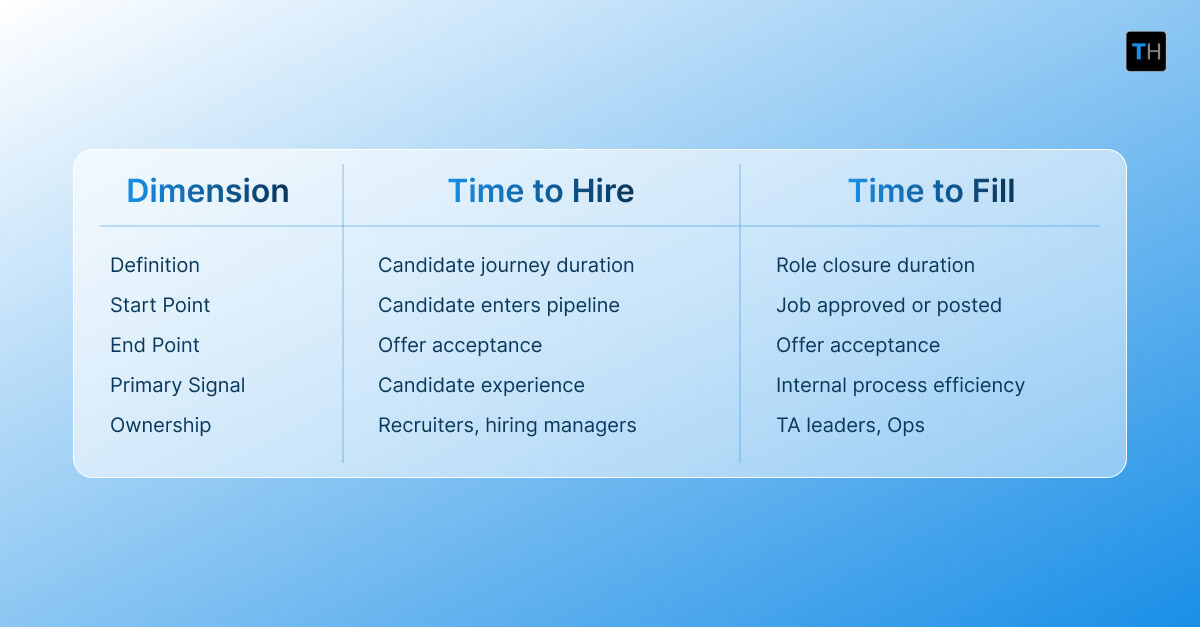
These benchmarks may vary by role, region, and industry. The more important takeaway is what each metric reveals about the system.
What Should Be Prioritized: Time to Hire or Time to Fill?
The answer depends on the role and responsibility.
1. For Talent Acquisition Leaders
Time to fill helps leaders forecast capacity, manage hiring inventory, and plan resources. It answers questions about how long roles remain open and how hiring demand aligns with team bandwidth.
2. For Recruiters and Hiring Managers
Time to hire helps reduce candidate drop-off, improve engagement, and protect offer acceptance rates. It reflects how smoothly decisions are made once candidates enter the process.
The most effective teams use both metrics together. Time to fill shows where internal processes slow hiring down. Time to hire shows where candidate experience suffers.
Why Time to Hire and Time to Fill Matter
These metrics matter because they highlight where hiring breaks down.
- Identify where delays occur across the hiring process
- Reveal friction in coordination and decision-making
- Influence candidate experience and employer credibility
- Impact hiring costs and recruiter productivity
- Affect quality of hire and early retention
- Provide visibility into how the hiring system performs under pressure
What Actually Slows Hiring Down
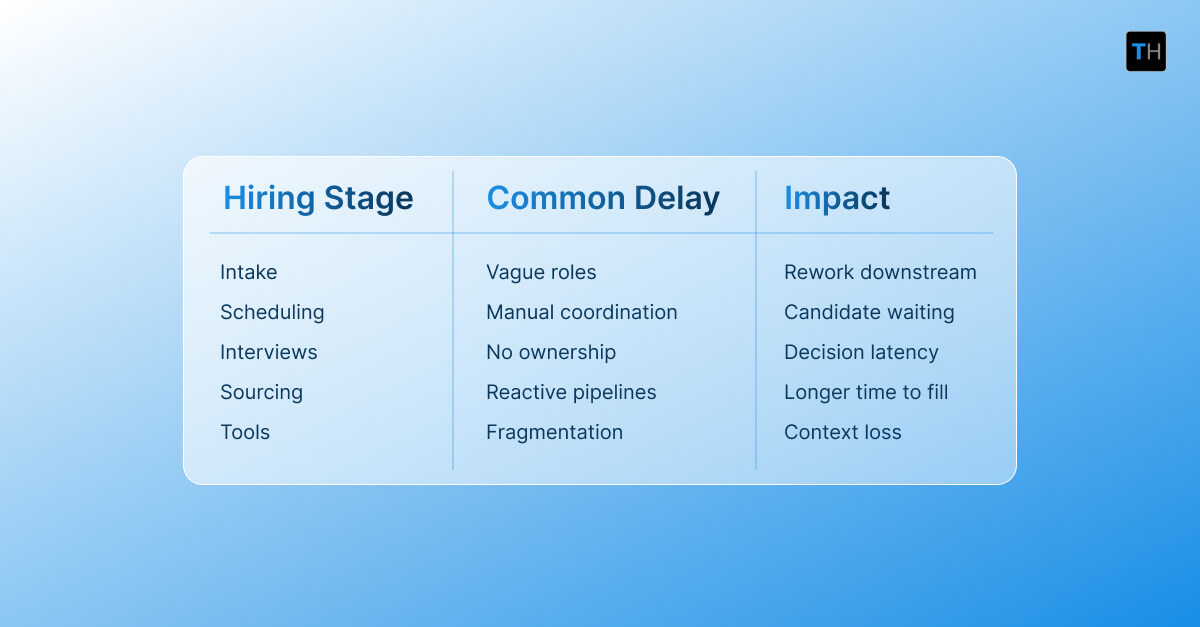
Metrics do not slow hiring down. System design does.
- Delayed job approvals
- Vague or poorly defined role requirements
- Manual coordination across interviews and stakeholders
- Reactive sourcing that starts from zero for each role
- Unstructured or delayed interview feedback
- Fragmented tools that create visibility gaps and rework
SHRM benchmarks show that nearly three weeks are lost before a role is even approved, with additional delays distributed across screening, interviews, and decision-making.
What to Look for in a Tool to Improve Time to Hire and Time to Fill
A recruitment automation tool helps only when it supports the hiring system end-to-end. The following capabilities matter because they reduce friction, preserve context, and keep work moving across stages.
1. Job Requisition and Intake
Structured job requisition ensures roles are clearly defined upfront, reducing rework, misalignment, and delays later in the hiring process.
2. Resume Parsing
Resume parsing standardizes candidate data early. It allows recruiters to review profiles and compare candidates faster.
3. Candidate Screening
Screening capabilities help filter noise from the pipeline. They ensure recruiters spend time evaluating relevant candidates rather than sorting through volume.
4. Candidate Scoring
Candidate scoring prioritizes profiles based on role-aligned criteria and improves decision-making speed without removing recruiter judgment.
5. Assessments
Role-aligned assessments validate skills early and reduce late-stage surprises to shorten interview cycles.
6. Automatic Interview Scheduling
Automated scheduling removes one of the biggest coordination bottlenecks by aligning recruiter, interviewer, and candidate availability without manual follow-ups.
7. Follow-Up and Communication
Consistent, automated communication keeps candidates informed, reduces uncertainty, and prevents drop-offs caused by silence or delays.
8. Offer Letter Acceptance and Denial
Streamlined offer workflows preserve candidate momentum, reduce approval delays, and ensure faster closure once decisions are made.
How Time to Hire and Time to Fill Connect to Hiring Velocity
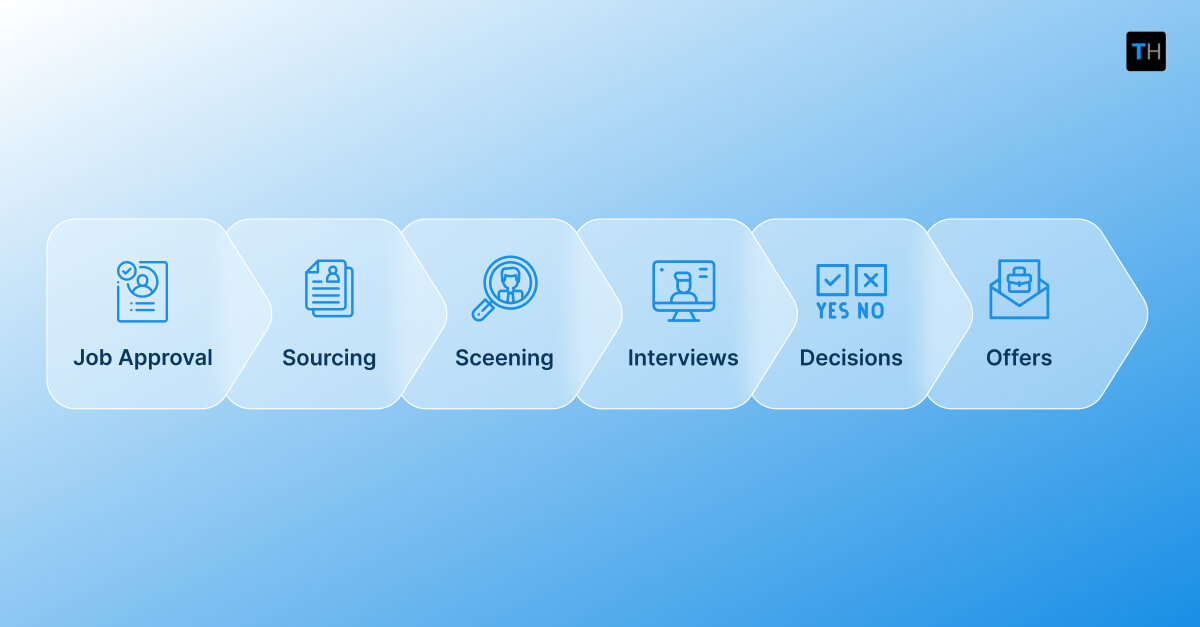
Time to hire and time to fill are useful signals. They show where delays appear. Hiring velocity explains why those delays happen.
Hiring velocity looks at how the entire system moves at scale. It considers throughput, coordination, and sustainability alongside time-based metrics.
Understanding this connection helps teams move beyond metric chasing and toward system improvement.
Conclusion
Time to hire and time to fill are not competing metrics. Each reveals a different constraint in the hiring system.
Improving hiring outcomes requires understanding both and addressing the system-level issues they expose. Sustainable progress comes from fixing flow, not forcing speed.
TurboHire supports time to hire and time to fill by enabling coordinated system-level hiring across the talent acquisition lifecycle.
Frequently Asked Questions (FAQs)
1. What is the difference between time to hire and time to fill?
Time to hire measures how long a candidate takes to move through the hiring process once they enter the pipeline. Time to fill measures how long it takes to close a role from job requisition approval to offer acceptance. Together, they reveal different constraints in the talent acquisition system, one from the candidate’s perspective and the other from the organization’s.
2. Which metric is more important: time to hire or time to fill?
Neither metric is more important in isolation. Time to hire helps teams understand candidate experience and recruitment speed, while time to fill supports workforce planning and operational efficiency. The most effective talent acquisition teams use both metrics together to diagnose system-level delays.
3. How can organizations improve time to hire and time to fill?
Organizations improve time to hire and time to fill by fixing system-level friction. This includes clear role definition at intake, proactive sourcing, structured interviews, faster feedback loops, and tools that connect stages instead of fragmenting them. Sustainable improvement comes from improving flow, not forcing speed.