

Skills-based hiring began as a response to an obvious problem. Titles, degrees, and brand-name employers were being used as shortcuts for capability. Organizations wanted to move toward evaluating what people can actually do.
Close to 65% of employers report using skills-based hiring practices for entry-level roles, and more than half use these practices consistently throughout the hiring process.
In practice, many companies still default to traditional filters. Job descriptions continue to list degree requirements. Screening still favors recognizable employers. Interview panels still rely on loosely defined experience thresholds.
Without structural redesign, legacy signals re-enter the process.
Improving quality of hire requires redefining how capability is identified, validated, and measured. Skills-based hiring only works when it is embedded into hiring design. It needs to be a part of a holistic talent acquisition system.
What Skills-Based Hiring Actually Means
Skills-based hiring treats observable capability as the core unit of evaluation. A skill reflects a demonstrated ability to perform a task, solve a problem, or deliver a defined outcome.
A joint Harvard Business School and Burning Glass Institute study found that even after removing degree requirements, fewer than 1 in 700 new hires were non-college graduates, highlighting the gap between policy and practice.
Titles compress experience into labels. Two candidates with the same title may have very different scopes of responsibility. Degrees signal exposure to knowledge, not necessarily applied competence.
Decision-making becomes clearer when capability becomes the primary signal. Evaluation criteria are tied to performance requirements rather than résumé interpretation.
Why Traditional Signals Break Down
Titles vary widely across industries and companies. Seniority labels are often inflated. Job responsibilities are rarely standardized.
Degree requirements are frequently used as filters, even when the role does not require specialized academic training. Pedigree becomes a proxy for quality, narrowing talent pools without guaranteeing performance.
The business impact appears in measurable ways:
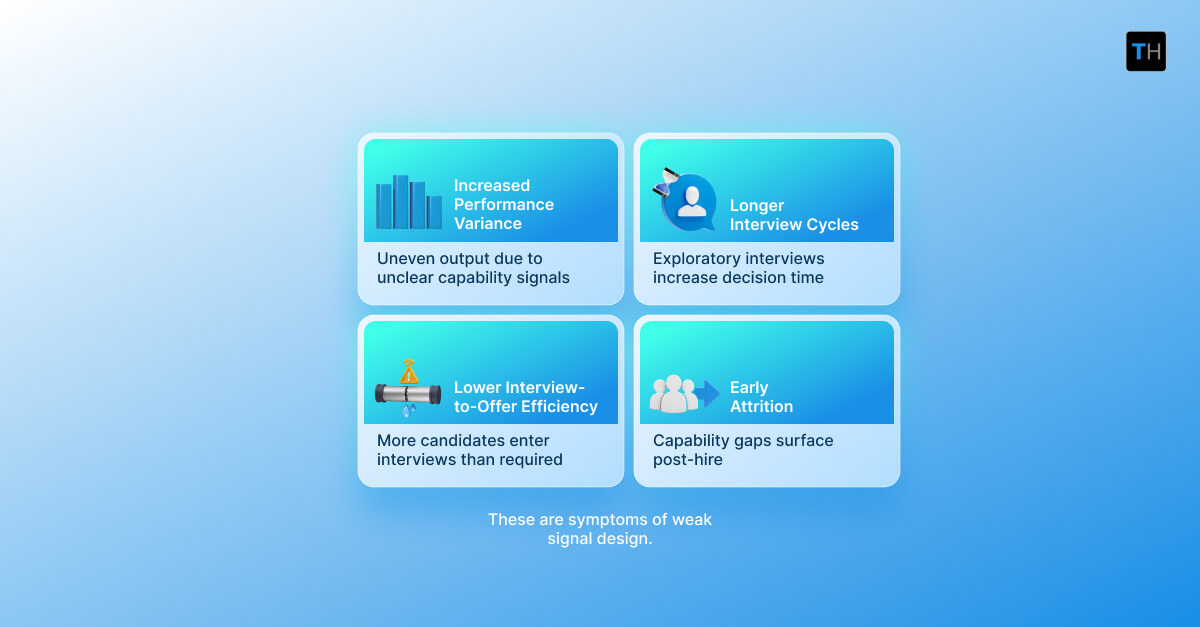
1. Increased performance variance: When roles are defined through titles rather than capabilities, expectations remain vague. Two candidates may appear equally qualified on paper, yet differ significantly in applied skill. This inconsistency leads to wide performance gaps once hired.
Over time, teams experience uneven output. Managers compensate by investing more time in supervision and correction. The organization absorbs hidden productivity costs because evaluation signals were imprecise at entry.
2. Longer interview cycles: When required skills are not clearly defined, interviews become exploratory rather than confirmatory. Each round aims to “understand the candidate” rather than validate specific capabilities.
This often results in additional interview stages. Decision-making slows because stakeholders lack structured criteria for comparison. Time-to-hire increases not due to candidate scarcity, but due to evaluation ambiguity.
3. Lower interview-to-offer efficiency: Excessive candidates progress through interviews without defined skill benchmarks. Screening relies on surface indicators, which increases false positives.
As a result, interview panels spend time evaluating candidates who do not meet actual performance requirements. Interview-to-offer ratios decline because evaluation precision at the top of the funnel is weak.
4. Early attrition due to skill misalignment: When hiring decisions are based on pedigree or generalized experience, capability gaps often surface only after onboarding. The role’s operational demands may differ from what the résumé implied.
This leads to underperformance within the first three to six months. Early exits increase replacement costs and disrupt team continuity. Retention instability becomes a downstream effect of flawed skill validation.
These are symptoms of weak signal design.
Redefining Roles Through Skill Mapping for Skills-Based Hiring
Activity Mapping Before Candidate Mapping
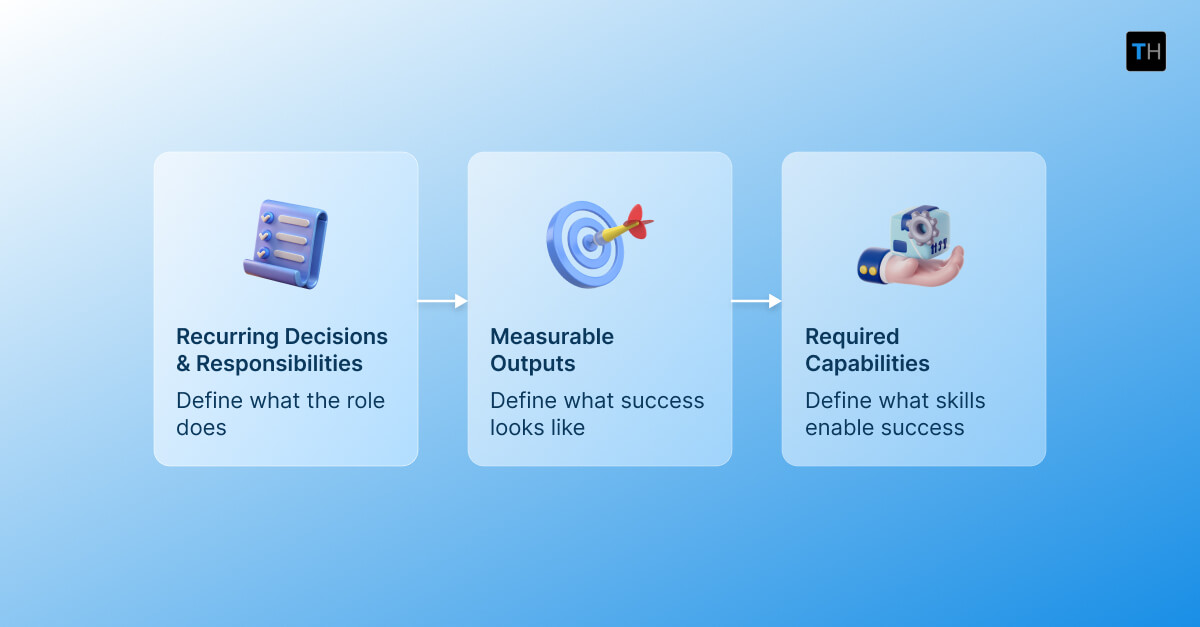
Effective skills-based hiring starts by defining the role through activities and outcomes. Before screening candidates, organizations must clarify what the job actually requires.
This includes:
1. Identifying recurring decisions and responsibilities: Every role involves a pattern of decisions and repeated actions. Instead of starting with years of experience or past titles, the focus should shift to what the person will actually do on a weekly basis.
This includes identifying the problems they are expected to solve, the trade-offs they must manage, and the stakeholders they must influence. When recurring decisions are clearly mapped, the role becomes concrete rather than abstract.
Clarity at this stage prevents inflated job descriptions and reduces reliance on proxy signals later in the process.
2. Defining measurable outputs: Once responsibilities are clear, the next step is to define what successful execution looks like. Outputs should be observable and, where possible, quantifiable.
For example, instead of stating “manage client relationships,” define outcomes such as retention rate, resolution time, or satisfaction scores. Instead of “lead projects,” define on-time delivery, budget adherence, or cross-functional alignment.
Measurable outputs create alignment between hiring, performance management, and business results. They also provide anchors for evaluation during interviews.
3. Translating outputs into required capabilities: Outputs alone are not sufficient. The organization must determine which capabilities enable those outcomes.
If the output is reduced resolution time, the required capabilities may include prioritization, structured problem-solving, and stakeholder communication. If the output is improved retention, the required capabilities may include coaching, data interpretation, and escalation handling.
This translation step connects business outcomes to skills. It ensures that hiring decisions are tied directly to performance expectations rather than generalized experience.
Only then can screening align with real performance expectations.
Example: Skill Mapping for a Customer Support Manager
A traditional job description may state:
- 5 years of experience
- MBA preferred
- Experience in SaaS
A skills-based definition would instead focus on capability.
Core skills:
- Escalation resolution
- SLA management
- Process documentation
- Cross-functional coordination
Adjacent skills:
- CRM proficiency
- Data interpretation
- Coaching and feedback delivery
Trainable skills:
- Product-specific knowledge
- Internal systems familiarity
This approach improves screening precision. Interviews align with what is actually needed from a candidate. Over-filtering based on pedigree is reduced.
The Playbook for Operationalizing Skills-Based Hiring
1. Define the Job Through Activity Mapping
Break the role into tasks, decisions, and expected outcomes. Clarify what high performance looks like. Convert responsibilities into structured skill statements that can be evaluated consistently.
2. Strengthen Assessment Design
Resume filtering should not be the primary validation method. Work samples, simulations, and structured tasks provide clearer signals. Standardized scoring criteria reduce interpretation drift between interviewers.
3. Build a Shared Skills Framework
Skills must be defined consistently across teams. Recruiters and hiring managers should operate from the same capability definitions. This reduces subjectivity and improves cross-functional alignment.
4. Rewrite Job Descriptions Around Capability
Remove unnecessary degree requirements. Replace generic experience thresholds with clearly defined competencies. This improves candidate self-selection and expands access to qualified talent.
5. Align Interviews to Defined Skills
Each interview round should validate specific capabilities. Redundant conversations decrease. Interview-to-offer ratios become more efficient when evaluation is structured.
6. Run, Measure, Optimize
Skills-based hiring is not static. Track outcomes against defined capabilities. Refine assessment criteria based on performance feedback. Close the loop between hiring and on-the-job results.
Measuring the Impact of Skills-Based Hiring
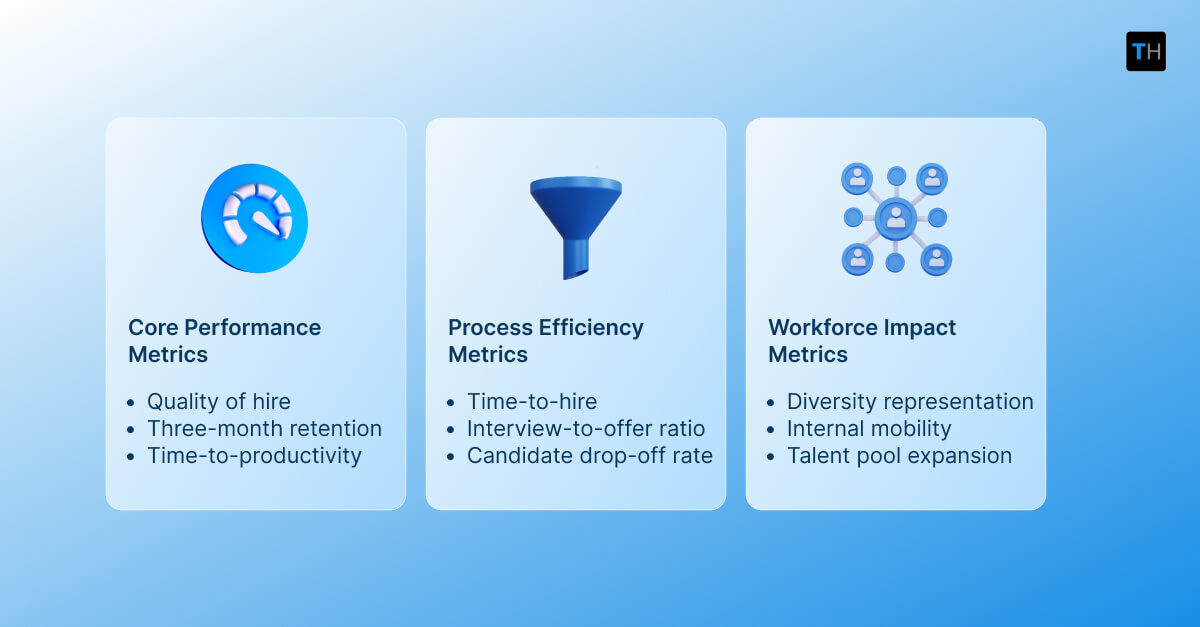
Core Performance Metrics
Quality of hire becomes the primary indicator. This can be measured through:
- Hiring manager performance ratings
- Three-month retention
- Time-to-productivity
When skills align with role demands, early attrition declines and ramp times shorten.
Process Efficiency Metrics
Operational signals include:
- Time-to-hire
- Interview-to-offer ratio
- Candidate drop-off rate
Clear capability criteria reduce unnecessary interview rounds. Screening becomes faster and more consistent.
Workforce Impact Metrics
Skills-based hiring often broadens the accessible talent pool. Diversity representation may improve as pedigree filters are removed. Internal mobility alignment strengthens when skills are documented systematically.
These outcomes reflect structural clarity rather than isolated improvements.
Business ROI of Skills-Based Hiring
Consider an organization hiring 100 mid-level roles annually with an average salary of $60,000.
If skills-based hiring reduces early turnover by 8 percent, eight replacement hires are avoided. Assuming replacement costs equal 30 percent of salary, each avoided hire saves $18,000. Eight avoided replacements generate $144,000 in savings.
If time-to-productivity improves by two weeks and each hire contributes an estimated $2,500 in incremental output during that period, total additional value equals $250,000 across 100 hires.
Combined, this represents nearly $400,000 in annual impact.
These gains come from better signal design, not increased recruiter effort.
Skills-Based Hiring at Enterprise Scale
Preventing Reversion to Legacy Filters
Teams revert to familiar shortcuts without governance. Skill definitions must be documented and standardized. Evaluation criteria should be auditable and consistent across business units.
Leadership alignment ensures that hiring managers do not reintroduce pedigree-based preferences.
Creating Repeatable Hiring Architecture
Structured skill capture creates comparability across roles. Centralized evaluation records enable visibility across stages. Capability data supports long-term workforce planning.
At scale, discipline determines sustainability.
Enabling Structured Skills Evaluation
Executing skills-based hiring consistently requires infrastructure.
Structured intake forms help capture required capabilities at the outset. Screening workflows can be aligned to defined skill criteria. Evaluation data must be centralized and measurable across stages.
Organizations maintain consistency without increasing administrative burden when infrastructure supports structured judgment, Skills-based hiring then becomes an embedded practice rather than an aspirational philosophy.
Conclusion
Skills-based hiring began as a corrective to title and pedigree bias. Its effectiveness depends on execution.
Capability must be clearly defined, systematically evaluated, and continuously measured. Quality of hire improves when signal design improves.
Organizations that treat skills as structured inputs rather than abstract values build more stable and scalable hiring performance. Leaders should examine how skills are currently defined, validated, and measured across their hiring process.
TurboHire is designed to support this discipline. It helps teams operationalize skills-based hiring at scale by enabling structured skill capture and consistent evaluation orchestration.
Frequently Asked Questions (FAQs)
1. What is skills-based hiring?
Skills-based hiring evaluates candidates primarily on demonstrated capabilities rather than titles, degrees, or employer pedigree.
2. How does skills-based hiring improve the quality of hire?
By aligning evaluation criteria to real job requirements, organizations reduce skill mismatches, shorten ramp time, and improve early retention.
3. How can enterprises implement skills-based hiring at scale?
Enterprises must define structured skill frameworks, align assessments to capability, standardize evaluation criteria, and measure outcomes against performance data.
4. What is the difference between skills-based hiring and competency-based hiring?
Skills-based hiring focuses on specific, demonstrable abilities required to perform tasks, while competency-based hiring may include broader behavioral traits and attributes. In practice, skills-based hiring emphasizes measurable capability tied directly to role outcomes, making evaluation more structured and performance-oriented.
5. How do you measure the success of a skills-based hiring strategy?
Success is measured through downstream performance and efficiency metrics such as quality-of-hire ratings, early retention, time-to-productivity, interview-to-offer ratio, and time-to-hire. These indicators show whether capability alignment has improved and whether evaluation criteria are producing stable hiring outcomes.