

Resume parsing and resume screening now sit at the center of modern talent acquisition systems. As organizations scale hiring, expand across geographies, and compete for specialized skills, early-stage screening determines whether hiring systems accelerate or collapse under volume. Over 51% of firms have adopted AI processes into their hiring procedures.
For years, resume screening was treated as a necessary administrative step. Recruiters reviewed resumes manually or relied on basic keyword matching to filter applications. That approach no longer works. Application volumes have grown, role requirements have become more nuanced, and hiring outcomes are increasingly measured by speed, quality, and experience rather than activity.
Modern talent acquisition systems demand more than faster screening. They require screening intelligence. This pillar explains why traditional resume parsing and screening fail at scale, how AI-driven screening changes the equation, and why parsing must evolve from automation into a system-level capability.
The Cost of Manual Resume Screening in Talent Acquisition Systems
Manual resume screening creates friction at the earliest point in the hiring process, and that friction tends to propagate through the rest of the talent acquisition system. As screening sits at the entry point of the funnel, any inefficiency here affects every downstream stage.
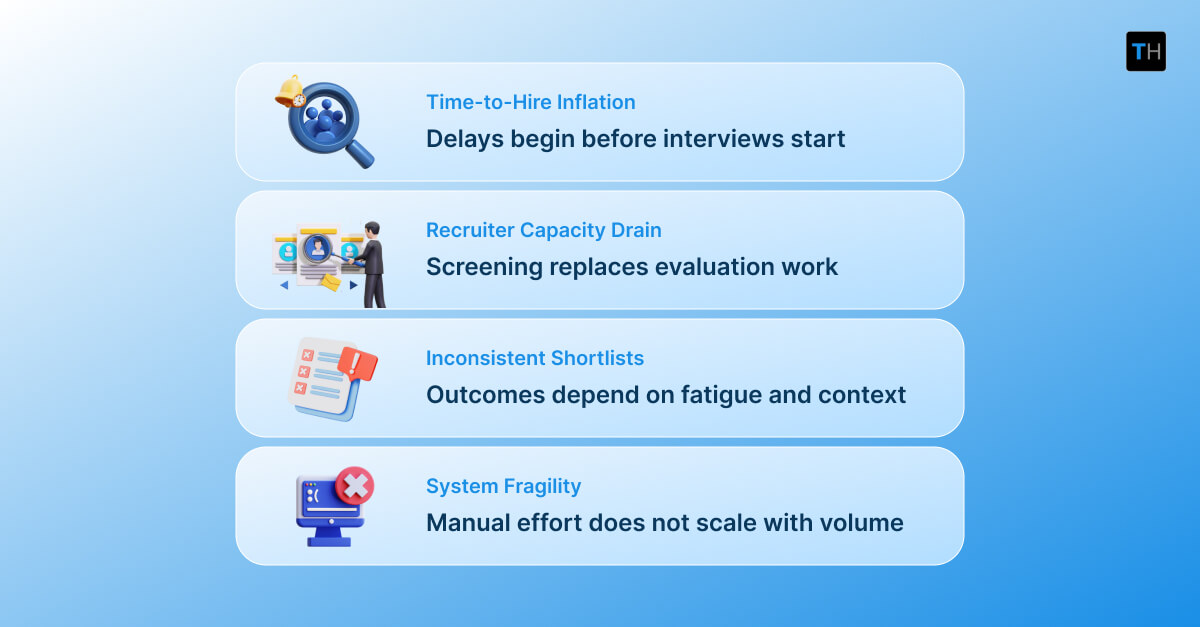
Delays in hiring often originate before interviews even begin. In high-volume or specialized roles, recruiters may spend several days or weeks reviewing applications manually. In fact, organizations’ employers received an average of 180 applicants for every hire. This slows initial shortlisting, compresses later stages, and reduces the overall predictability of hiring timelines.
Manual screening also places sustained pressure on recruiter capacity. Time spent reviewing and filtering resumes is time not spent on higher-value work such as assessing candidate fit, aligning with hiring managers, or maintaining candidate communication. As application volume increases, this imbalance becomes more pronounced and limits how effectively recruiters can support multiple open roles.
In addition, the quality of shortlists generated through manual screening can vary significantly. Outcomes are influenced by individual recruiter context, workload, and fatigue at the time of review. Two recruiters evaluating the same role may arrive at materially different shortlists, creating inconsistency in hiring decisions and interview outcomes without a concrete structure.
Manual resume screening does not break down because recruiters lack expertise or judgment. It becomes a constraint because it relies on individual effort rather than system design. As part of a growing talent acquisition system, manual screening lacks the consistency, scalability, and reliability required to support sustained hiring performance.
Why First-Generation Resume Parsing and Screening Fall Short
Early resume parsing tools focused on keyword extraction. They scanned resumes for predefined terms and ranked candidates based on frequency or proximity.
This approach breaks down for several reasons:
- Keywords miss context. A candidate may demonstrate a skill without naming it explicitly.
- Titles vary across industries and companies, even for identical roles.
- Non-linear career paths confuse rigid parsers.
- Candidates adapt resumes to game keyword systems, increasing noise.
When keyword-based resume parsing is scaled across the system, it amplifies false positives and false negatives. Recruiters spend time validating poor matches while strong candidates are filtered out early.
Screening automation without intelligence accelerates the wrong outcomes.
The Mechanics of Intelligent Resume Parsing: From Keywords to Context
1. NLP-Driven Resume Parsing
Natural Language Processing allows systems to interpret meaning rather than surface-level matches. Instead of asking whether a resume contains a keyword, NLP evaluates how skills, experience, and responsibilities are described.
This enables more accurate interpretation of roles, accomplishments, and career progression.
2. Handling Diverse Resume Formats at Scale
Resumes arrive in inconsistent formats. Intelligent parsing normalizes this variation. PDFs, documents, structured profiles, and free-form layouts are converted into standardized data without losing nuance.
Consistency at this stage is critical for reliable resume screening.
3. Interpreting Synonyms, Skills, and Role Language
Intelligent parsing recognizes equivalent skills and role language across industries. It understands that different terms can represent the same capability. This reduces false rejection and improves inclusivity.
The Deep Learning Advantage in Resume Screening
Deep learning models improve resume screening by learning from outcomes rather than static rules.
As hiring decisions are made and outcomes are observed, models refine how they interpret signals. Screening accuracy improves over time without constant manual tuning.
This shifts resume screening from rule maintenance to system learning.
From Resume Parsing to Precision Screening: AI Candidate Matching
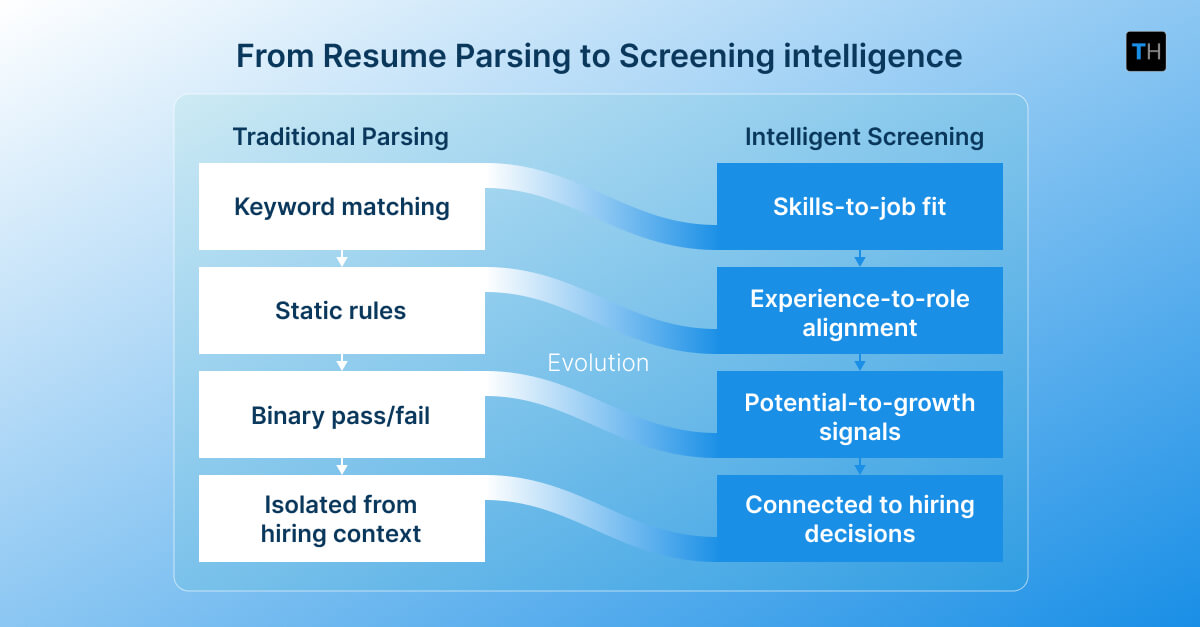
Resume parsing on its own does not meaningfully improve hiring outcomes. Parsing creates structure, but value is realized only when that structured data is used to support better screening and decision-making. Without intelligent matching layered on top, parsed data remains descriptive rather than actionable.
AI-driven resume screening applies structured resume data to evaluate candidates across multiple, role-relevant dimensions. Rather than relying on keyword presence or binary filters, it assesses how closely a candidate aligns with the requirements and intent of the role.
Skills-to-job fit examines the relevance, depth, and application of skills in the context of the role’s expectations. This helps distinguish surface-level familiarity from demonstrated capability.
Experience-to-role fit evaluates how a candidate’s prior roles, tenure, and industry exposure align with the functional and contextual demands of the position. It provides a clearer signal of readiness and reduces ambiguity during early evaluation.
Potential-to-growth fit looks beyond direct experience to identify transferable skills and adjacent capabilities. This dimension is particularly important for evolving roles, where long-term value depends on adaptability rather than exact past matches.
By evaluating candidates across these dimensions, intelligent resume screening improves the quality of shortlists and increases the likelihood that interviews lead to informed decisions. Interview time is spent on candidates with a stronger overall fit, reducing wasted interview cycles and improving both hiring efficiency and outcome quality.
Mitigating Bias Through Skills-Based Resume Screening
Unstructured resume screening introduces bias through familiarity, assumptions, and inconsistency.
Skills-based resume screening creates structure without removing human judgment. Candidates are evaluated against defined criteria rather than subjective impressions.
When screening decisions are explainable and consistent, trust improves across candidates and hiring teams. Diversity outcomes improve naturally because evaluation focuses on capability rather than pedigree.
Resume Parsing and Screening as Part of an End-to-End Talent Acquisition System
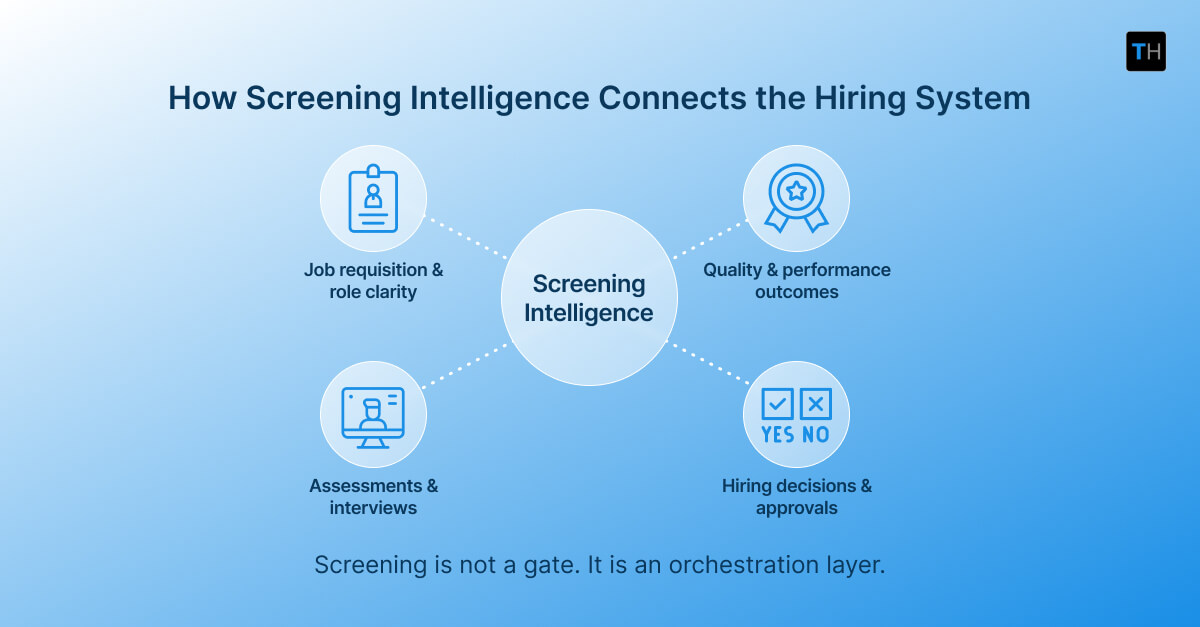
Resume parsing and screening deliver value only when connected to the broader hiring system.
In mature talent acquisition systems, screening intelligence does not operate in isolation. It is integrated across the hiring lifecycle and connected directly to upstream and downstream processes that shape hiring outcomes.
Screening intelligence aligns closely with job requisitions and role definitions. Clear success criteria and role expectations established at intake inform how candidates are evaluated during screening. This alignment reduces rework later in the process and ensures that early decisions reflect actual hiring needs rather than generic qualifications.
Screening also connects to assessments and interviews. The insights generated during screening guide which competencies are validated during later stages, helping interviewers focus on the most relevant areas. This continuity improves interview quality and reduces redundant evaluation.
Hiring decisions and approvals benefit from screening intelligence through improved visibility and consistency. Decision-makers have access to structured evaluation signals rather than fragmented notes or subjective impressions, which supports faster and more confident decisions.
Finally, screening intelligence feeds into quality and performance outcomes. By linking early screening signals to post-hire performance data, organizations can refine evaluation criteria over time and improve hiring accuracy.
In this context, screening moves beyond acting as a simple gate at the top of the funnel. It becomes an orchestration layer that connects role intent, evaluation, decision-making, and long-term outcomes into a coherent talent acquisition system.
The Power Trio: NLP, Machine Learning, and Artificial Intelligence in Modern Resume Screening
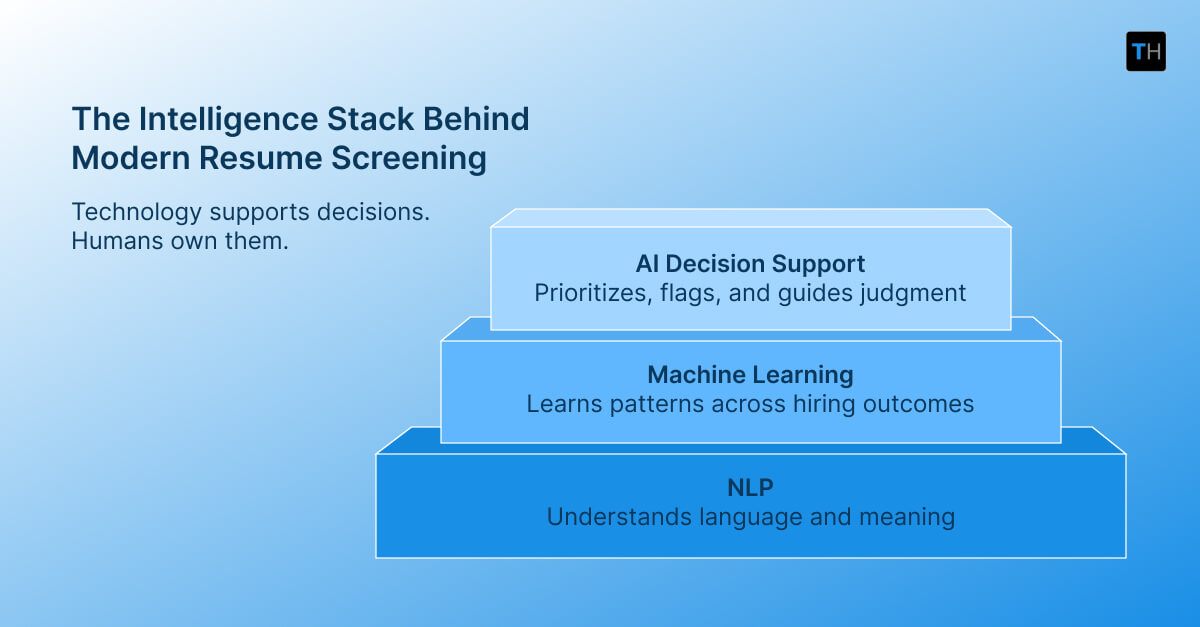
Each technology plays a distinct role:
Natural language processing interprets language beyond surface-level keywords. It understands how skills, experience, and intent are expressed across varied resume formats, job titles, and descriptions. This allows candidate information to be read in context rather than treated as isolated terms.
Machine learning identifies patterns and relationships across large volumes of hiring data. It learns how combinations of skills, experience, and background correlate with successful hires and continuously improves screening accuracy as more data flows through the system.
Artificial intelligence orchestrates decision support across the talent acquisition system. It connects insights from parsing, screening, assessments, and outcomes to surface signals at the right stage, helping recruiters and hiring managers make informed decisions without replacing human judgment.
Together, these capabilities transform resume parsing from a static extraction process into an adaptive intelligence layer within the hiring system.
Tools built natively with these capabilities behave differently from retrofitted automation. Native-AI screening systems adapt as hiring changes. Rule-based systems degrade over time.
Benefits of Modern Resume Parsing and Screening Technologies
When implemented as part of a connected talent acquisition system, screening intelligence delivers compounding benefits across hiring outcomes.
- Screening accuracy improves because candidates are evaluated against consistent, role-aligned criteria rather than subjective or momentary judgment. Recruiters spend less time filtering noise and more time assessing genuine fit.
- Time to hire reduces as early-stage bottlenecks are removed. Faster, more reliable screening prevents delays from cascading into interviews, decisions, and offers.
- Interview-to-hire ratios improve because interview slots are reserved for candidates with a higher likelihood of success. This reduces wasted interview cycles and improves decision confidence for hiring managers.
- Recruiter fatigue decreases as repetitive screening work is replaced by structured, system-supported evaluation. Recruiters regain time for stakeholder alignment, candidate engagement, and quality control.
- Candidate experience improves through faster responses, clearer progression, and reduced uncertainty. Applicants receive timely feedback and encounter a process that feels intentional rather than opaque or stalled.
- Together, these outcomes reinforce screening as a leverage point for system-wide hiring performance rather than a standalone efficiency gain.
Read: How Lenskart Achieves 10X Faster Hiring with TurboHire
These benefits compound only when screening intelligence is embedded into the talent acquisition system.
Creating Seamless Resume Parsing Integration with ATS Systems
1. Optimizing Data Flow Across the Hiring System
Effective integration requires clean field mapping and structured data transfer. Parsed data must land in the right context within the ATS to remain usable.
Validation workflows prevent data loss and ensure consistency across stages.
2. Real-World Integration Impact
Organizations with integrated parsing and screening can automatically prioritize candidates, build shortlists faster, and analyze sourcing effectiveness with confidence.
Disconnected tools create activity. Connected systems create flow.
Common Resume Parsing and Screening Pitfalls (and How to Avoid Them)
- Poor field mapping that corrupts candidate data
- Lack of validation leading to unreliable screening signals
- Insufficient recruiter training
- Treating screening as a one-time setup instead of a living system
Avoiding these pitfalls requires treating screening as infrastructure, not software.
Maximizing the ROI of Resume Parsing and Screening
Organizations using AI for hiring report a 30% reduction in cost per hire. This is what they get right to extract value from screening intelligence:
- Define screening objectives clearly
- Choose tools aligned with system design
- Train recruiters to interpret signals, not chase scores
- Establish validation and quality benchmarks
- Scale gradually and measure impact continuously
Measuring the Impact of Resume Parsing and Screening
Key system-level metrics include:
- Time to hire
- Interview-to-hire ratio
- Quality of hire
- Recruiter productivity
These metrics should be analyzed together. Improvements in one area at the expense of others indicate a system imbalance.
eBook: Hiring in the Age of AI: What Actually Determines Hiring Speed
Preparing for the Future of Resume Screening in Talent Acquisition Systems
Resume screening within mature talent acquisition systems is shifting from static filtering toward adaptive intelligence.
- Continuous learning models enable screening systems to improve over time by learning from hiring outcomes. As organizations make decisions and observe performance and retention, screening logic becomes more accurate and role-specific rather than fixed to initial assumptions.
- Soft-skill inference is advancing through deeper analysis of language patterns, career narratives, and contextual signals. Instead of relying only on explicit keywords, modern systems identify communication ability, problem-solving orientation, and collaboration indicators embedded in how candidates describe their work.
- Candidate-centric screening experiences are becoming a priority as organizations recognize screening as part of employer credibility. Faster feedback, clearer role alignment, and more transparent progression help candidates feel evaluated rather than filtered out by opaque processes.
- Adaptive screening systems respond dynamically to hiring context. Screening thresholds, prioritization logic, and matching signals adjust based on role urgency, talent market conditions, and pipeline health rather than applying rigid rules across all hiring scenarios.
- Together, these shifts position resume screening not as a static gatekeeper, but as an intelligent, evolving component of the talent acquisition system that supports both scale and quality over time.
Organizations that invest in screening intelligence today future-proof their hiring systems.
Building Screening Intelligence Into Your Talent Acquisition System
Resume parsing and screening are no longer back-office functions. They shape hiring speed, quality, and trust.
TurboHire enables AI-native resume parsing and screening as part of an end-to-end talent acquisition system. By connecting screening intelligence to the entire hiring lifecycle, TurboHire helps organizations reduce noise, improve decisions, and scale hiring without sacrificing quality.
Conclusion: Resume Screening Is Where Hiring Intelligence Begins
Resume screening determines who enters the hiring conversation. Systems that treat it as automation struggle to scale. Systems that treat it as intelligence build sustainable advantage.
Platforms built with native AI and end-to-end orchestration enable screening to function as part of a connected hiring system rather than a standalone step. When screening intelligence feeds role clarity, assessments, interviews, and outcomes, organizations move from reactive hiring to predictable, high-quality talent decisions.
Frequently Asked Questions (FAQs)
1. What is resume parsing in talent acquisition?
Resume parsing is the process of extracting structured information such as skills, experience, education, and role history from resumes. In modern talent acquisition systems, resume parsing converts unstructured resume data into standardized inputs that can be analyzed, matched, and evaluated consistently across roles and candidates.
2. How is resume screening different from resume parsing?
Resume parsing focuses on extracting data from resumes, while resume screening evaluates that data to determine candidate relevance. Screening applies criteria such as skills alignment, experience depth, and role fit to decide which candidates move forward in the hiring process. Parsing enables screening, but screening drives hiring decisions.
3. Why does manual resume screening slow down hiring?
Manual resume screening slows hiring because it does not scale with volume. Recruiters spend significant time reviewing applications, reconciling information, and making subjective judgments, which increases time to hire and introduces inconsistency. In high-volume environments, this friction compounds across the entire talent acquisition system.
4. How does AI improve resume screening accuracy?
AI improves resume screening by evaluating candidates beyond keyword matching. AI-driven screening analyzes skills in context, interprets experience patterns, and identifies transferable capabilities. This reduces noise, improves shortlist quality, and increases interview-to-hire ratios while preserving recruiter judgment.
5. How does resume screening fit into an end-to-end talent acquisition system?
In an end-to-end talent acquisition system, resume screening connects directly to role definition, assessments, interviews, and hiring outcomes. Screening functions as an orchestration layer that preserves context and supports decision-making rather than acting as a gate. This integration enables faster, more consistent, and higher-quality hiring at scale.