

Recruitment automation and AI are now commonplace across talent acquisition teams. 88% organizations already use some form of recruitment automation, whether for sourcing, scheduling, or communication. Yet hiring outcomes have not improved in proportion to adoption.
The issue is not a lack of technology. It is how automation is being applied.
Most teams automate activity rather than coordination and decision flow. As a result, recruiters move faster but not necessarily better. Processes scale, but judgment does not. Candidate experience deteriorates even as tools multiply.
Recruitment automation works when it reduces friction and improves operational stability without replacing human judgment. This article explains what recruitment automation actually means in the context of talent acquisition, where teams go wrong, and what effective automation looks like in practice.
What Recruitment Automation Actually Means in Talent Acquisition
Recruitment automation is not about removing recruiters from the hiring process. It is about reducing the operational drag that prevents them from doing their best work.
At its core, recruitment automation is the use of technology to:
- Reduce coordination overhead across stakeholders
- Standardize execution without rigidifying decisions
- Improve visibility across hiring stages and ownership
Automation supports the fundamentals of talent acquisition rather than redefining them. Role clarity still matters. Structured evaluation still matters. Informed decision-making still matters.
These fundamentals do not disappear with automation. They become more enforceable. When processes are clearly defined and consistently executed, recruiters and hiring managers can focus on judgment instead of logistics.
What Most Teams Get Wrong About Recruitment Automation
1. Automation Eliminates Work
Automation does not eliminate thinking, reviewing, or deciding. It eliminates repetitive execution and fragile handoffs. 88% of employers use AI or recruiting automation for talent acquisition.
Teams still need to design their hiring processes. They still need to define what good looks like. Automation only stabilizes what already exists. When teams automate poorly designed processes, they simply make inefficiencies faster and more visible.
Automation removes noise. It does not remove responsibility.
2. Automation Replaces Recruiters
Recruitment automation changes recruiter leverage, not recruiter relevance.
As automation takes over coordination tasks like scheduling, follow-ups, and pipeline updates, recruiters move away from task execution and toward orchestration and decision support. Their value shifts from doing more work to enabling better outcomes.
Human judgment remains central to hiring. Automation can surface insights and maintain consistency, but accountability and context cannot be delegated.
3. More Tools Mean Better Automation
Tool sprawl fragments workflows and increases manual reconciliation. 67% of large enterprises juggle multiple HR systems for overlapping functions; It drives tool sprawl that inflates admin costs by 34% compared to unified platforms. Recruiters in fragmented stacks waste 20-30% more time on manual data reconciliation.
When sourcing, scheduling, interviewing, and making offers live in disconnected systems, recruiters spend more time stitching information together than evaluating candidates.
Automation without shared context creates more work, not less. Effective recruitment automation requires an end-to-end view of talent acquisition, where data and decisions flow across stages without friction.
The problem is not the number of tools. It is the lack of orchestration.
4. More Outreach Automatically Means Better Results
High-volume messaging does not improve hiring outcomes. Candidates are overwhelmed by repetitive or irrelevant communication, especially in high-demand roles.
Automation that optimizes for volume often reduces response quality and erodes trust. Relevance, timing, and context determine engagement. When outreach lacks intent, automation amplifies noise rather than signal.
Recruitment automation should help teams reach the right candidates at the right moment, not simply more candidates more often.
What Recruitment Automation Looks Like When It Works
When automation works, it is embedded into the structure of hiring operations rather than layered on top of them.
Requisition intake, pipeline tracking, and recruiter workload are coordinated automatically. Recruiters spend more time evaluating candidates and advising hiring managers, and less time chasing approvals or calendars.
Hiring managers move faster because expectations and context are clear. Candidates experience fewer delays and handoffs. Scale is balanced with personalization because automation removes friction without flattening judgment.
Most importantly, automation is judged by downstream outcomes, not surface-level activity. Faster cycles matter only if quality and experience are preserved.
What to Automate and What to Keep Human
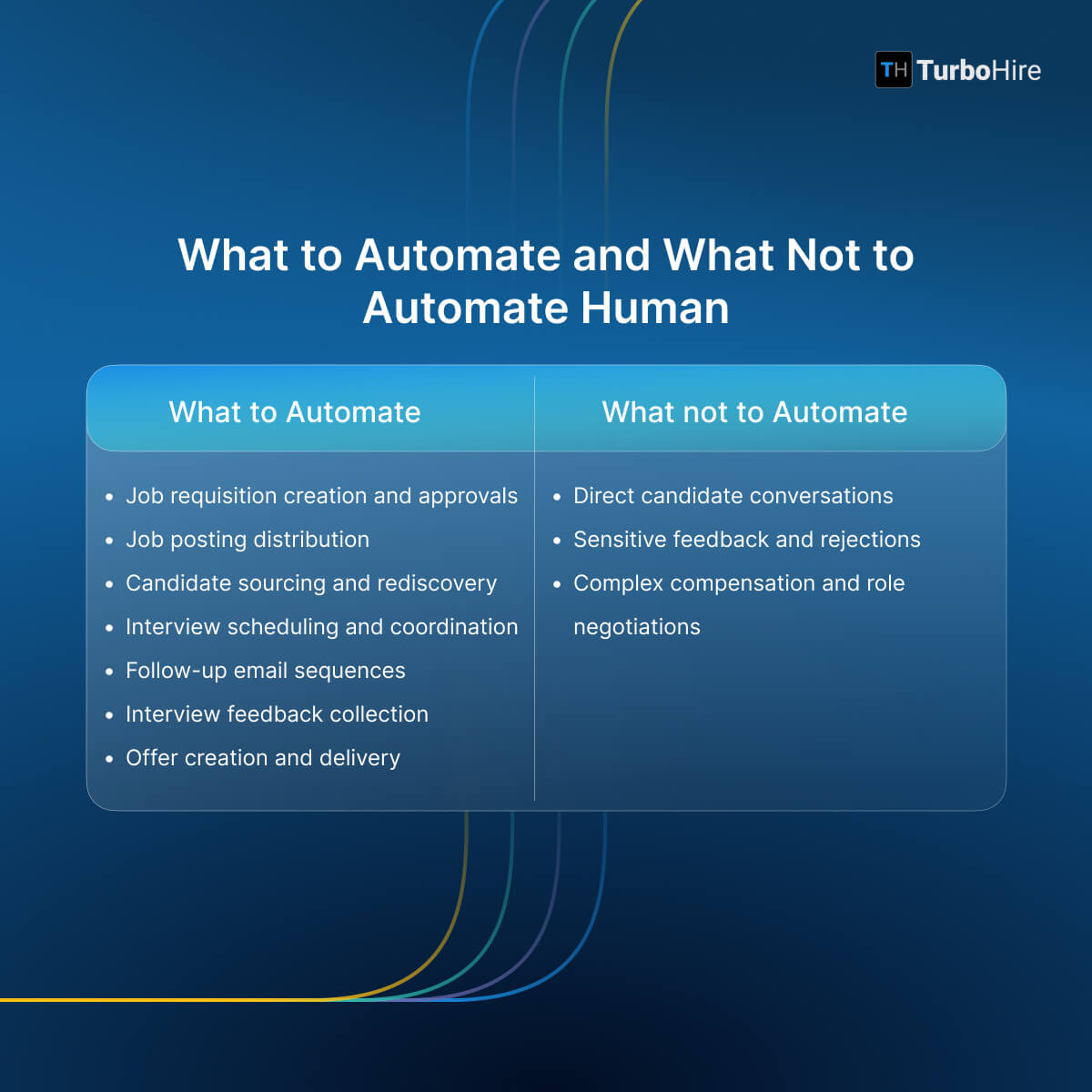
Recruitment automation delivers the most value when applied to coordination-heavy and repeatable workflows:
- Job requisition creation and approvals
- Job posting distribution
- Candidate sourcing and rediscovery
- Interview scheduling and coordination
- Follow-up email sequences
- Interview feedback collection
- Offer creation and delivery
Automation here reduces delay, inconsistency, and manual error. It improves reliability without intruding on decision-making.
What Not to Automate (Judgment and Trust)
Some moments in hiring require human presence and accountability:
- Direct candidate conversations
- Sensitive feedback and rejections
- Complex compensation and role negotiations
These interactions depend on empathy, nuance, and adaptability. Automating them weakens trust and introduces unnecessary risk.
Do’s and Don’ts of Recruitment Automation at Scale
DO: Start Small and Build a Scalable Strategy
Effective recruitment automation begins with stabilizing one or two high-friction workflows. Teams that attempt to automate everything at once often amplify existing inefficiencies. Automation should mature alongside process clarity.
DON'T: Automate Without Clear Objectives
Before automating any workflow, define what success looks like. Faster time to hire, higher recruiter capacity, or improved candidate experience require different design choices. Automation without intent creates activity without outcomes.
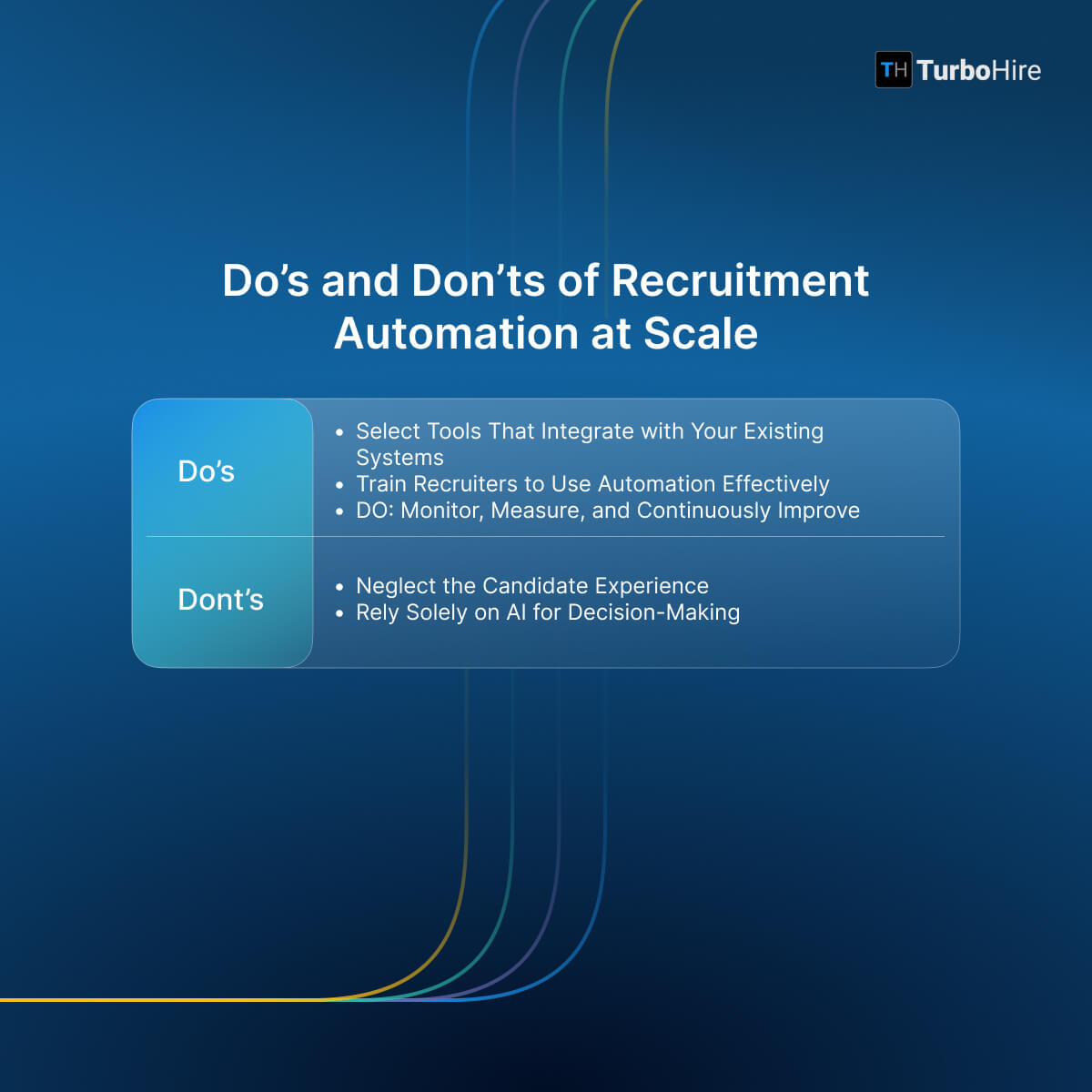
DO: Select Tools That Integrate with Your Existing Systems
Automation must operate within the broader talent acquisition ecosystem. Tools that integrate cleanly reduce duplication and reconciliation work. Fragmented automation increases overhead.
DON'T: Neglect the Candidate Experience
Speed without relevance damages trust. Candidate experience acts as a guardrail against over-automation. If automation improves internal metrics but harms engagement, it is failing.
DO: Train Recruiters to Use Automation Effectively
Automation changes how recruiters work. Without training, tools are underutilized or misused. Recruiters must know when to rely on automation and when to intervene.
DON'T: Rely Solely on AI for Decision-Making
AI can support insights and recommendations, but accountability remains human. Hiring decisions require context, judgment, and ownership.
DO: Monitor, Measure, and Continuously Improve
Time to hire and recruiter productivity should be reviewed regularly, with candidate experience or offer acceptance acting as a guardrail. Automation must evolve as hiring needs change.
Benefits of Recruitment Automation When Done Right
When recruitment automation is applied with intent and structure, teams see measurable improvements:
- Faster time to hire without sacrificing relevance
- Higher recruiter productivity through reduced coordination work
- Improved candidate engagement through clarity and consistency
- Fewer manual errors and reduced bias via structured workflows
- Stronger compliance and data security
| Benefit | Impact |
| Time-to-Hire | (-)30-85% |
| Cost-per-Hire | (-)40% |
| Recruiter Productivity | +71% |
| Retention | +82% new hires |
| Quality of Hire | +21% score |
These benefits compound only when automation is system-led.
Conclusion: Automation Doesn’t Fix Hiring. Systems Do.
Recruitment automation fails when treated as a shortcut. It succeeds when treated as infrastructure.
Teams that automate coordination rather than judgment move faster without losing quality. Recruitment automation is not about replacing recruiters. It is about enabling better decisions, consistently and at scale.
TurboHire enables AI-native and end-to-end recruitment automation designed to support modern talent acquisition systems.
Frequently Asked Questions (FAQs)
1. What is recruitment automation?
Recruitment automation refers to the use of technology to streamline and standardize repetitive hiring tasks such as job posting, candidate sourcing, interview scheduling, and follow-ups. Its goal is to reduce coordination overhead and improve efficiency, while keeping human judgment central to hiring decisions.
2. Does recruitment automation replace recruiters?
No. Recruitment automation does not replace recruiters. It changes how they work by automating coordination and administrative tasks, allowing recruiters to focus on evaluation, stakeholder alignment, and hiring decisions where human judgment is critical.
3. How do you measure the success of recruitment automation?
The success of recruitment automation is typically measured using time to hire and recruiter productivity. These metrics should be balanced with a guardrail, such as candidate experience or offer acceptance rate, to ensure speed does not come at the expense of quality or trust.