

Recruitment automation usually enters the conversation as a pathway to improve hiring efficiency. However, its deeper impact shows up in candidate experience. In high-volume hiring, experience’s decline cannot be attributed to recruiters’ lack of effort.
About 60% of candidates report receiving a poor candidate experience, and 72% of those candidates are likely to share that negative experience with others.
It declines when coordination across the talent acquisition system starts to fall apart. Recruitment automation strengthens candidate experience only when it fills the gaps between stages and reduces friction during handoffs.
Tasks and their complexity increase as hiring volume rises. More candidates entering the foray means interview slots must align across calendars. The number of stakeholders increases, and so do the decision makers.
Recruitment automation becomes meaningful at this stage. It reinforces structure and empowers judgment rather than replacing it. Clearly defined workflows, and the transitions are managed by the system. Candidate experience improves because the underlying hiring system regains stability.
What Is the Current Approach to Recruitment Automation?
In many organizations, recruitment automation develops in isolated pockets rather than as a coordinated system upgrade. Here is how it typically unfolds:
1. Automation Is Introduced in Fragments
Recruitment automation is seen as tickboxes. Teams automate resume screening. Interviews are auto-scheduled, and so is candidate outreach.
Each of these changes reduces manual effort at a specific step. Recruiters seem to have gotten their hands washed of repetitive tasks. The burden of administrative tasks seems to be lessened. However, this does not mean that the overall hiring flow is free of bumps.
2. Focus Is on Local Efficiency, Not System Flow
Isolated automation improves speed within individual stages rather than connecting them holistically. Screening may move faster, but interview alignment still relies on stakeholder availability. Scheduling links may go out instantly, but evaluation criteria may remain unclear, resulting in subjective decisions across the board. Emails may be automated, but there are pending approvals.
3. Early Acceleration Creates Downstream Imbalance
An imbalance begins to take shape when automation accelerates early screening without reinforcing alignment in the later stages of hiring.
A larger number of candidates move forward at the same time, which increases the load on interview panels. From the candidate’s point of view, the experience feels inconsistent. Progress appears quick at the beginning, but the pace becomes unpredictable once interviews and approvals come into play.
4. Activity Increases, But Flow Does Not Stabilize
Automation often increases overall activity across the hiring process. Recruiters send more outreach messages, schedule more interviews, and process a higher volume of resumes within shorter timeframes.
However, candidate experience does not improve simply because more work gets done. It improves when movement between stages becomes predictable, and transitions follow a clear structure. When automation supports coordination across the entire talent acquisition system rather than accelerating isolated tasks, the hiring flow stabilizes, and experience improves as a result.
How Recruitment Automation Strengthens Candidate Experience
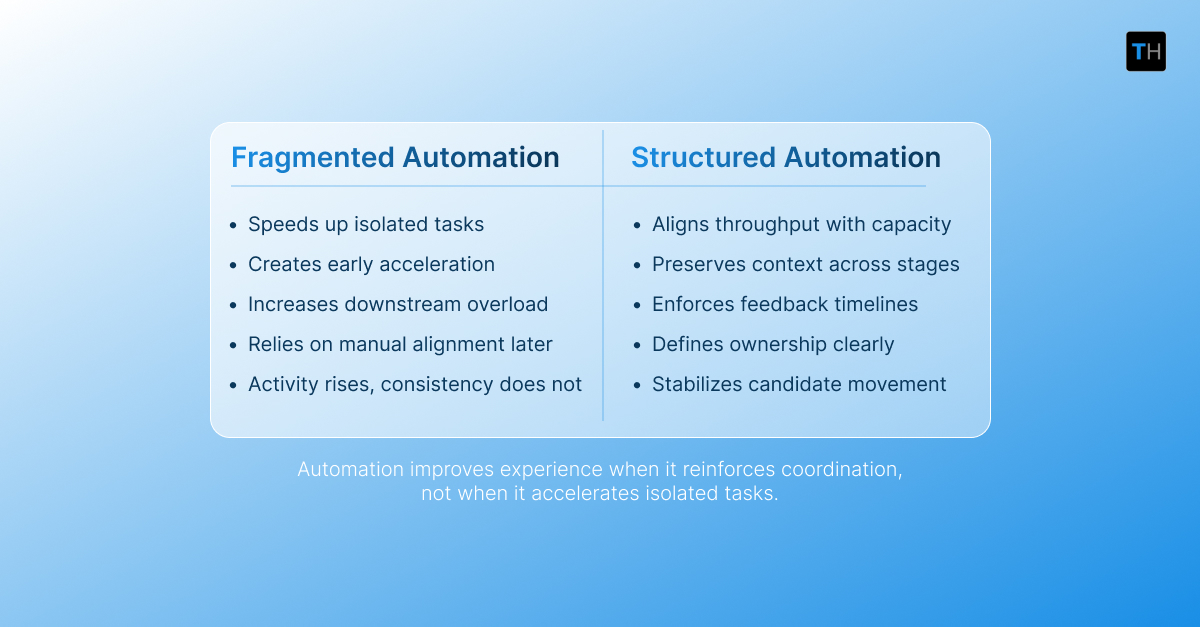
Recruitment automation strengthens candidate experience when applied across structured workflows rather than single tasks. The difference lies in how it supports coordination.
1. Structured Role Intake and Approval
Standardized intake workflows ensure that role definitions remain stable from the beginning.
Screening criteria do not shift midway, and interviews are all on the same page. Candidates experience stability rather than witnessing shifting goalposts. In fact, nearly 78% of candidates view the overall candidate experience as a signal of how a company values its people.
A consolidated and structured approach at the beginning of the recruitment process strengthens the candidate experience.
2. Coordinated Screening and Pipeline Continuity
Automation can align screening throughput with downstream capacity. Structured shortlisting processes ensure that interviews are scheduled within defined windows rather than reactively.
When early-stage acceleration is matched with interview availability and feedback discipline, movement remains steady. Candidates do not experience a fast start followed by silence.
3. Automated Interview Scheduling With Guardrails
Scheduling automation reduces dependency on manual coordination. Calendar synchronization and predefined interview windows limit gaps between rounds.
Instead of multiple emails to align availability, the system manages alignment. Recruiters intervene only when exceptions occur.
4. Feedback Timelines Enforced Through Workflow
Decision delays often stem from undefined feedback ownership. Recruitment automation can enforce response windows and surface overdue evaluations.
Automated reminders and escalation pathways reduce reliance on informal nudges. Meetings are scheduled with purpose rather than as alignment placeholders.
5. Standardized Offer and Approval Workflows
Late-stage unpredictability frequently damages candidate experience. Defined approval chains and digital offer workflows reduce ambiguity around timelines. Predictability at the final stage reinforces trust built earlier in the process.
Recruitment Automation and Hiring Metrics
When recruitment automation reinforces structure instead of just speeding up tasks, hiring metrics begin to stabilize. The improvement shows up in flow, not just activity.
Here is how that connection plays out:
1. Candidate Drop-Off Rate Becomes More Predictable
Drop-offs often increase when candidates wait without clarity. Murky timelines and irregular follow-ups create disengagement.
The waiting time gets defined when automation supports defined stage transitions and timely communication. Candidates understand what happens next and when. As a result, drop-off rates begin to decline.
2. Time to Hire Shortens When Ownership Is Clear
Time-to-Hire stretches when decisions move without clear accountability. Decision move fast, and clearly when recruitment automation supports defined ownership and structured approval paths. The reduction in time to hire reflects clearer coordination rather than rushed evaluation.
3. Interview-to-Offer Lag Narrows With Structured Approvals
In many systems, interviews conclude quickly, but offers take longer to materialize. This lag often stems from ad-hoc approval processes and fragmented documentation.
The transition from interview to offer becomes more consistent when workflows follow predefined paths and approval checkpoints are visible. The gap narrows because escalation and alignment follow structure instead of improvisation.
4. Metrics Reflect System Stability
These improvements do not happen because automation exists. They happen because automation supports structured flow across the talent acquisition system.
When coordination strengthens, metrics stabilize. When structure weakens, metrics fluctuate. Hiring data reflects how disciplined the system truly is.
Recruitment Automation as Coordination Infrastructure
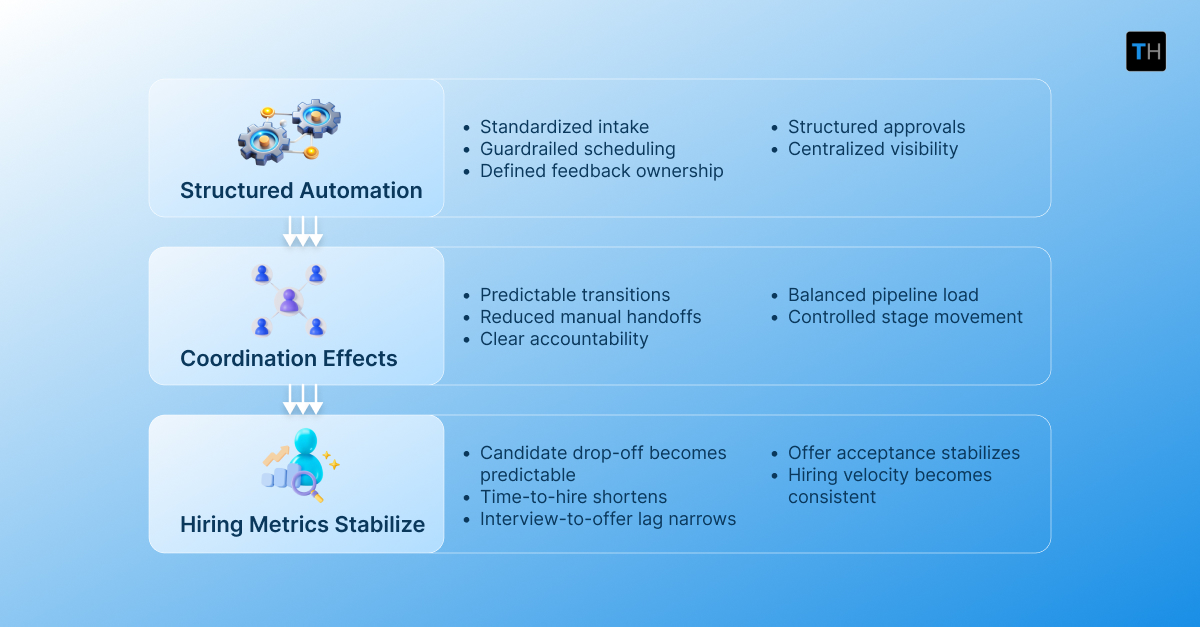
Recruitment automation strengthens candidate experience at scale when it operates as a coordination infrastructure rather than a collection of isolated tools. Its impact becomes visible when it supports how work moves across the hiring system.
Here is how that plays out:
1. It Reduces Manual Handoffs
In manual environments, transitions between stages depend on emails, follow-ups, and informal reminders. When workflows are system-managed, transitions occur within a defined path. Ownership is clear, and fewer steps rely on memory or manual tracking.
2. It Preserves Context Across Stages
Candidate information often fragments across interviews and stakeholders. Feedback lives in separate documents. Notes are interpreted differently by different evaluators.
Automation that centralizes evaluation data ensures that context travels with the candidate. Each stage builds on the previous one rather than restarting the conversation.
3. It Enforces Timelines Through Structure
Timelines frequently slip when accountability is informal. When timelines are embedded into workflows, the system enforces progression. Escalations follow predefined paths. Movement does not depend entirely on manual follow-up.
4. It Distributes Accountability Clearly
Ambiguity around ownership creates delays. If it is unclear who must act next, the process slows.
Structured automation assigns responsibility at each stage. Every transition has a defined owner. Accountability becomes visible rather than assumed.
5. Experience Becomes a Structural Outcome
When coordination is built into the hiring system, recruiters spend less time chasing alignment and more time evaluating candidates. Movement across stages feels steady instead of reactive.
Candidate experience improves not because more communication is sent, but because the system itself moves with consistency. Experience becomes a byproduct of disciplined design.
Conclusion
When recruitment automation is fragmented, it increases activity without improving consistency. When it is structured across the talent acquisition system, it stabilizes movement.
Candidate experience strengthens when flow is predictable, ownership is visible, and transitions are controlled.
Use TurboHire to unify recruitment automation across your talent acquisition system. Gain real-time visibility into drop-offs, approvals, and bottlenecks.
Frequently Asked Questions (FAQs)
1. How does recruitment automation improve candidate experience?
Recruitment automation improves candidate experience when it strengthens coordination across the hiring process. Structured intake workflows, automated scheduling, defined feedback timelines, and standardized approval paths reduce waiting time and uncertainty. Candidate experience improves not because tasks are faster, but because movement between stages becomes predictable.
2. Can recruitment automation reduce candidate drop-off in high-volume hiring?
Yes, when applied across the entire talent acquisition system. Candidate drop-off often increases due to prolonged silence, delayed feedback, and late-stage unpredictability. Recruitment automation helps reduce drop-off by enforcing timelines, managing handoffs, and ensuring candidates do not experience long gaps between stages.
3. What is the role of AI in strengthening candidate experience?
AI strengthens candidate experience when layered onto structured recruitment automation. It can identify stalled stages, surface at-risk candidates, and highlight bottlenecks across the pipeline. However, AI is most effective when the underlying workflows are clearly defined. It enhances visibility and prioritization but does not replace structured coordination within the talent acquisition system.