

High-volume hiring is a staple in many organizations. Expansion into new markets, seasonal demand, large delivery commitments, and rapid growth plans all create constant hiring pressure. Talent acquisition teams are responsible for meeting this demand without slowing business execution.
In these situations, hiring often starts to feel harder than it should. Roles remain open longer for long periods of time. Candidates drop out midway through the process. Recruiters carry more open job requisitions than they can realistically manage. Hiring managers lose confidence in the pipeline because progress feels unpredictable.
The usual response is to increase effort and manpower. New tools are added to the arsenal to accelerate the process. Organizations start badgering potential candidates with outreach. These actions create short-term movement, but they rarely stabilize hiring outcomes in the long run.
The issue is not effort or intent. The problem lies in how traditional hiring processes are designed and where they begin to crack when volume increases. High-volume hiring exposes structural weaknesses that remain hidden at a lower scale.
This pillar examines why traditional hiring approaches fail under pressure and what high-volume hiring actually demands from a talent acquisition system.
What High-Volume Hiring Really Means
High-volume hiring is often described simply as “hiring a lot of people.” In practice, it is more specific and more demanding.
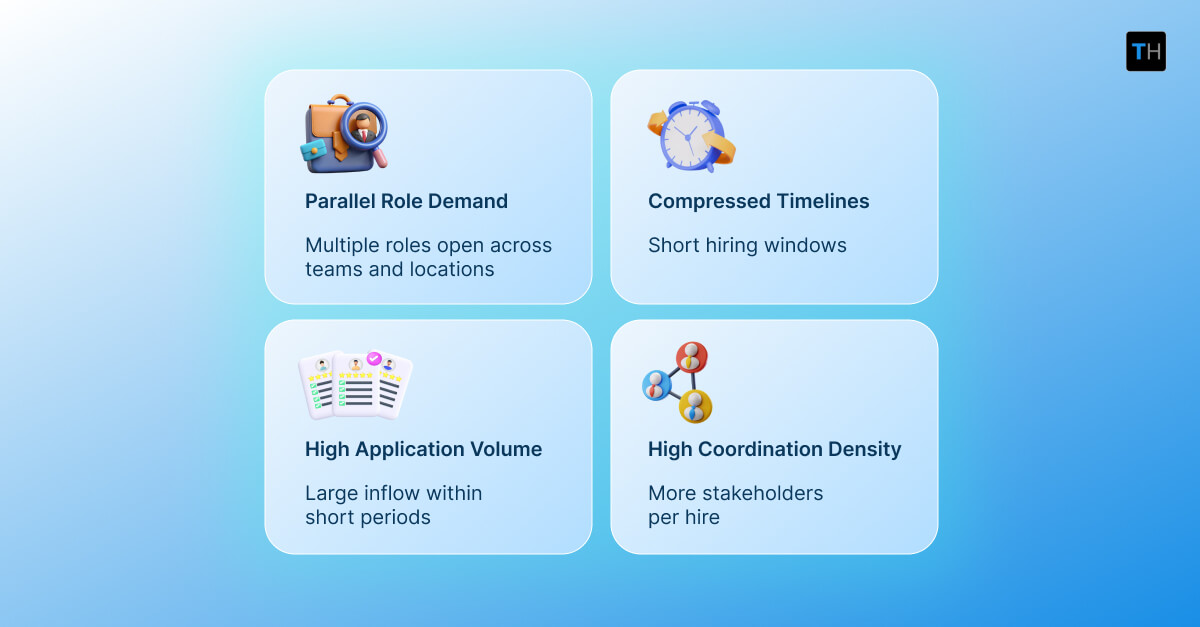
High-volume hiring is characterized by:
- Multiple roles open simultaneously across teams or locations
- Repeated or similar roles with tight hiring windows
- Large candidate inflow within compressed timelines
- High coordination density across recruiters, hiring managers, interviewers, and candidates
What makes high-volume hiring challenging is not the number of candidates alone. It is the number of parallel decisions and handoffs required to move candidates through the system without delay.
At low volume, teams compensate for inefficiencies with effort. Recruiters chase approvals, while managers make time. Context is shared haphazardly without a structure. These workarounds mask structural weaknesses.
At scale, those same weaknesses multiply. Coordination work grows faster than decision-making capacity. The system slows even though people work harder.
High-volume hiring is therefore not a sourcing problem or a recruiter capacity problem. It is a systems problem.
Why Traditional Hiring Processes Break Down at Scale
Traditional hiring processes were built for control, consistency, and risk mitigation. These goals made sense when hiring volumes were lower, and timelines were flexible. At scale, the same structures become constraints.
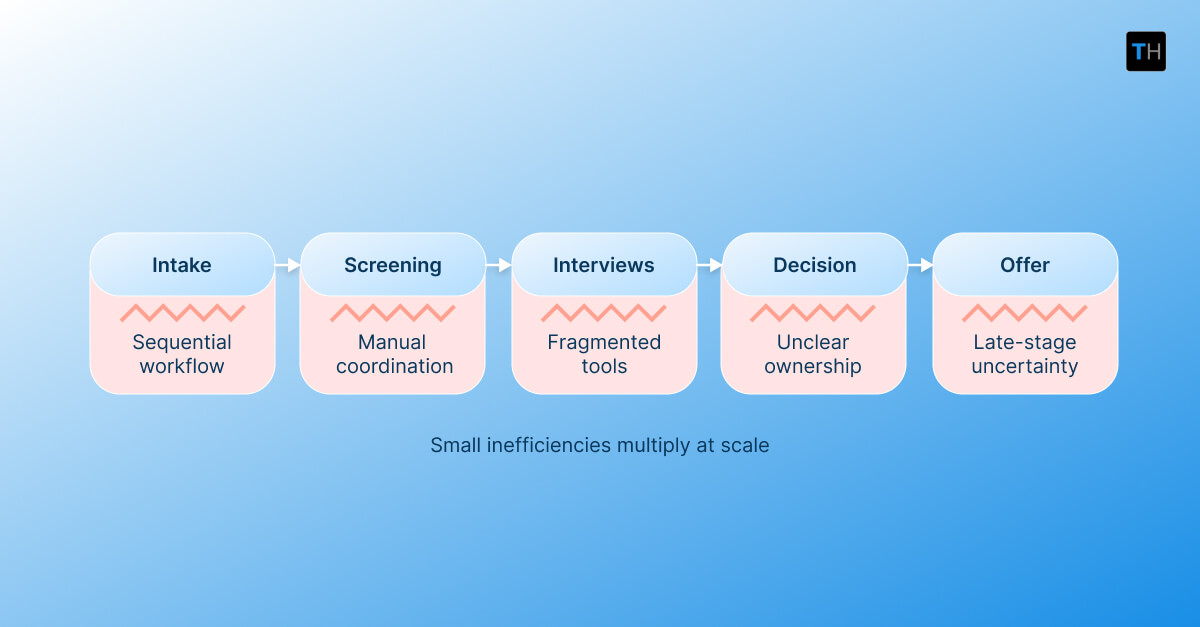
1. Sequential Process Design
Most traditional hiring workflows follow a linear sequence. One stage finishes before the next begins. Approvals are completed before sourcing ramps up. Interviews wait until the screening is fully done. Feedback is collected after all interviews conclude.
High-volume hiring does not operate in a linear environment. Screening, scheduling, interviews, and decision-making need to overlap to maintain momentum. Sequential designs introduce waiting time between stages, and those waits compound as volume increases.
2. Manual Coordination as an Operating Model
Recruiters play the role of coordinators in most hiring systems. Most recruiters spend just 28% of their time on actual recruiting. The rest goes to coordination, data entry, hiring manager alignment, meetings, and status updates. They align calendars, remind interviewers, track feedback, update candidates, and follow up on approvals. This model functions when hiring volume is limited. Recruiters manage 20 requisitions (median) to 50 (75th percentile) in organizations with dedicated recruiters.
As volume grows, coordination work expands faster than evaluative work. Recruiters spend more time managing logistics and less time improving hiring quality. Candidates experience delays that no one intended. Progress slows without a clear point of failure.
3. Fragmented Systems and Lost Context
Many hiring teams rely on multiple tools across sourcing, screening, interviews, and offers. Candidate information does not always move cleanly across these systems. Recruiters often re-enter data or reconcile updates manually. Decisions get revisited because information feels incomplete.
Each handoff introduces friction. Under high volume, that friction becomes systemic rather than occasional.
4. Interviews Used to Resolve Uncertainty
When early screening lacks structure or consistency, interviews are expected to compensate. Additional interview rounds are added. More stakeholders are brought in. Decisions take longer because confidence is built late in the process.
This increases interview load without improving clarity, which further slows hiring under pressure.
Common Failure Patterns in High-Volume Hiring
As pressure builds, several issues tend to appear together rather than independently.
Application volume increases faster than screening capacity. 43% of applicants drop off during early recruitment phases in high-volume hiring, often due to lengthy/complex applications and lack of mobile optimization. It results in the following problems:
- Recruiters struggle to prioritize effectively.
- Candidate communication becomes uneven across roles.
- Interview scheduling grows complex.
- Feedback arrives later than expected.
None of these problems stems from a lack of effort. They emerge because traditional systems rely on people to absorb friction from the process.
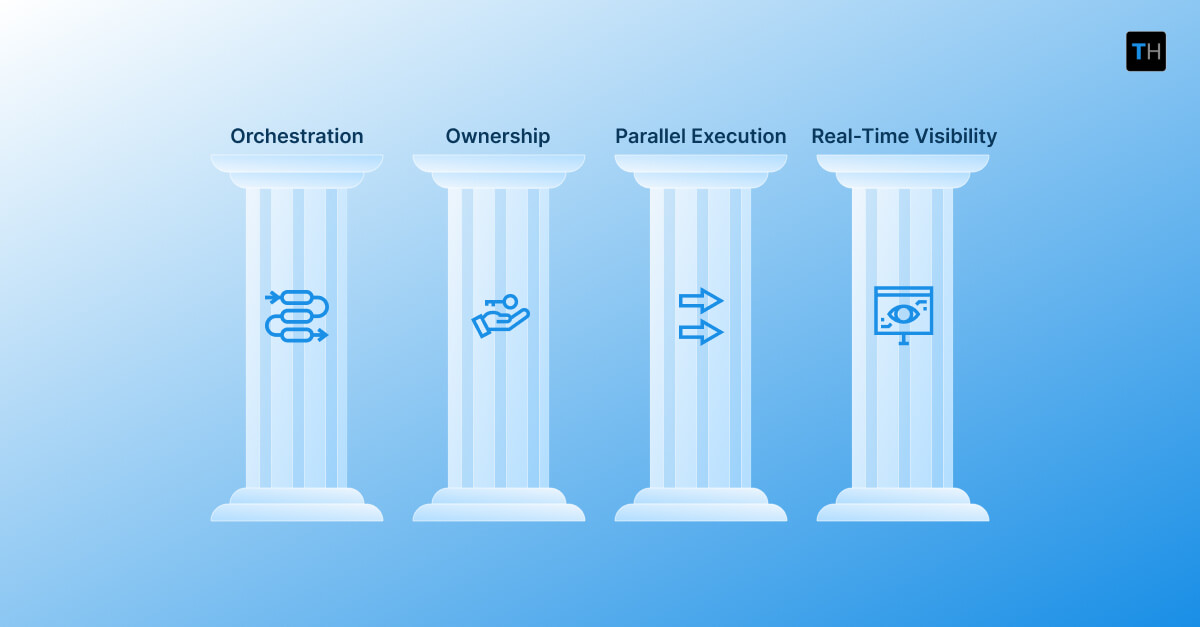
- End-to-end orchestration
In scalable high-volume hiring, individual stages cannot operate as standalone workflows. Requisition intake, sourcing, screening, interviews, decisions, and offers must function as parts of a single coordinated system.
Candidate context, evaluation criteria, and ownership need to move forward together so that each stage builds on the previous one.
Teams spend time re-explaining roles, re-validating candidates, and correcting misalignment, which compounds delays as volume increases because of a lack of structure.
- Clear decision ownership
Hiring velocity deteriorates when accountability is unclear. In high-volume environments, even small pauses caused by uncertainty around who owns a decision can cascade into significant delays.
Scalable systems define responsibility explicitly at every transition, including screening approvals, interview progression, and final decisions. This clarity ensures that candidates do not stall between stages and that progress does not depend on repeated follow-ups or informal escalation.
- Parallel execution
High-volume hiring cannot rely on strictly sequential processes. Screening, interview scheduling, feedback collection, and candidate communication need to operate concurrently wherever possible. Systems designed for parallel execution allow work to continue even when one component slows temporarily.
This design absorbs demand without increasing overall cycle time and prevents bottlenecks from forming simply because tasks are waiting on one another.
- Real-time visibility
Managing high-volume hiring requires continuous insight into how candidates are moving through the system. Teams need visibility into stage-level delays, aging candidates, and overloaded decision points.
Real-time data enables proactive intervention, such as reallocating recruiter capacity or addressing stalled approvals, before delays become systemic. Without this visibility, problems are discovered only after candidates disengage or hiring targets are missed.
The Role of Technology in High-Volume Hiring Systems
- Reducing coordination overhead
In high-volume hiring systems, technology creates the most value when it reduces the time and effort spent on coordination. Automated scheduling, reminders, approvals, and pipeline updates prevent candidates and stakeholders from waiting on manual follow-ups. By removing these delays, recruiters and hiring managers can focus their time on evaluation and decision-making rather than process management.
- Preserving context across hiring stages
Technology supports scale when candidate information, role context, and evaluation criteria remain intact as candidates move through the funnel. When context is preserved, teams do not need to re-interpret resumes, repeat screening logic, or revisit earlier decisions. This continuity becomes increasingly important as volume grows and more stakeholders are involved.
- Supporting human judgment rather than replacing it
Evaluation, feedback, and final hiring decisions require context, nuance, and accountability. Technology should not attempt to replace these responsibilities. Instead, it should create the conditions that allow better judgment by ensuring timely information, structured inputs, and clear next steps.
- Avoiding activity without throughput
When automation is introduced without orchestration, it often increases visible activity without improving results. Candidates move faster through isolated steps but still wait at handoffs. Recruiters appear busier, yet hiring throughput does not improve. High-volume hiring systems benefit only when automation is applied as part of an integrated workflow designed to maintain flow end to end.
QR Codes as an Entry Point in High-Volume Hiring

In many high-volume contexts, candidates encounter job opportunities offline or in motion. Retail locations, factory floors, campuses, transit hubs, events, and referral touchpoints often generate interest long before a candidate sits down at a computer.
QR codes have become a practical way to bridge this gap.
They allow candidates to move directly from a physical or contextual touchpoint into the hiring system with minimal friction. A scan leads to a mobile-optimized application or pre-screening flow. QR codes in recruitment increase candidate engagement by 8.4% compared to traditional ads by reducing application friction and enabling instant mobile access. There is no searching, no delayed intent, and no dependency on memory or follow-up.
This matters because high-volume hiring often depends on immediacy. Candidates who intend to apply later frequently do not return. Mobile-first hiring experience, be it via message-based applications or QR codes that redirect them to the job application and serve as reminders to finish their application. In addition, it is not unusual for blue-collar candidates to not have a resume, and it helps them if they have easy access to job applications.
QR codes contribute value only when they are connected to a system prepared to handle volume. When linked to structured intake, screening, and clear next steps, they improve application conversion without increasing downstream chaos.
QR codes go beyond being a hiring strategy. They act as an access layer. Their effectiveness depends entirely on the system behind them.
Designing Predictable High-Volume Hiring Frameworks
Predictability matters more than raw speed.
Organizations that scale hiring successfully focus on:
- Clear role definition at intake
- Structured interviews aligned to decision criteria
- Proactive talent pipelines
- Flexible workflows that absorb demand spikes
These choices reduce rework and protect recruiter capacity.
Measuring Hiring Performance at Scale
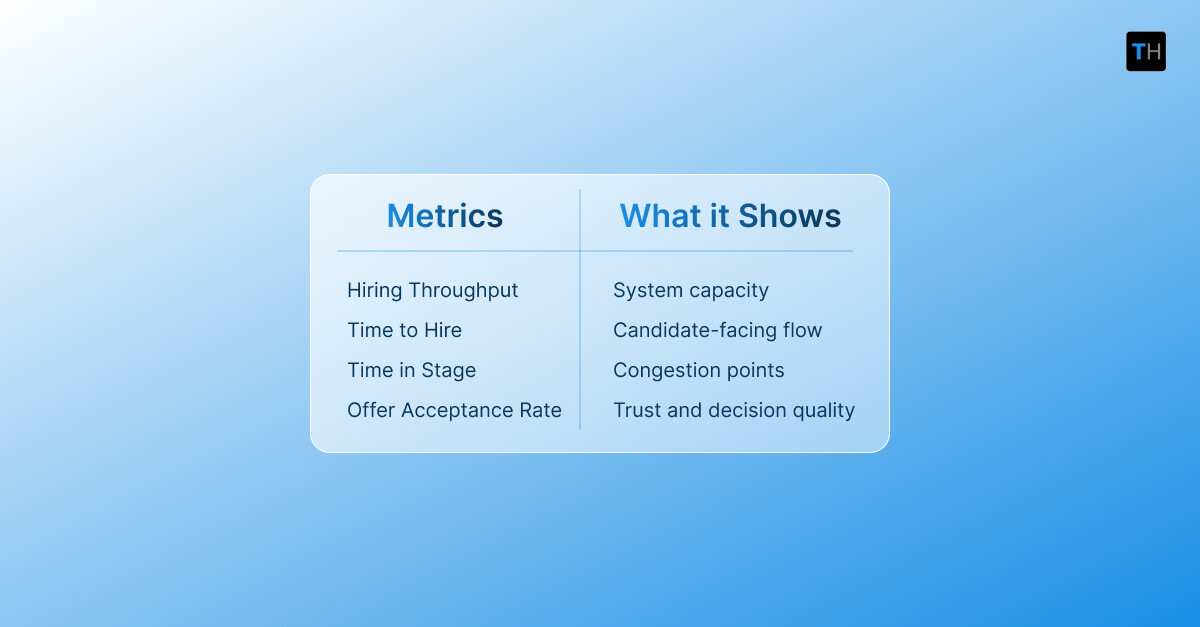
Metrics help diagnose system health. They do not fix problems on their own.
The most useful indicators include:
- Hiring throughput to understand system capacity
- Time to hire to track candidate-facing flow
- Time in stage to locate congestion
- Offer acceptance rate to assess decision quality and trust
Metrics should be reviewed together. Improvements in one metric that coincide with declines in others usually indicate pressure rather than progress.
Time to Hire as a System Outcome
Time to hire increases in high-volume hiring environments because coordination grows faster than decision-making.
Manual processes introduce delay at every transition. Feedback and scheduling become harder. Offers wait on approvals.
Automation improves time to hire when it removes coordination friction and allows stages to move in parallel. Structured workflows and prioritization help restore momentum without increasing strain on teams.
Ethical and Experience Risks at Scale
- Risk of transactional hiring: As hiring volume increases, candidates can be reduced to numbers moving through a funnel. When systems prioritize throughput over clarity, trust and credibility suffer.
- Fairness must scale with volume: High-volume hiring requires consistent evaluation criteria across roles and teams. Without structure, decisions vary by recruiter or manager, increasing bias and inconsistency.
- Relevance over speed: Faster cycles only work when candidates receive role-appropriate communication and assessment. Speed without relevance creates confusion and disengagement.
- Timely communication is non-negotiable: Delays in updates, feedback, or decisions erode candidate confidence quickly. At scale, small communication gaps compound into systemic drop-off.
- Candidate experience reflects system design: Experience does not deteriorate because teams move fast. It deteriorates when hiring systems lack structure, ownership, and clear handoffs.
- Ethics are embedded in process design: Fairness, transparency, and accountability depend on how workflows are designed. Ethical outcomes are a result of system choices, not individual intent.
Conclusion: High-Volume Hiring Tests System Design
High-volume hiring does not overwhelm teams by itself. It reveals whether a talent acquisition system was built to scale.
Traditional processes depend too heavily on manual coordination and linear workflows. Under pressure, these designs slow down even when teams work harder.
Organizations that design for orchestration, ownership, and visibility hire more predictably at scale. High-volume hiring becomes manageable when the system carries the load instead of relying on individual effort.
TurboHire supports high-volume talent acquisition by enabling end-to-end hiring systems that reduce coordination overhead and preserve decision quality as organizations grow.
Frequently Asked Questions
1. What is high-volume hiring?
High-volume hiring refers to recruiting a large number of candidates within a short period, often for similar or operational roles. It is common in industries such as retail, manufacturing, logistics, customer support, and seasonal staffing. Success depends on system design rather than individual recruiter effort.
2. Why do traditional hiring processes fail at scale?
Traditional hiring processes rely heavily on manual coordination, sequential workflows, and fragmented tools. As volume increases, these approaches create delays, inconsistent decision-making, and recruiter overload.
3. How does technology support high-volume hiring without reducing quality?
Technology supports quality when it removes coordination work and preserves context across hiring stages. Automation handles scheduling, reminders, approvals, and pipeline updates, while recruiters and hiring managers focus on evaluation and decisions. This balance allows scale without sacrificing judgment.
4. What metrics matter most in high-volume hiring systems?
Key metrics include time to hire, hiring throughput, offer acceptance rate, and candidate drop-off rate. These metrics help leaders understand whether the hiring system can absorb demand without breaking, rather than simply measuring recruiter activity.
5. Is automation enough to fix high-volume hiring challenges?
Automation alone is not sufficient. It improves outcomes only when applied as part of an integrated talent acquisition system. Automation increases activity but does not improve flow, decision speed, or hiring throughput without orchestration.