

Talent acquisition has evolved from a hiring function into a core business system. As organizations scale, expand into new markets, and compete for increasingly specialized talent, fragmented recruitment processes are no longer sufficient.
Today, hiring success depends on how well organizations design, manage, and optimize their end-to-end talent acquisition system. This guide explains what such a system looks like, why it matters, how it differs from traditional recruitment, and how enterprises can build one that delivers measurable outcomes.
What Is Talent Acquisition?
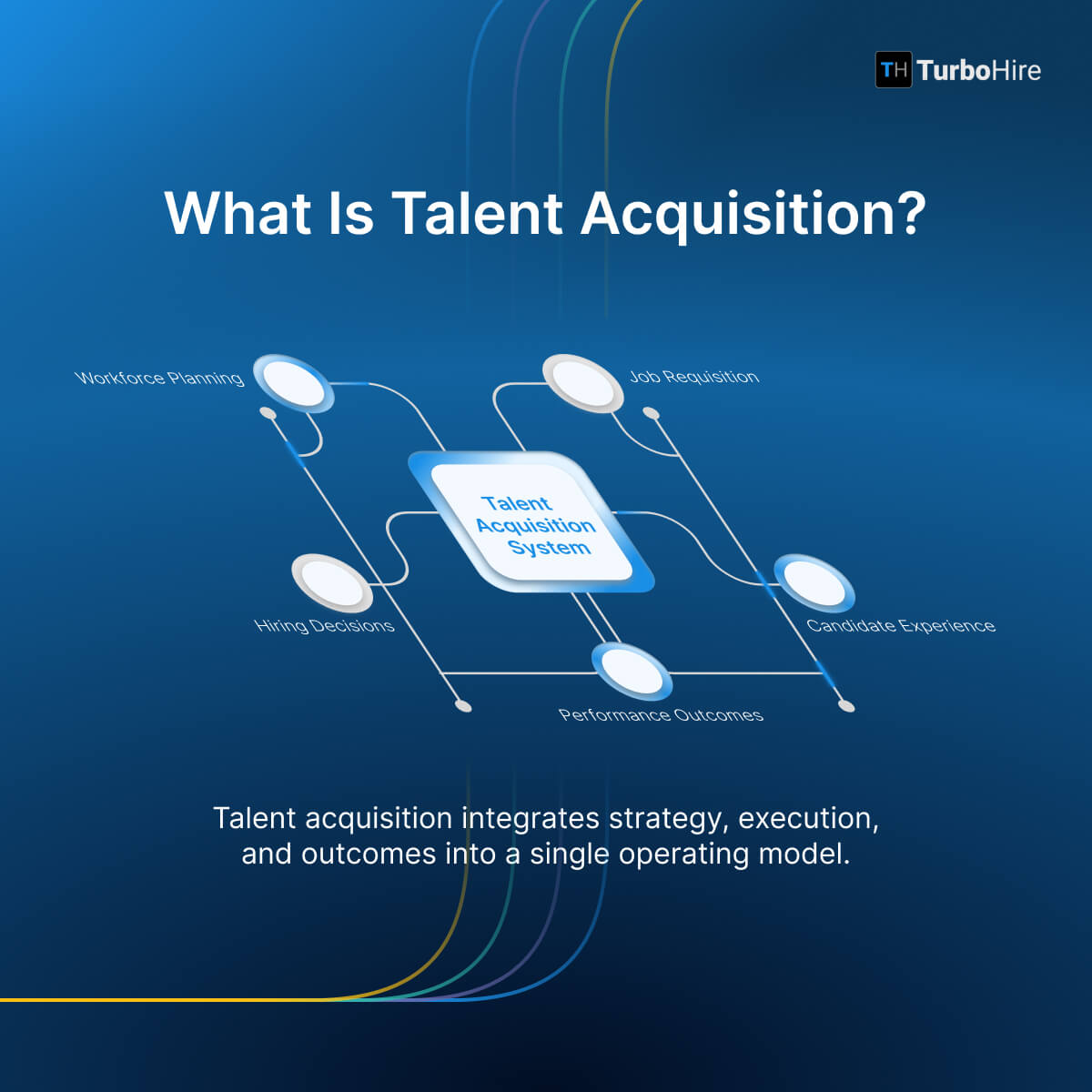
Talent acquisition is a strategic, continuous process for identifying, attracting, evaluating, hiring, and enabling talent in alignment with long-term business objectives.
Talent acquisition operates at a system level. It integrates workforce planning, hiring strategy, candidate experience, decision-making frameworks, and performance outcomes into a single operating model.
A modern talent acquisition system is designed to:
- Scale across teams, roles, and geographies
- Support consistent and high-quality hiring decisions
- Balance speed, experience, and business impact
Benefits of a Strong Talent Acquisition System
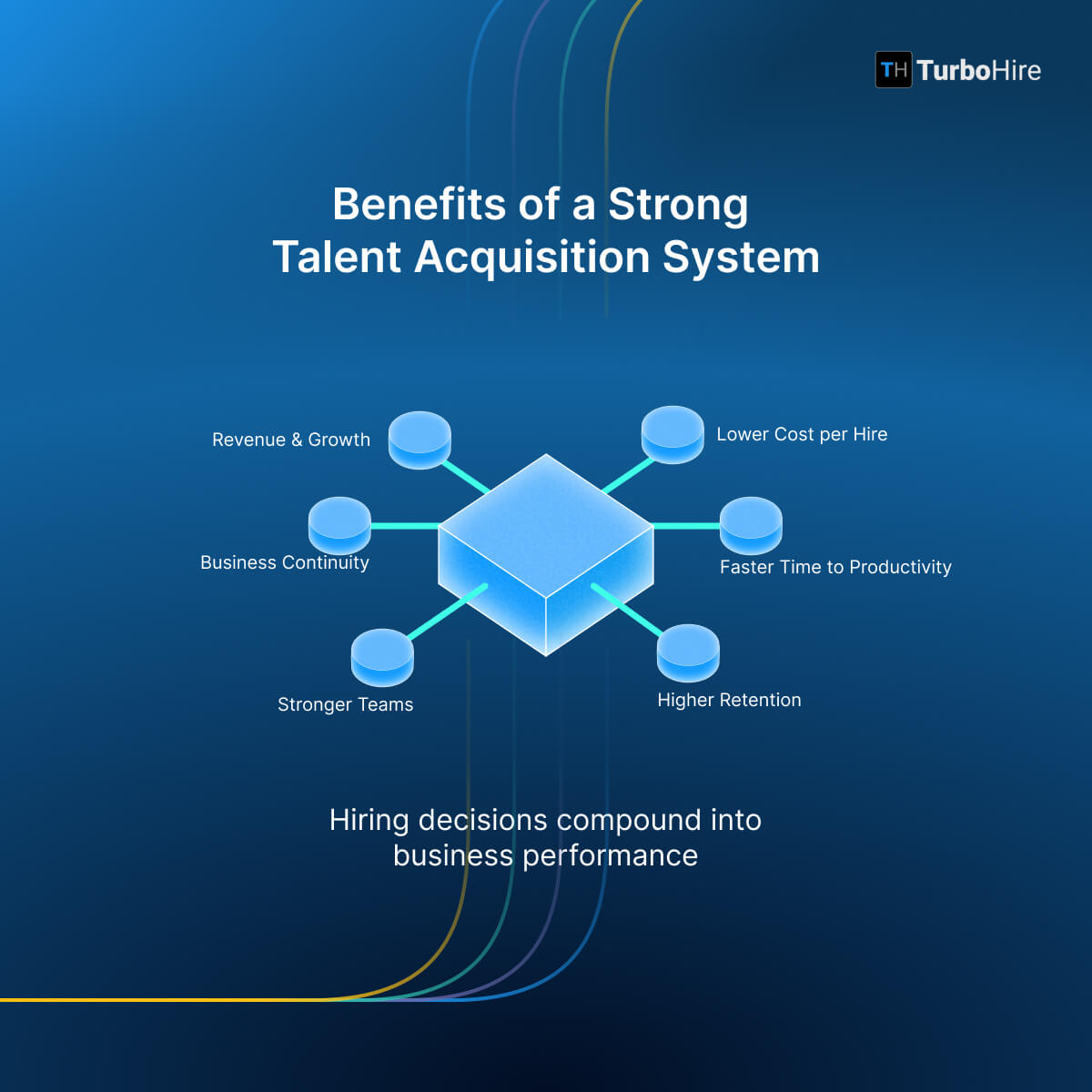
Hiring outcomes directly influence organizational performance. Delays, poor hiring decisions, and inconsistent processes create compounding costs across teams. In 2025, 76% of employers report difficulty filling roles, it is a near-record level of talent scarcity globally.
An effective talent acquisition system enables the following outcomes:
1. Attracting High-Quality Talent
High-quality candidates make decisions quickly and based on signals. Speed, clarity, and experience are no longer differentiators. They are expectations. More than half of candidates (53% in 2025) report encountering misleading hiring practices, and 34% feel ghosted after just one week in the process.
A structured talent acquisition system reduces ambiguity at every stage of the candidate journey. Roles are clearly defined. Interview stages are transparent. Timelines are predictable. Communication is consistent.
This clarity builds trust. Candidates understand what success looks like and how decisions will be made. As a result, organizations see higher application-to-interview conversion, lower candidate drop-off, and stronger engagement from in-demand talent.
Attracting high-quality talent today is less about employer branding campaigns and more about operational credibility.
2. Reducing Hiring Costs
Inefficient processes and poorly informed decisions increase hiring costs.
Manual coordination, duplicated effort, and prolonged hiring cycles inflate recruiter time, interviewer hours, and sourcing expenses. Poor-fit hires compound these costs by triggering rehiring, onboarding repetition, and productivity loss. The average cost per hire is $4,683, while executive hires cost an average of $28,329, demonstrating how inefficiencies compound costs at senior levels.
Automation and standardization address these issues directly. Repetitive tasks are removed. Decision-making becomes structured. Bottlenecks are visible and resolved earlier.
Organizations reduce cost per hire not by spending less on talent, but by wasting less effort across the hiring lifecycle.
3. Improving Retention and Performance
Employee churn is often a hiring problem, not an employee problem.
Candidates accept offers based on incomplete expectations when roles are vaguely defined or assessments are inconsistent. The result is misalignment that surfaces within the first year.
Here’s how ClearTax improved its hiring performance.
A strong talent acquisition system emphasizes role clarity, structured evaluations, and evidence-based decisions. Candidates are assessed against real success criteria instead of subjective impressions.
This leads to better role fit, faster ramp-up, and stronger first-year performance. Retention improves not because employees are incentivized to stay, but because they were hired correctly in the first place.
4. Building High-Performing Teams
Consistency in hiring standards ensures that each new hire complements existing team dynamics rather than disrupting them. Skills, behaviors, and potential are evaluated against shared benchmarks.
Here’s how Accel improved its no code recruitment automation
Over time, this consistency compounds. Teams develop shared expectations. Collaboration improves. Managers spend less time correcting misalignment and more time enabling performance.
A talent acquisition system that prioritizes team-level outcomes moves hiring beyond individual roles and toward organizational capability building.
5. Reducing Bias and Promoting Meritocracy
Bias sneaks into hiring through unstructured processes and subjective decision-making. Only 34–37% of organizations use structured interviews, while unstructured interviews remain common across roles.
Decisions become influenced by familiarity, recency, or personal preference when interviews lack consistent criteria or feedback is loosely captured. This undermines both fairness and hiring quality.
Systematic evaluation introduces structure without removing human judgment. Clear criteria, standardized assessments, and documented feedback create a level playing field for candidates.
The result is a hiring process where decisions are based on merit and evidence. Diversity outcomes improve naturally when evaluation is consistent and transparent.
6. Ensuring Business Continuity
Reactive hiring creates vulnerability.
Organizations expose themselves to delays, missed opportunities, and operational strain when they hire only in response to immediate gaps. Critical roles remain open longer. Teams operate understaffed.
A mature talent acquisition system enables proactive workforce planning. Pipelines are built ahead of demand. Hiring priorities are aligned with business forecasts.
This predictability ensures continuity. Teams are staffed on time. Growth plans are supported rather than constrained by hiring delays.
7. Enabling Succession Planning
Succession planning is ineffective without visibility into talent readiness. In fact, only 16% of non-executive roles and 23% of executive roles are filled internally.
Strong talent acquisition systems create structured data around roles, performance expectations, and skill gaps. This visibility helps organizations identify internal talent capable of stepping into future leadership roles.
External hiring decisions are also informed by long-term succession needs rather than short-term urgency.
Organizations reduce reliance on last-minute external hires and build sustainable leadership pipelines by keeping leadership development in mind when making hiring decisions.
8. Driving Business Growth
Hiring decisions shape how fast an organization can execute its strategy. With average time-to-hire extending to about 50 days, slow hiring directly impacts execution speed and revenue realization.
Execution slows when critical roles remain open or are filled with poor-fit candidates. Product roadmaps slip. Sales capacity is constrained. Operational teams operate below potential. These delays translate directly into lost revenue and missed market opportunities.
A strong talent acquisition system improves both hiring velocity and hiring quality. Roles are approved faster. Interview cycles move with clarity. Decisions are made with confidence. High-impact candidates enter the organization when they are needed, not months later.
Quality hiring also fuels innovation. Teams staffed with the right skills and perspectives are better positioned to experiment, solve complex problems, and adapt to market change. Over time, this compounds into a sustained competitive advantage. 72% of organizations offer skills training, but critical skills like leadership (78%), problem-solving (67%), and data analytics (54%) remain in high demand.
Organizations that treat talent acquisition as growth infrastructure do not view hiring as a support activity. They view it as a strategic accelerator of revenue, execution, and innovation.
Talent Acquisition vs Recruitment
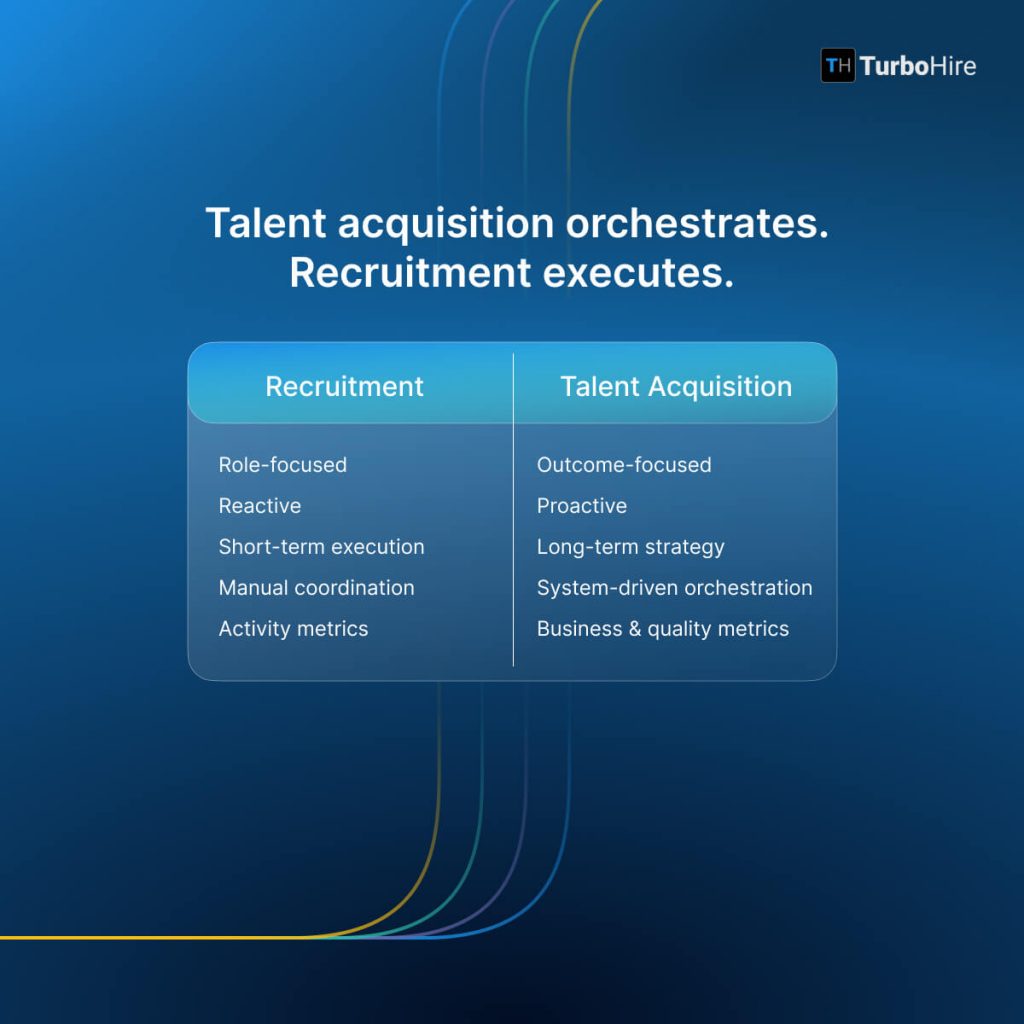
Recruitment plays a critical role in meeting immediate hiring needs, but it is inherently transactional. It responds to open positions, focuses on short-term execution, and often operates under time pressure. Recruitment tends to optimize for speed alone, sometimes at the expense of decision quality, candidate experience, and long-term fit.
Talent acquisition takes a fundamentally different approach. It views hiring as a continuous system that must function reliably over time. Talent acquisition aligns hiring activity with broader business outcomes such as team productivity, retention, leadership readiness, and growth velocity.
The distinction becomes most visible at scale. As organizations grow, manual coordination between recruiters, hiring managers, and interviewers becomes a constraint. Delays in approvals, interview scheduling, and feedback collection accumulate quickly.
A talent acquisition system replaces ad hoc coordination with structured workflows and clear ownership to ensure that hiring remains predictable even as volume and complexity increase.
Their respective metrics differ as well. Recruitment often tracks activity-based measures such as the number of applications or interviews completed. Talent acquisition prioritizes metrics that reflect impact, including time to productivity, first-year retention, and hiring quality. These metrics help organizations understand whether hiring decisions are strengthening the business rather than simply closing requisitions.
Recruitment remains an essential execution layer. However, without an overarching talent acquisition system, it cannot consistently deliver outcomes at scale. Talent acquisition provides the structure, visibility, and accountability required to transform recruitment from a reactive function into a strategic capability.
High-performing organizations do not choose between recruitment and talent acquisition. They embed recruitment within a broader talent acquisition framework that ensures hiring decisions are repeatable, measurable, and aligned with long-term business goals.
Recruitment addresses immediate hiring needs. Talent acquisition builds a repeatable system that delivers consistent results over time.
How Talent Acquisition Fits Within Human Resources
Talent acquisition functions as the execution layer of HR strategy. It translates workforce planning and leadership intent into tangible hiring outcomes.
It operates across multiple stakeholders:
- HR leadership and TA teams
- Hiring managers and business leaders
- Finance and workforce planning teams
- Candidates and new hires
A well-defined talent acquisition system ensures a holistic approach to hiring.
Most organizations do not operate with a single talent strategy. Business conditions change, skill requirements evolve, and workforce needs fluctuate. As a result, enterprises rely on a combination of approaches to ensure they have the right talent at the right time.
A mature talent acquisition system supports multiple strategies simultaneously, removing fragmentation or operational blind spots.
Core Talent Acquisition Strategies
Most organizations rely on a combination of strategies depending on the business context:
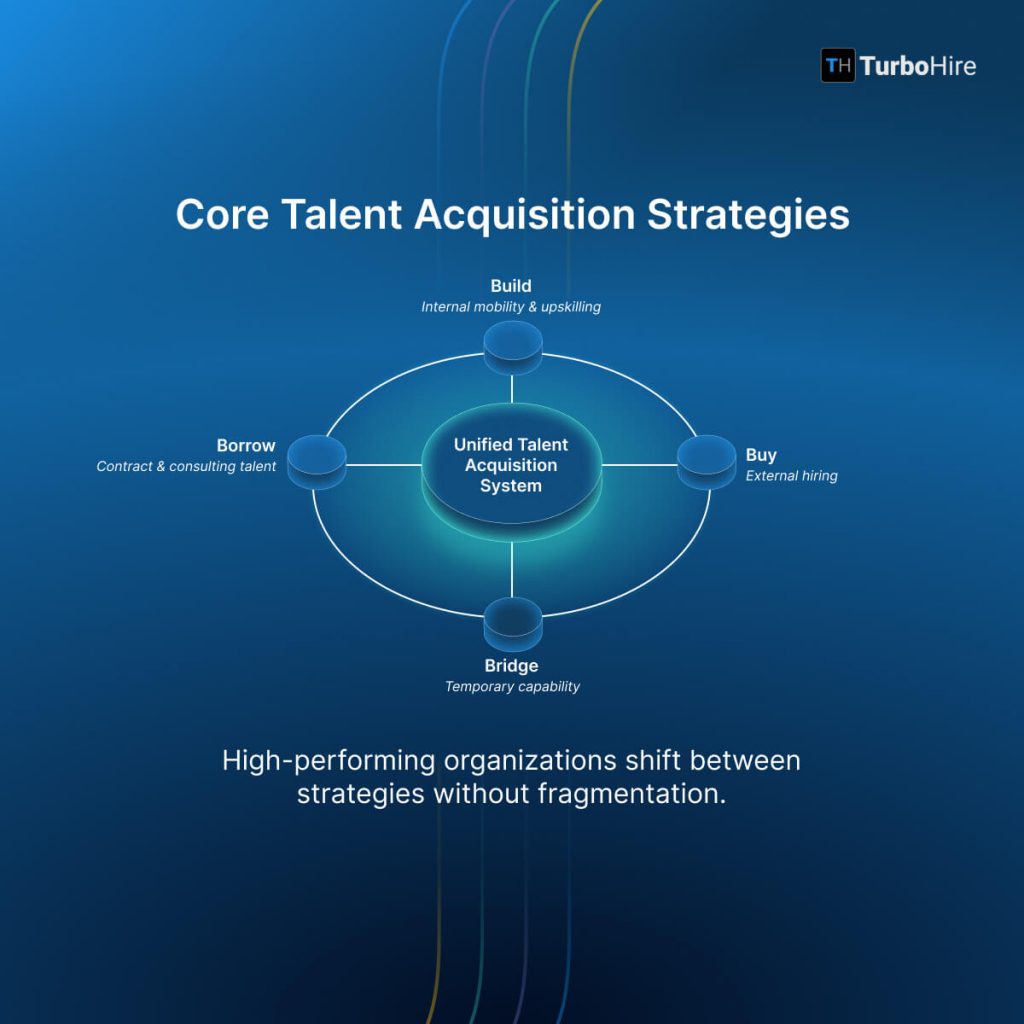
1. Build
The “build” strategy focuses on developing internal talent through upskilling, internal mobility, and leadership development programs. It is used for roles where institutional knowledge, cultural alignment, and long-term capability are critical.
Effective internal hiring requires visibility into employee skills, performance, and potential. Internal mobility becomes informal and opaque, leading to missed opportunities and disengagement without structure. A strong talent acquisition system enables internal candidates to be evaluated with the same rigor and transparency as external applicants, ensuring fairness and clarity.
2. Buy
The “buy” strategy involves hiring external talent to meet immediate business needs or acquire capabilities that do not yet exist internally. This approach is essential during periods of rapid growth, market expansion, or technological change.
External hiring demands speed without sacrificing quality. A structured talent acquisition system ensures that sourcing, assessment, and decision-making remain consistent even when timelines are compressed. It also helps organizations balance urgency with long-term fit.
3. Bridge
The “bridge” strategy is used when organizations need immediate expertise while developing internal capability over time. This may include interim roles, project-based hires, or fixed-term positions.
Bridging requires careful coordination. A mature talent acquisition system provides visibility into timelines, expectations, and handoff points.
4. Borrow
The “borrow” strategy involves engaging contractors, consultants, or external partners for specialized or short-term needs. This approach offers flexibility and access to niche expertise without long-term headcount commitments.
Managing borrowed talent alongside full-time employees requires consistent evaluation, onboarding, and governance. A unified talent acquisition framework ensures that even non-permanent hires are aligned with role expectations, performance standards, and compliance requirements.
Why Supporting All Four Strategies Matters
Relying on a single talent strategy exposes organizations to risk. Over-indexing on external hiring increases cost and attrition. Over-reliance on internal development can slow innovation. Excessive dependence on temporary talent creates knowledge gaps.
A well-designed talent acquisition system allows organizations to:
- Shift between strategies as business needs evolve
- Maintain consistency in evaluation and decision-making
- Gain visibility across all talent inflows
- Make informed trade-offs between speed, cost, and long-term capability
Talent acquisition becomes a strategic control system rather than a reactive function by incorporating build, buy, bridge, and borrow within a single framework.
Key Metrics in Talent Acquisition
Measuring talent acquisition effectiveness requires metrics that reflect outcomes, not just activity.
1. Candidate and Employee Experience
1. Candidate Net Promoter Score (cNPS)
Measures how candidates perceive the hiring experience and whether they would recommend it to others. It is a strong indicator of employer credibility and process efficiency.
How to calculate Candidate Net Promoter Score (cNPS)
% of Promoters (score 9–10) − % of Detractors (score 0–6)
2. Employee Net Promoter Score (eNPS)
Reflects how likely employees are to recommend the organization as a place to work, indicating alignment between hiring expectations and reality.
How to calculate Employee Net Promoter Score (eNPS)
% of Promoters − % of Detractors
3. Offer Acceptance Rate
Indicates how compelling and well-aligned offers are with candidate expectations. Low rates often point to delays, misaligned roles, or compensation issues.
How to calculate the Offer Acceptance Rate
(Number of offers accepted ÷ Number of offers made) × 100
2. Speed and Efficiency
1. Time to Fill
Measures how long it takes to close a role, reflecting overall hiring efficiency and pipeline effectiveness. The average time-to-fill is 54 days for non-executive roles and 62 days for executive roles, with some organizations taking up to 90 days.
How to Calculate Time to Fill
Number of days from job requisition approval to offer acceptance
2. Time to Hire
Captures the candidate-facing speed of the hiring process and directly impacts candidate experience. In fact, only 11% of organizations track candidate satisfaction, despite experience being strongly correlated with offer acceptance.
How to Calculate Time to Hire
Number of days from candidate application or sourcing to offer acceptance.
3. Recruiter Efficiency
Evaluates recruiter productivity by linking output to effort, helping optimize workload and resource allocation.
How to calculate Recruiter Efficiency:
Number of hires made ÷ Number of recruiters (over a defined period)
4. Time to Productivity
Measures how quickly new hires reach expected performance levels, indicating hiring quality and onboarding effectiveness.
How to calculate Time to Productivity:
Number of days from start date to achieving predefined performance benchmarks
3. Quality and Retention
1. First-Year Turnover
Highlights early attrition caused by poor role fit, misaligned expectations, or weak assessment processes.
How to calculate First-Year Turnover
(Number of employees who leave within 12 months ÷ Total hires in the same period) × 100
2. Employee Retention Rate
Shows how well the organization retains talent over time and reflects long-term hiring and engagement success.
How to Calculate Employee Retention Rate
((Employees at end of period − New hires during period) ÷ Employees at start of period) × 100
3. Attrition and Churn
Measures the overall rate at which employees leave the organization, voluntary or involuntary.
How to Calculate Attrition and Churn
(Number of employees who left during period ÷ Average number of employees) × 100
4. Sourcing Channel
a. Sourcing Channel Effectiveness
Assesses which hiring channels deliver the best quality and conversion outcomes.
How to Calculate Sourcing Channel Effectiveness
Number of successful hires from a channel ÷ Total candidates sourced from that channel
b. Sourcing Channel Cost
Evaluates the cost efficiency of each sourcing channel to inform budget allocation.
How to Calculate Sourcing Channel Cost
Total spend on a sourcing channel ÷ Number of hires from that channel
The End-to-End Talent Acquisition Process
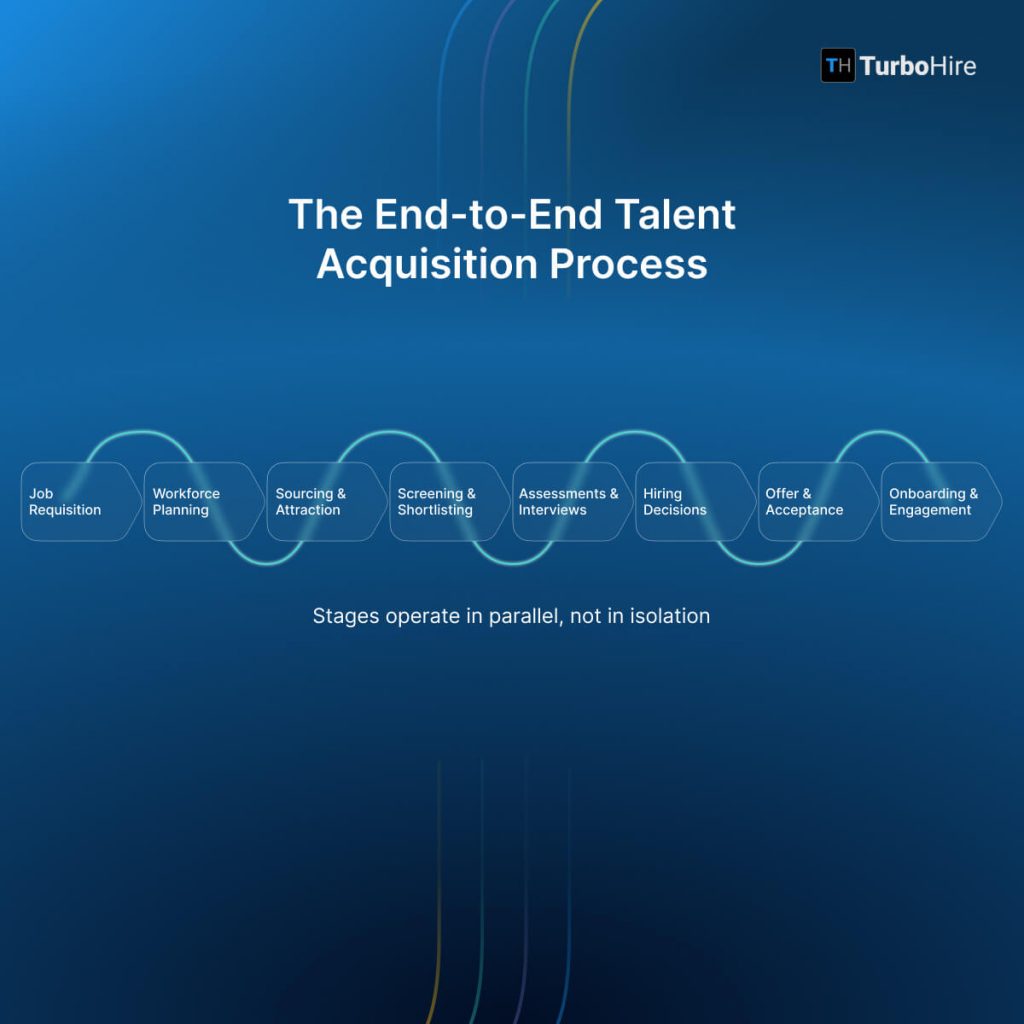
A comprehensive talent acquisition system supports the full hiring lifecycle while allowing multiple stages to operate in parallel. This ensures speed and coordination without sacrificing decision quality. According to a SHRM report, this is how long it takes an organization to hire someone.
For instance,
Requisition open → approved: 19 days (average)
Interviews alone take: 9 days
Final decision + offer: 6 days
Offer to acceptance: 4 days
1. Job requisition and role definition
This stage establishes clarity around the business need, role responsibilities, and success criteria. Well-defined requisitions align stakeholders early and prevent downstream confusion. The median recruiter demonstrates responsibility for 20 requisitions per year, with some handling 50+, making manual coordination unsustainable at scale.
2. Workforce planning and hiring strategy
Hiring priorities are aligned with business goals, timelines, and capacity planning. This ensures resources are allocated effectively, and roles are filled proactively rather than reactively.
3. Candidate sourcing and attraction
Candidates are identified and engaged through multiple channels, including internal talent pools and external sources. A strong employer value proposition and targeted outreach improve conversion.
4. Screening and Shortlisting
Applications are evaluated against structured criteria to identify candidates who best match role requirements. This stage reduces noise and ensures interview time is spent on high-quality profiles.
5. Structured assessments and interviews
Candidates are assessed using consistent frameworks and interview structures. This improves comparability, reduces bias, and strengthens hiring decisions.
6. Hiring decisions and approvals
Decisions are made with clear accountability and visibility. Structured approvals ensure speed while maintaining governance and alignment.
7. Offer management and acceptance
Offers are created, approved, and communicated efficiently. Clear timelines and transparency improve acceptance rates and candidate confidence.
8. Onboarding and early engagement
New hires are transitioned smoothly into the organization. Early engagement and clarity on expectations accelerate productivity and improve retention.
Features to Look for on a Talent Acquisition Platform
Talent acquisition platforms should function as core infrastructure rather than isolated tools.
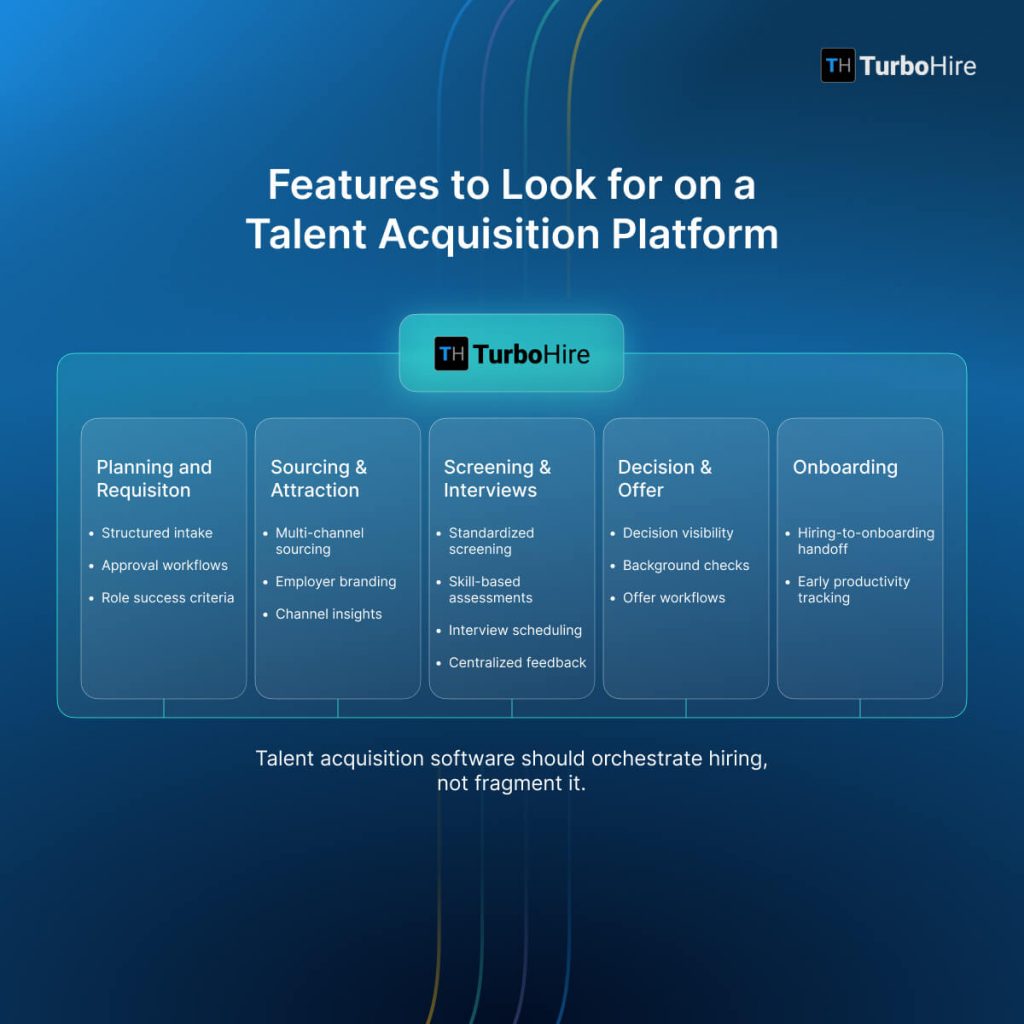
1. Planning and Requisition Management
1. Structured vacancy intake
Ensures roles are defined consistently with a clear business context, reducing ambiguity and misalignment across stakeholders.
2. Approval workflows
Standardized approvals provide governance without delays, ensuring accountability while maintaining hiring velocity.
3. Clear role success criteria
Defines measurable outcomes for the role, enabling more accurate screening, assessment, and decision-making.
2. Candidate Attraction and Sourcing
1. Multi-channel sourcing
Expands reach across internal and external channels, ensuring access to diverse and relevant talent pools.
2. Employer branding support
Communicates role clarity and organizational value to candidates, improving engagement and conversion rates.
3. Channel performance insights
Provides visibility into which sourcing channels deliver quality hires, enabling data-driven budget and strategy decisions.
3. Screening, Assessment, and Interviews
1. Standardized screening workflows
Applies consistent evaluation criteria to reduce noise, bias, and variability in early-stage candidate assessment. Only 27% of organizations use automated pre-screening tools, indicating widespread reliance on manual screening processes.
2. Skill-based assessments
Evaluates candidates against job-relevant skills, improving hiring quality and role fit.
3. Automated interview scheduling
Eliminates coordination delays by aligning interviewer and candidate availability efficiently.
4. Centralized feedback and evaluation
Captures structured feedback in one place, improving comparability and decision readiness.
4. Decision and Offer Management
1. Hiring decision visibility
Provides real-time clarity on decision status, ownership, and next steps to prevent bottlenecks.
2. Background verification
Ensures compliance and risk mitigation through structured verification workflows.
3. Offer creation and acceptance workflows
Streamlines offer generation, approvals, and communication to improve speed and acceptance rates.
5. Onboarding and Transition
1. Seamless handoff from hiring to onboarding
Ensures continuity of information and expectations as candidates become employees.
2. Engagement and productivity tracking
Monitors ramp-up progress to identify gaps early and accelerate time to productivity.
Skills Required for Modern Talent Acquisition Teams
Talent acquisition professionals today require a broader skill set than traditional recruiters.
Key capabilities include:
- Hiring judgment and structured decision-making
- Stakeholder management and coordination
- Data literacy and metric interpretation
- Process design and optimization
- Effective use of AI-assisted hiring tools
- Focus on outcomes rather than activity volume
Building an End-to-End Talent Acquisition System with TurboHire
TurboHire enables organizations to manage the complete talent acquisition lifecycle from job requisition to offer acceptance within a unified system.
Here’s how TurboHire helped Springer Nature build an end to end automation talent acquisition system
Built for enterprise-scale hiring, TurboHire supports complex workflows, multiple stakeholders, and high-volume hiring needs.
As an AI-native platform, TurboHire incorporates:
- Generative AI to support role clarity, screening, and hiring workflows
- Agentic AI to automate coordination, scheduling, and repetitive operational tasks
This allows teams to improve speed and efficiency while preserving human judgment in hiring decisions.
Conclusion: Talent Acquisition as a Strategic Advantage
Talent acquisition is no longer a supporting function. It is a strategic system that directly impacts organizational performance.
Organizations that invest in end-to-end talent acquisition infrastructure benefit from faster execution, better hiring decisions, and stronger teams. Those that rely on fragmented processes continue to face delays, inconsistencies, and rising costs.
Building a modern talent acquisition system is not about adding more tools. It is about designing a system that aligns hiring with business outcomes at scale.
TurboHire empowers organizations to create end-to-end talent acquisition systems that can scale and sustain.
Frequently Asked Questions (FAQs)
1. What is an end-to-end talent acquisition system?
An end-to-end talent acquisition system manages the complete hiring lifecycle—from job requisition and workforce planning to hiring decisions, offer acceptance, and onboarding. It connects strategy, execution, data, and technology to deliver consistent hiring outcomes at scale.
2. How is talent acquisition different from recruitment?
Recruitment focuses on filling immediate vacancies, while talent acquisition is a long-term, strategic system aligned with business outcomes. Recruitment is transactional and reactive. Talent acquisition is proactive, system-driven, and measured by hiring quality, retention, and time to productivity.
3. Why is talent acquisition critical for business growth?
Hiring velocity and hiring quality directly impact execution speed, innovation, and revenue growth. Delays or poor hiring decisions slow teams down, constrain capacity, and lead to missed market opportunities. Strong talent acquisition systems enable organizations to scale effectively.
4. What are the most important metrics in talent acquisition?
Key talent acquisition metrics include time to hire, time to fill, candidate Net Promoter Score (cNPS), offer acceptance rate, first-year turnover, time to productivity, and sourcing channel effectiveness. These metrics focus on outcomes rather than activity volume.
5. How does technology improve talent acquisition?
Technology improves talent acquisition by automating repetitive tasks, enabling structured workflows, and providing visibility across stakeholders. AI-enabled platforms further enhance speed, consistency, and decision quality while preserving human judgment.