

Candidate experience in hiring is often treated as a branding concern. Many organizations focus on communication tone, employer reputation, or interface design. But candidate experience usually reflects something much deeper. It reflects how well the hiring process is designed inside the talent acquisition system.
Candidates struggle to understand what the job responsibilities actually are when the definitions of roles are murky. Interview stages ought to be structured properly to keep them engaged. Taking your own sweet time for decisions will only create trust issues at the candidate’s end.
Research shows that 58% of candidates say a positive recruitment process increases their likelihood of accepting an offer. At the same time, 72% of candidates who have a poor experience share it publicly or with someone in their network. These are not surface-level branding issues. They are measurable business outcomes.
Candidate experience is a signal that conveys to the organizations whether their hiring system is working as intended.
Read eBook: Hiring in the Age of AI: What Actually Determines Hiring Speed
What Candidate Experience Really Reflects
Candidate experience is shaped by the hiring process’ consistency. It usually comes down to three things: clarity, consistency, and flow.
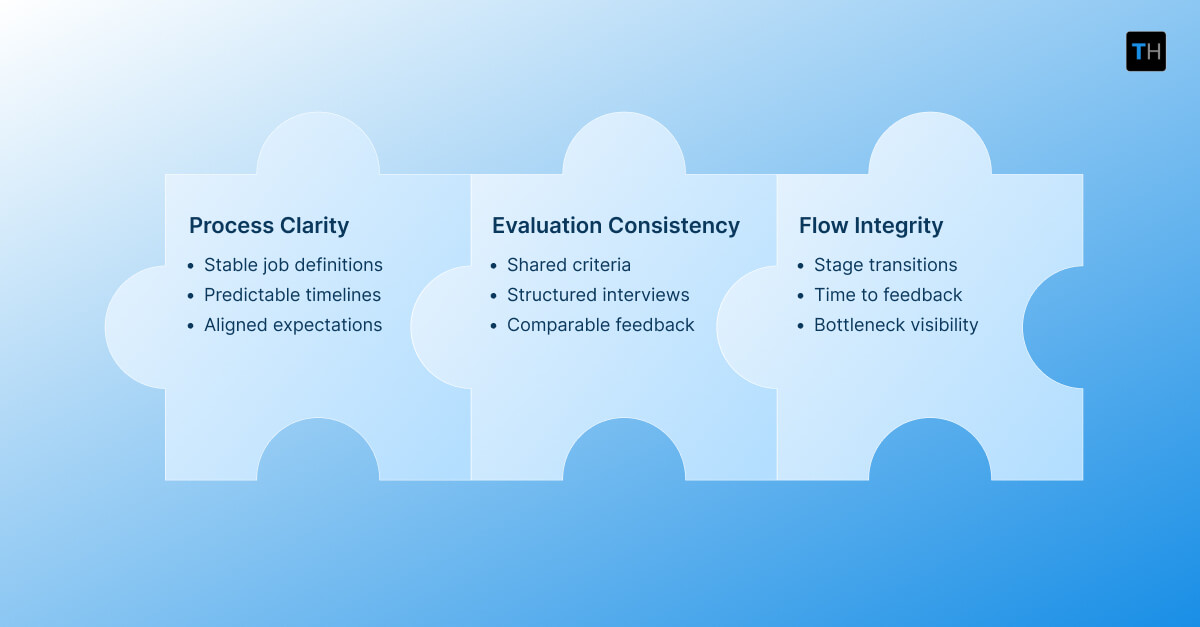
1. Process Clarity
Candidates want to understand what they are stepping into.
Confusion is bound to set in if the job description does not match the interview conversations. Their confidence in the organization takes a hit if the expectations change halfway through the process. Vague timelines will make the candidates assume that the process lacks direction.
Clear role definitions and predictable next steps create stability. That stability shows up as a better candidate experience.
2. Evaluation Consistency
Candidates notice when interviewers are aligned. They also notice when they are not.
The conversations are disconnected if each interviewer focuses on a different set of priorities without shared criteria and common fundamentals of what they are looking for in a candidate. Feedback may appear contradictory. Decisions seem delayed because stakeholders are not evaluating against the same standards.
In structured talent acquisition systems, evaluation criteria are defined before interviews begin.
3. Flow Integrity
Candidate experience also reflects how smoothly people move through the process. Time to feedback, predictability, transitions, feedback speed, and predictability matter.
Candidates feel the friction when they experience the bumps, but the organizations seem to be unaware of it. Even if the organizations are aware of it, it doesn’t matter to candidates as their priority is to have a smooth experience rather than empathizing with your internal issues.
Consistent discipline inside the hiring system shows up externally as responsiveness and momentum.
Why Candidate Experience Breaks Down
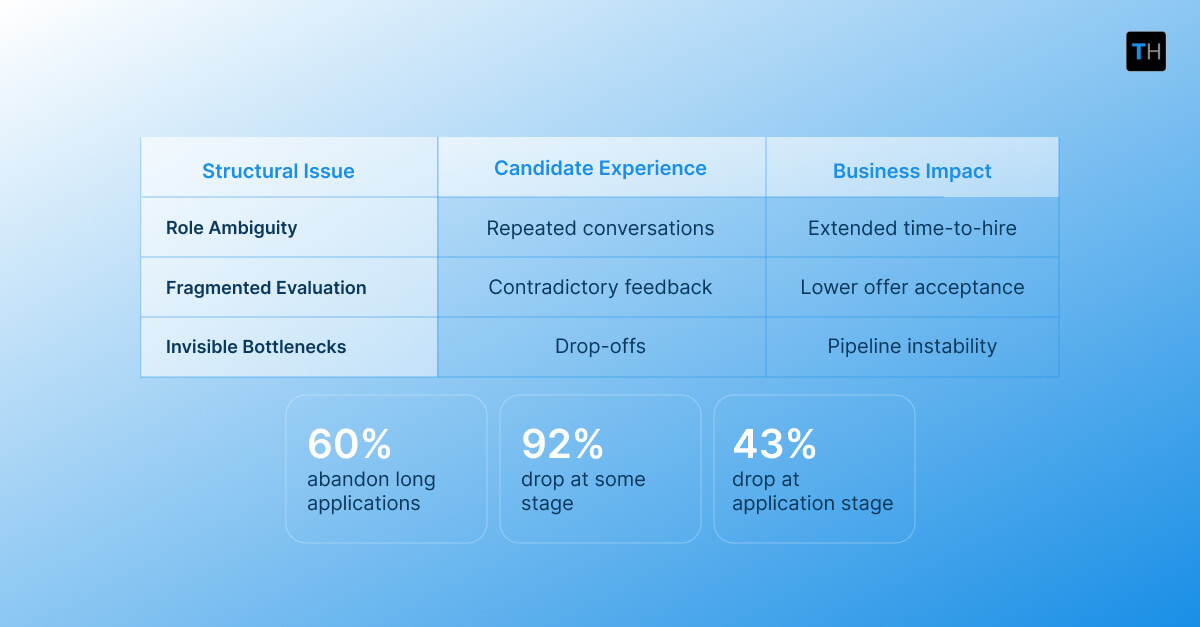
When candidate experience suffers, the root cause is usually structural.
1. Role Ambiguity
Recruiters cast a wide net if the hiring managers and the organizations fail to define the required capabilities at the intake stage. Hiring managers adjusting expectations during interviews serves as a double whammy as shortlists shift mid-process.
Candidates are at the receiving end of the repercussions of the ambiguity as conversations restart and questions overlap. The process feels as if it’s built on murky waters.
Clarity at the beginning prevents confusion later.
2. Fragmented Evaluation
Decisions take longer when interviewers are not on the same page about what they are assessing. Feedback becomes harder to compare as it is being seen through different criteria altogether. Hiring discussions revolve around interpretation rather than evidence.
Candidates experience this as repetition and uncertainty. Interviewers’ alignment from the onset prevents both and establishes clarity.
3. Invisible Bottlenecks
Data from hiring research shows that 60% of candidates abandon applications that are too long or complicated. Broader findings indicate that 92% of candidates exit the hiring process at some stage, with 43% leaving during the application phase.
These exits do not happen by chance. In fact, they expose the friction inside the process.
Delays and drop-offs remain hidden without visibility into stage-level metrics. Teams respond by adding more steps instead of addressing the underlying issue. Over time, the process becomes heavier while experience declines.
Drop-offs are signals that show where the system needs attention.
Measuring Candidate Experience in Talent Acquisition Systems
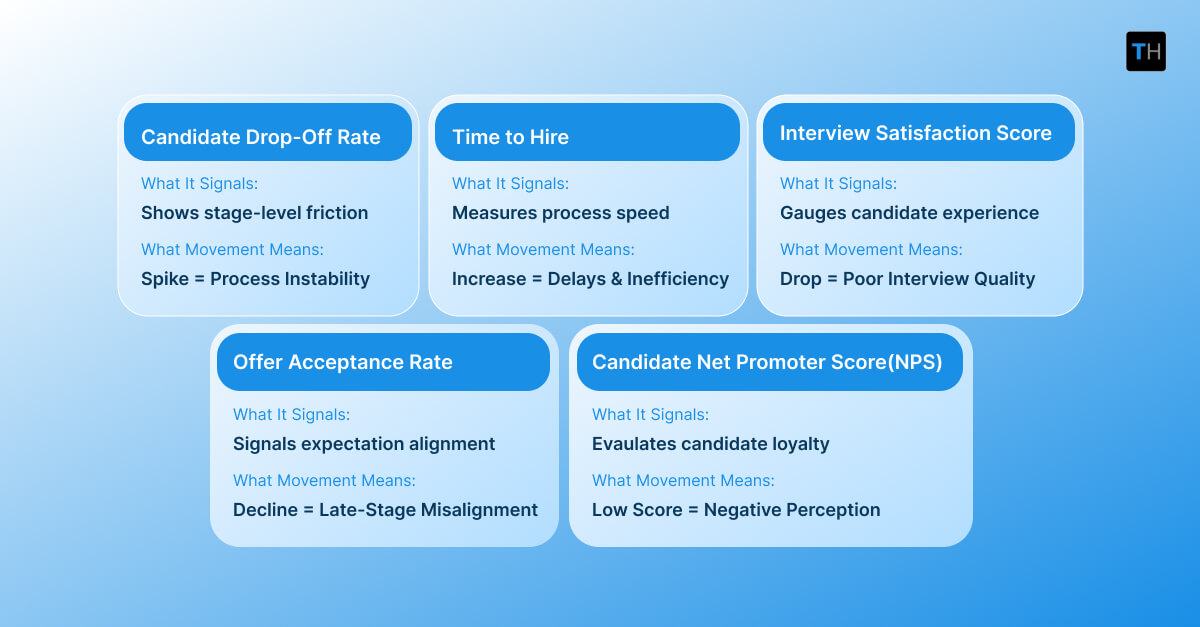
Candidate experience becomes meaningful when it is measured.
Within modern talent acquisition systems, experience can be tracked through specific indicators:
- Candidate drop-off rate by stage: This shows where candidates exit the process. A spike at a specific stage usually signals friction, confusion, or delay that needs attention.
- Application completion rate: This measures how many candidates finish the application after starting it. Low completion often points to overly long forms or unclear role information.
- Time to feedback: This tracks how quickly candidates hear back after each stage. Delays here create uncertainty and can push strong candidates toward other offers.
- Interview-to-offer ratio: This reflects how many interviewed candidates are required to make one hire. A high ratio may indicate weak screening precision or unclear evaluation criteria.
- Offer acceptance rate: This measures how many candidates accept the offers extended to them. Declines in this metric often signal expectation gaps or misalignment during the hiring process.
Offer acceptance deserves particular attention. When candidates decline after progressing through multiple rounds, it often signals misalignment between expectations and reality. Since 58% of candidates say a good recruitment process increases their likelihood of accepting an offer, experience and acceptance are closely linked.
Candidate experience and hiring velocity move together because both depend on how clearly the hiring system operates. When the structure weakens, both suffer. When alignment improves, both stabilize.
What Is the Connection Between Candidate Experience and Hiring Velocity
A weakened structure results in a negative impact on both. Improving the alignment in the organization consolidates candidate experience and hiring velocity.
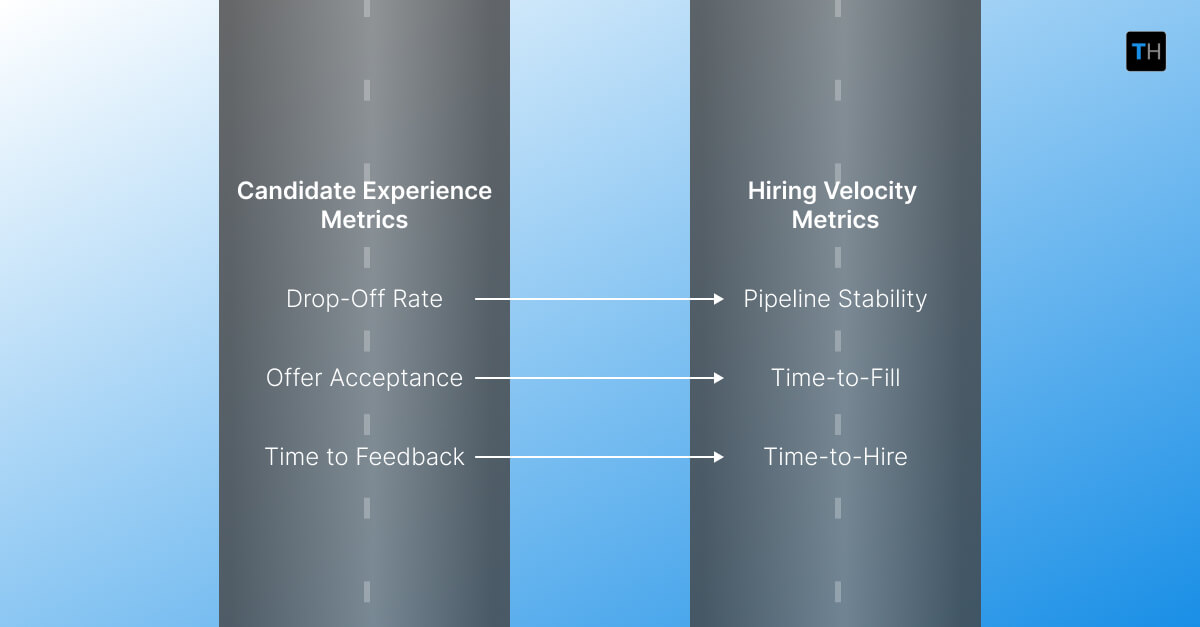
Here is how they connect in practical terms:
1. Drop-Off Rates Directly Affect Pipeline Stability
When a large number of candidates exit midway, the hiring pipeline becomes difficult to predict. Recruiters have to re-source, re-screen, and re-engage new applicants. This resets progress and adds variability to timelines.
A steady pipeline supports hiring velocity. High drop-offs disrupt that stability and slow momentum.
2. Offer Acceptance Impacts Time-to-Fill
When offer acceptance rates decline, roles remain open longer than planned. Teams return to earlier-stage candidates or reopen sourcing entirely. This extends time-to-fill and increases hiring pressure.
Candidates hesitate if expectations shift during interviews or communication lacks clarity, candidates hesitate at the final stage. Strong alignment throughout the process improves acceptance and protects hiring velocity.
3. Feedback Speed Shapes Time-to-Hire
Delayed feedback leaves candidates in a dilemma and stalls decision-making internally. Strong candidates may disengage or accept competing offers while waiting. As a result, delayed feedback turns out to be a double-edged sword for organizations.
Clear feedback timelines and disciplined decision loops keep the process moving. Faster, structured feedback supports both experience and overall time-to-hire.
4. Defined Capabilities Improve Screening Precision
Clear defined roles help interviewers evaluate against shared criteria, and screening becomes sharper. Fewer misaligned candidates move forward. Interviews stay focused on validating specific competencies instead of drifting into broad discussions.
This shortens decision cycles without compromising on quality and screening precision.
5. Structured Evaluation Reduces Rework
Teams revisit earlier decisions when the process lacks clarity and is filled with bottlenecks. This often results in repeated discussions and overlapping interviews. Over time, this repetition stretches timelines and slows the entire hiring cycle.
Candidates go through a connected interview process when evaluation follows a structured format. Decisions rely on documented evidence rather than interpretation. The process moves forward with fewer restarts, which improves both candidate experience and hiring velocity.
6. Clarity Strengthens Both Speed and Quality
The process tends to move faster when it is clear, and expectations are well defined without additional pressure. When validation follows a structured approach, hiring quality improves without the need to add extra rounds or checkpoints.
For this reason, candidate experience and hiring velocity both reflect the hiring system’s discipline. When the underlying structure strengthens, improvements in one area usually reinforce the other.
Designing Candidate Experience as a System Outcome
1. Structured Intake
Expectations are less likely to shift halfway through the process when capabilities are mapped clearly at the very beginning. Interviews do not require constant recalibration or last-minute adjustments with stable role definitions in place.
2. Aligned Screening Logic
Fewer misaligned candidates move forward when recruiters and hiring managers evaluate against shared criteria. This reduces unnecessary interviews and prevents candidate fatigue.
3. Coordinated Interview Design
Each interview stage should serve a defined purpose. Repetition decreases and clarity increases when rounds validate specific competencies.
4. Centralized Metric Visibility
Stage-level tracking makes friction visible. Drop-offs, delays, and acceptance patterns become manageable rather than surprising.
Experience improves when orchestration improves.
Candidate Experience at Enterprise Scale
At enterprise scale, there are a lot of moving factors, and as a result, variation increases. Different business units, hiring managers, and recruiters may follow slightly different approaches.
If teams operate without clear governance, small differences in approach start to pile up. Candidates then receive inconsistent experiences across roles or departments, and hiring velocity begins to vary more than it should.
Sustained candidate experience requires:
- Standardized intake frameworks: Define roles using a consistent structure before hiring begins. This prevents shifting expectations and keeps recruiters and hiring managers aligned from the start.
- Shared evaluation definitions: Ensure everyone assesses candidates against the same capability criteria. Shared standards reduce subjectivity and make hiring decisions more comparable.
- Consistent communication timelines: Set clear expectations for when candidates will hear back at each stage. Predictable timelines build trust and prevent unnecessary drop-offs.
- Centralized reporting across the talent acquisition system: Track hiring metrics in one unified view. Central visibility helps leaders identify bottlenecks early and maintain consistency across teams and business units.
When structure holds, experience remains stable even during hiring surges.
Technology’s Role in Supporting Candidate Experience
Technology plays an important role in shaping candidate experience, but only when it strengthens the underlying hiring structure.
- Technology should support clarity instead of replacing it: A modern interface can make applications easier to complete. Automated updates can keep candidates informed. These improvements matter, but they do not fix unclear job definitions or inconsistent evaluation standards.
- Tools cannot compensate for weak role design: If hiring managers redefine expectations midway or interviewers assess different competencies, no software layer can hide that instability. Candidates will still experience confusion and delay.
- Structured capability capture improves alignment: When technology helps teams document required skills at intake, screening becomes more focused. Recruiters and hiring managers operate from the same definitions, which reduces recalibration later.
- Aligned workflows create consistency across stages: Configurable workflows ensure that each interview round serves a defined purpose. This prevents overlap, shortens feedback loops, and keeps conversations anchored to role requirements.
- Centralized visibility strengthens accountability: When hiring metrics are tracked in one place, leaders can quickly identify bottlenecks, drop-offs, and delays. Visibility prevents friction from building quietly inside the system.
Conclusion
Candidate experience in hiring is not just about how candidates feel. It reflects how clearly roles are defined, how consistently interviews are conducted, and how reliably decisions move forward.
When the talent acquisition system operates with clarity and discipline, candidates experience transparency and momentum. Offer acceptance strengthens. Drop-offs stabilize. Hiring velocity becomes more predictable.
Organizations that treat candidate experience as a measurable hiring outcome build more resilient talent acquisition systems over time.
Infrastructure that supports structured capability capture, aligned workflows, and centralized visibility enables disciplined execution. Use TurboHire to standardize capability intake, align evaluation criteria across interview stages, and gain real-time visibility into drop-offs, offer acceptance, and time-to-hire.
Frequently Asked Questions (FAQs)
1. What is candidate experience in hiring?
Candidate experience in hiring refers to how applicants perceive and move through the recruitment process, from application to final decision. It reflects the clarity of role definitions, consistency of evaluation, and predictability of communication within the talent acquisition system. Strong candidate experience is typically a byproduct of structured hiring design rather than isolated engagement efforts.
2. Why is candidate experience important in talent acquisition?
Candidate experience directly impacts measurable outcomes such as candidate drop-off rate, offer acceptance rate, and re-application likelihood. Research shows that 58% of candidates are more likely to accept an offer after a positive recruitment process. Poor experience can also damage an employer’s reputation and reduce future pipeline stability. In structured talent acquisition systems, experience serves as an indicator of operational health.
3. How do you measure candidate experience?
Candidate experience can be measured through specific hiring metrics, including:
- Candidate drop-off rate by stage
- Application completion rate
- Time to feedback
- Interview-to-offer ratio
- Offer acceptance rate
These indicators provide observable signals of friction, alignment, and decision discipline within the hiring process.
4. How does candidate experience affect hiring velocity?
High drop-offs, delayed feedback, and low offer acceptance rates slow hiring velocity. When evaluation criteria are clear and interview stages are structured, candidates move more predictably through the process. Improved experience reduces rework, stabilizes throughput, and shortens time-to-hire without compromising quality.
5. How can talent acquisition systems improve candidate experience at scale?
Talent acquisition systems improve candidate experience at scale by standardizing role intake, aligning evaluation criteria, and centralizing visibility into hiring metrics. Structured workflows reduce ambiguity and prevent mid-process recalibration. When infrastructure supports consistent decision-making and clear communication, candidate experience improves as a systemic outcome rather than a manual effort.