

Candidate experience is often treated as a communication layer in hiring. However, organizations need to go a step further in high-volume hiring. Candidate experience turns into a structural outcome.
Approximately 60% of candidates say they’ve had a poor experience, and a large majority will share it with others if their experience was negative.
Coordination complexity increases alongside high-volume hiring. More candidates means a bigger pipeline, and that too, the candidates enter the pipeline simultaneously. Interviews became a tricky affair as they need to be aligned according to the varying schedules of both the interviewers and interviewees. There are more people to please in the evaluation and approval rounds. Under these conditions, minor inefficiencies are no longer absorbed through effort. They pile up and choke the whole process.
High-volume hiring does not automatically weaken candidate experience. It exposes whether the talent acquisition system was designed to sustain predictable flow at scale.
Candidate Experience in High-Volume Hiring Is a Flow Indicator
Candidate experience reflects how consistently a candidate moves through the hiring process.
In high-volume hiring, candidates evaluate the system through four observable variables:
- Time between stages
- Clarity of next steps
- Consistency in evaluation criteria
- Predictability of decisions
Candidate experience goes for a toss when the aforementioned variables are not looked after.
A candidate does not disengage because one message was delayed. Disengagement happens when momentum slows repeatedly and without explanation. That loss of momentum is not emotional. It is structural.
Candidate experience, in this context, becomes a signal of how well the talent acquisition system manages flow under pressure.
Why High-Volume Hiring Exposes System Weaknesses
At lower volumes, inefficiencies are often compensated for through manual effort. Recruiters follow up individually. Hiring managers make informal adjustments. Ambiguities are corrected through additional conversations.
High-volume hiring removes that flexibility. Each stage must operate with clarity because it repeats at scale.
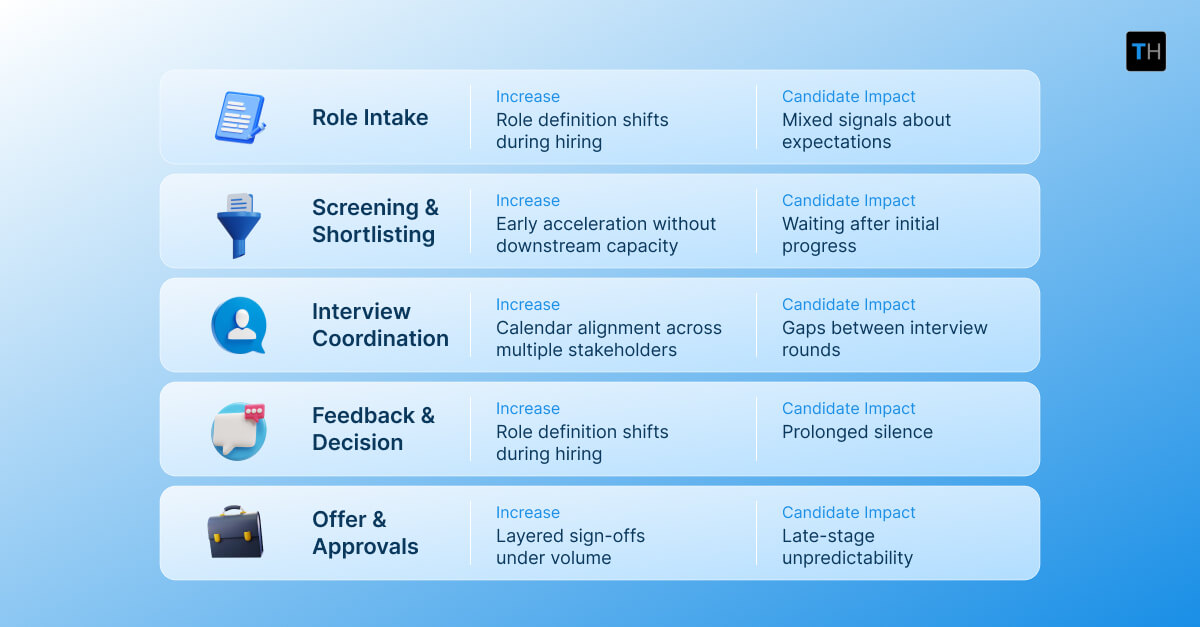
Structural strain commonly appears in five areas:
- Role Intake and DefinitionWhen intake is not structured properly, the definition of the role does not stay stable. Expectations shift mid-process, weakening alignment between recruiters, hiring managers, and candidates. Screening criteria get tinkered with midway. Interviewers evaluate based on their own interpretation instead of arriving at a common ground. Candidates end up facing the brunt of this chaos, and it spoils their whole experience.
Lengthy or cumbersome application steps correlate strongly with candidate dropoff: roughly 60% of job seekers abandon applications midway if the process feels overly complex.
- Screening and Shortlisting CapacityEarly-stage acceleration without downstream alignment creates imbalance. Candidates may be screened quickly, but wait longer for interview scheduling or feedback.
- Interview CoordinationMultiple stakeholders require synchronized availability. Without defined timelines and ownership, gaps between interview rounds increase across the pipeline.
- Feedback and Decision OwnershipDecision-making moves at a snail’s pace when responsibility for feedback is unclear or when deadlines are not defined. Organizations get caught in a loop of meetings that should’ve never happened if the systems were set. Timelines keep stretching as the personnel end up spreading themselves too thin.
- Offer and Approval WorkflowsCompensation approvals and leadership sign-offs often lack standardized turnaround expectations. Under volume, these layers create late-stage unpredictability.
Each of these issues may appear manageable individually. Under high-volume hiring, repetition turns them into systemic friction.
How Candidate Experience Breaks Inside the Talent Acquisition System
Experience breakdown rarely begins inside a single task. It usually starts in the gaps between stages.
Those gaps demand alignment across recruiters, hiring managers, tools, and evaluation standards. When that alignment is not built into the talent acquisition system, clarity drops during handoffs. One stage completes, but the next does not begin cleanly. Time slips in between, and the delay keeps expanding as more candidates move through the same transition.
Three transition points are particularly vulnerable:
- Intake to Sourcing: Incomplete role clarity leads to rework and shifting candidate messaging.
- Interview to Feedback: Undefined feedback timelines result in prolonged silence.
- Decision to Offer: Layered approvals create unpredictable waiting periods.
High-volume hiring magnifies these transition risks. Without structured workflows and visible ownership, context is lost between stages. Candidates experience this as repetition, uncertainty, or delay.
The system may appear active internally. Externally, it feels inconsistent.
The Metrics That Signal Candidate Experience Breakdown
Candidate experience deterioration is measurable.
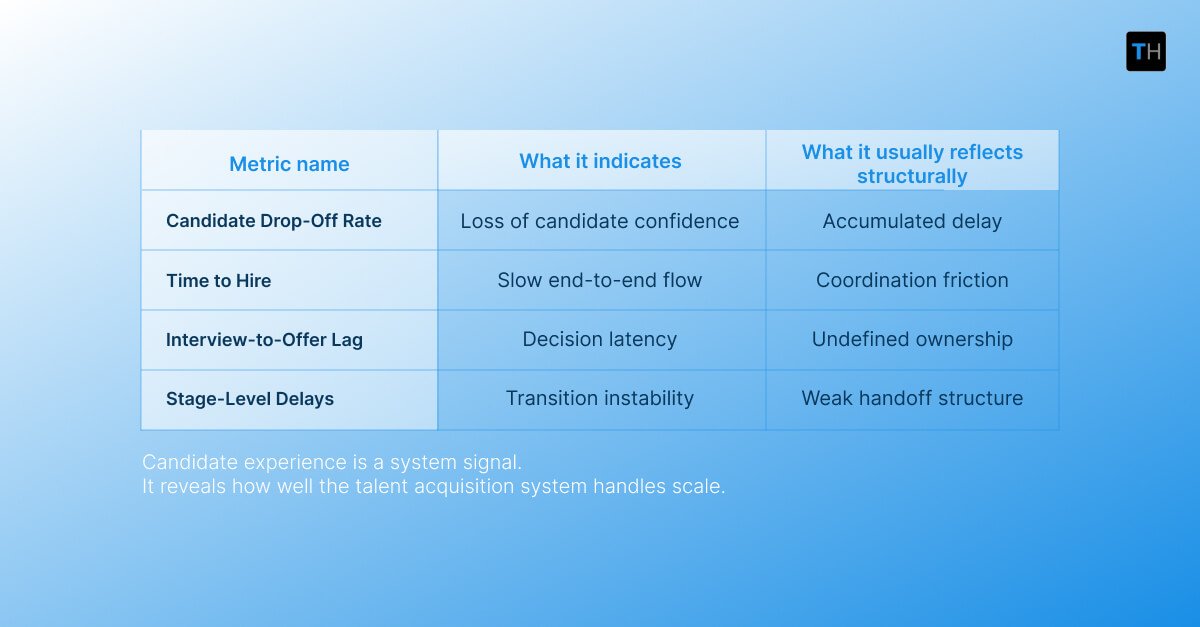
Common indicators include:
- Rising candidate drop-off rate
- Increasing time to hire
- Extended gaps between interview rounds
- Interview-to-offer lag
These metrics are not isolated performance issues. They are system-level signals.
A higher drop-off rate often reflects accumulated waiting time. Extended time to hire reflects distributed coordination friction across stages.
In high-volume hiring, these indicators reveal whether the talent acquisition system can sustain predictable movement.
The Recruiter Experience Connection
Candidate experience and recruiter experience are outputs of the same system.
In high-volume hiring, recruiters gradually spend less time evaluating candidates and more time managing coordination. They follow up repeatedly for feedback, chase interview confirmations, and step in when approvals stall. Instead of relying on defined timelines, they depend on reminders and nudges to keep the process moving.
When workflows lack structure, recruiters compensate through effort. As internal coordination becomes reactive, external experience becomes inconsistent.
Sustainable candidate experience cannot depend on individual effort alone. It depends on how the talent acquisition system distributes accountability and manages transitions.
Why Fixing Candidate Experience Requires System Design
Improving candidate experience in high-volume hiring requires structural clarity, not incremental adjustments.
Stability depends on five elements:
- Standardized role intake
- Defined feedback windows and ownership
- Coordinated interview workflows
- Transparent approval processes
- Visibility into stage-level delays
High-volume hiring demands orchestration across the entire talent acquisition system. Accelerating isolated tasks does not restore flow if transitions remain unstable.
When coordination is embedded into the system, movement becomes predictable. Predictability strengthens candidate confidence and reduces disengagement.
Conclusion: Candidate Experience as a System Signal
Candidate experience in high-volume hiring is not a surface metric. It reflects the operational capacity of the talent acquisition system.
When disengagement increases or timelines stretch, the system is operating beyond its coordination limits.
High-volume hiring does not require urgency alone. It requires structural alignment across intake, evaluation, and decision-making.
This is the philosophy behind platforms like TurboHire, as we treat talent acquisition as an end-to-end system rather than a collection of tasks.
Frequently Asked Questions (FAQs)
1. Why does candidate experience suffer in high-volume hiring?
Candidate experience often suffers in high-volume hiring because coordination complexity increases faster than system structure. As more candidates move through the pipeline simultaneously, delays between stages, unclear ownership, and inconsistent feedback become more frequent. Without a well-designed talent acquisition system, these small inefficiencies compound and reduce predictability, leading to disengagement.
2. How is candidate drop-off related to high-volume hiring?
In high-volume hiring, candidate drop-off is often a symptom of accumulated friction. Extended time between interview rounds, delayed feedback, and unclear next steps weaken candidate confidence. Rather than being purely a motivation issue, drop-off typically reflects structural delays within the talent acquisition system.
3. How can organizations improve candidate experience at scale?
Improving candidate experience at scale requires strengthening the talent acquisition system rather than increasing communication volume. Clear role intake, defined decision timelines, structured interview workflows, and visible ownership across stages help maintain predictable movement. When flow is stable, candidate experience improves naturally, even in high-volume hiring environments.