

Candidate dropoff seldom starts at sourcing. It usually starts right after screening, when candidates are waiting for the next step. The interview stage looks simple on paper. In practice, it creates more friction than most teams expect.
Recruiters finish screening and move strong candidates forward. And this is when the delays start occurring. Candidates experience calendar alignment, calendar realignment, reschedules, and delayed confirmations. Candidates wait without clarity. Some of them simply move on.
Automated interview workflows are often introduced to fix this. But scheduling software alone does not reduce candidate dropoff. It works only when it supports the broader talent acquisition system and removes coordination gaps across stages.
Understanding Candidate Dropoff at the Interview Stage
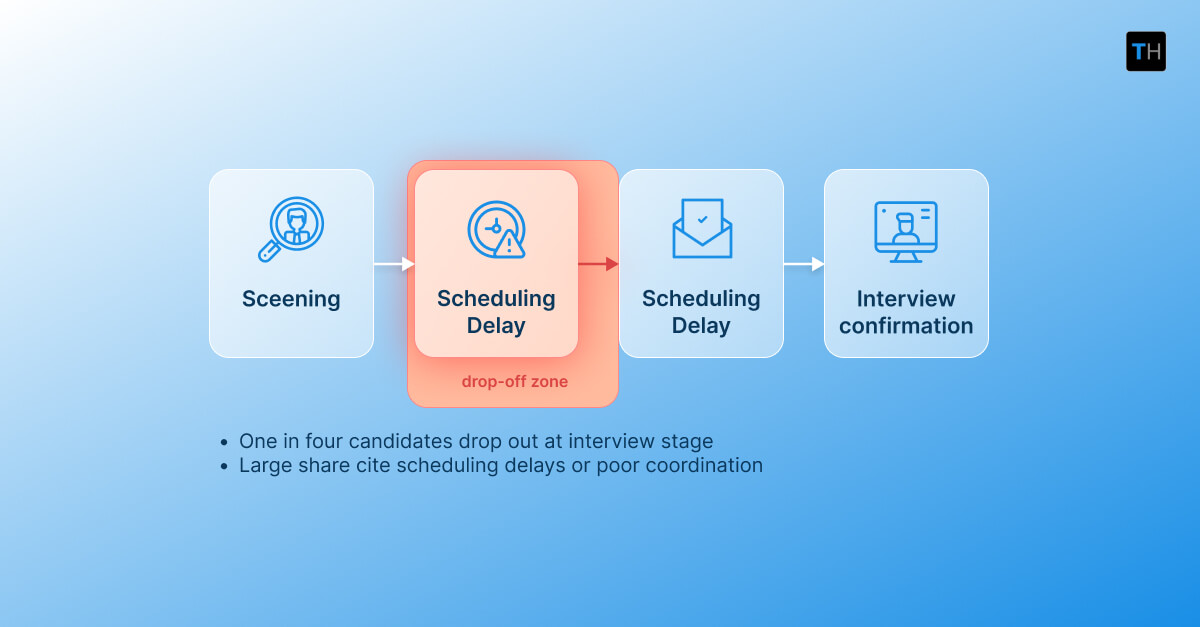
Candidate dropoff refers to applicants who exit the hiring process before a decision is made. It can happen at any stage, but interviews are one of the most fragile points in the funnel. Around one in four candidates drop out at the interview stage, which is the single highest drop-off point in many hiring funnels.
At this stage, candidates have already invested time. They have submitted information and completed screening. They are raring to go as they wait for the interview call with bated breath. As a consequence of rising expectations and hopes, their sensitivity to delays increases as well.
Candidates start questioning the seriousness of the opportunity and the organization when the interview scheduling gets delayed. Their hopes come crashing and they stop trusting the organization to turn up. Candidates end up dropping off.
The Scheduling Bottleneck in Traditional Hiring
Manual interview coordination creates hidden friction inside the hiring system. Recruiter surveys show that about two‑thirds of recruiters spend 30 minutes to two hours just to lock in a single interview slot, and over a third say scheduling is the most time‑consuming part of their job.
1. Email chains replace structure
Recruiters share available slots and wait for responses. Hiring managers reply when their calendars clear. Candidates often suggest different timings that work better for them. Email threads start stretching across days. What began as a simple coordination task slowly turns into a back-and-forth that delays the interview without anyone intending to slow it down.
2. Spreadsheet tracking replaces visibility
Interview updates are often tracked in spreadsheets or separate tools. Status changes do not always get recorded in real time. Recruiters end up double-checking calendars, messages, and notes to confirm what has actually happened. Instead of moving candidates to the next step, they spend time making sure the information is accurate.
3. Follow up chasing replaces ownership
Recruiters end up nudging interviewers to confirm time slots. Then they follow up again to get feedback from hiring managers. The process keeps moving, but only because someone keeps pushing it. Instead of flowing on its own, progress relies on repeated reminders and manual follow-ups.
4. Status ambiguity replaces confidence
Candidates often do not know if their interview is locked in or still tentative. Hiring managers sometimes assume someone else is driving the next step. In the middle of it all, recruiters end up holding the entire coordination thread.
Over time, this creates drag. The hiring process takes longer than it should. Recruiters spend more energy managing updates than moving candidates forward. And candidates start to disengage right at the point where interest should be getting stronger. Surveys report that roughly 40–60% of candidates have walked away from a process because interviews took too long to schedule or the experience felt unnecessarily cumbersome.
What Automated Interview Scheduling Actually Does
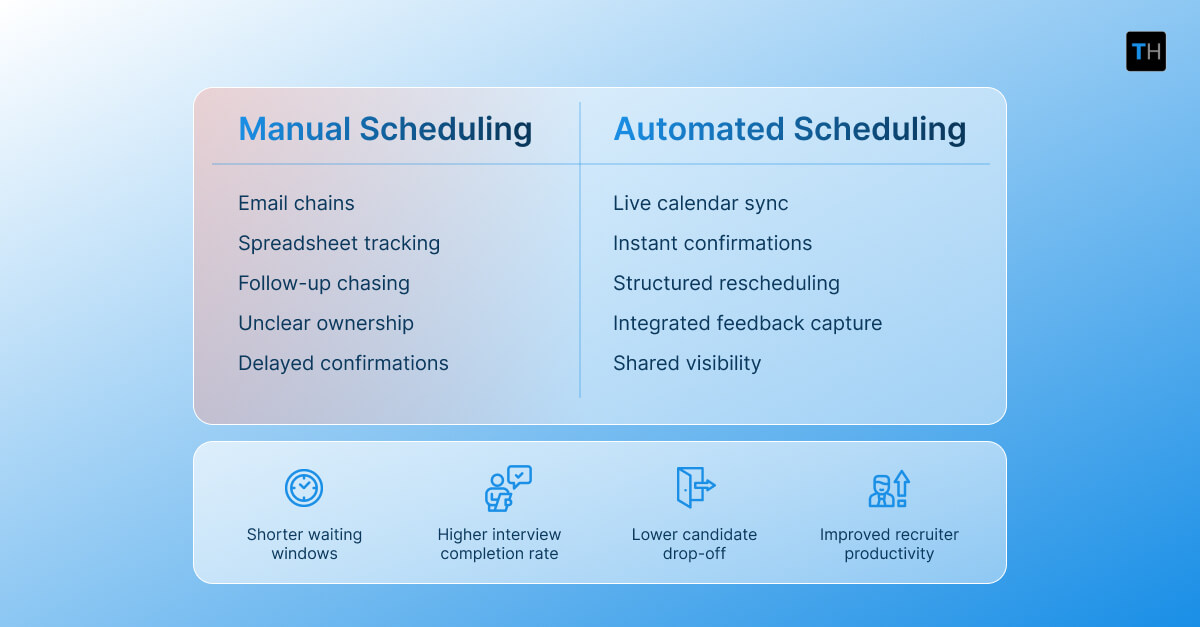
Automated interview scheduling focuses on coordinating work. It does not attempt to replace human evaluation.
1. Real-time calendar alignment
Interview slots are synced across stakeholders. Candidates select from confirmed availability instead of negotiating by email.
2. Instant confirmations and reminders
Once a time is selected, confirmations go out automatically. Reminders reduce no-shows and last-minute confusion.
3. Structured rescheduling
If plans change, the system handles the adjustment without restarting the process.
4. Feedback capture integration
Interviewers submit feedback inside the same workflow. Recruiters do not need to chase responses manually.
These improvements seem operational. In reality, they protect candidate momentum.
How Automated Interview Workflows Reduce Candidate Dropoff
Reducing dropoff depends on reducing uncertainty.
1. Shorter waiting windows
When candidates can schedule immediately after screening, the time between stages shrinks. Momentum is preserved.
2. Clear next steps
Automated confirmations signal that the process is structured. Candidates know what happens next.
3. Fewer missed interviews
Reminders reduce accidental no-shows. Fewer cancellations mean fewer frustrated candidates.
4. Stable communication
Consistent updates prevent silent gaps. Silence often causes more dropoff than rejection.
When coordination friction drops, the interview stage becomes a validation step rather than a bottleneck.
Automated Scheduling Inside a Talent Acquisition System
Scheduling tools deliver value only when connected to the broader hiring system.
1. End-to-end flow
Interview scheduling should connect directly to screening outcomes and feed into feedback workflows. Context must move forward with the candidate.
2. Defined ownership
Each transition needs a clear owner. Automation supports this by triggering the next steps automatically instead of relying on reminders.
3. Shared visibility
Recruiters and hiring managers should see where candidates are waiting. Stage-level transparency prevents delays from becoming patterns.
When automation operates in isolation, it speeds up one step while others remain slow. When embedded inside a talent acquisition system, it improves overall flow.
Metrics That Signal Real Improvement
Automated interview workflows should be evaluated through measurable outcomes.
1. Candidate dropoff rate
Track how many candidates exit between screening and final interviews. A decline indicates stronger engagement.
2. Time to hire
Faster interview coordination reduces total cycle time. Improvements here show smoother stage transitions.
3. Interview completion rate
Higher completion rates suggest better scheduling clarity and fewer missed commitments.
4. Recruiter productivity
Time saved from coordination can be redirected toward evaluation and stakeholder alignment.
If scheduling speeds up but dropoff remains high, the system has other gaps. Automation must support flow, not just activity.
Risks of Poorly Implemented Automation
Automation can introduce new issues if not designed carefully.
1. Over automation
Generic reminders without context can feel transactional. Candidates still expect relevance.
2. Fragmented tools
If scheduling sits outside the main workflow, recruiters end up reconciling data across systems.
3. Lack of hiring manager accountability
Automation cannot fix unclear decision ownership. The delays will simply shift their positions instead of disappearing.
Technology reduces friction. It does not replace structure.
Practical Steps to Reduce Candidate Dropoff
1. Map scheduling friction
Identify where candidates wait the longest between stages.
2. Standardize interview stages
Define the number of rounds and who owns each transition.
3. Implement automated scheduling within the core system
Avoid tools that operate separately from your ATS or hiring workflows.
4. Monitor dropoff and time in stage
Track trends weekly. Look for patterns rather than isolated delays.
Conclusion
When candidates drop out around the interview stage, it is often because the process feels unclear. Manual scheduling adds unnecessary friction.
Automated interview workflows remove administrative friction. When embedded inside a well-designed talent acquisition system, they protect candidate momentum and stabilize hiring outcomes.
The goal is to ensure that candidates move through interviews without avoidable delay. TurboHire supports this by connecting automated scheduling to a unified hiring system that reduces friction while preserving human decision-making.
Frequently Asked Questions
1. How does automated interview scheduling reduce candidate dropoff?
Automated interview scheduling reduces candidate dropoff by shortening the time between screening and interviews. When candidates can book confirmed slots instantly and receive timely reminders, uncertainty decreases. Clear timelines and structured communication help maintain engagement, which lowers the likelihood of candidates exiting the process midway.
2. Can automated interviews improve time to hire?
Yes. Automated interview workflows reduce coordination delays, such as calendar alignment and follow-up chasing. When scheduling friction is removed, candidates move through stages faster. This shortens the overall time to hire without increasing recruiter workload.
3. Is automated interview scheduling enough to fix candidate dropoff?
No. Scheduling automation helps, but it must operate within a connected talent acquisition system. Clear role definition, structured feedback, and defined ownership at each stage are also necessary. Automation supports flow, but system design ultimately determines hiring outcomes.