

The recruitment process plays a direct role in determining hiring outcomes. It shapes how candidates enter the pipeline, how they are filtered, and how consistently hiring teams receive qualified profiles.
Organizations often focus on improving hiring outcomes at the evaluation stage. Interviews get refined over time. Teams start introducing structured assessment frameworks. Decision-making also becomes more organized and deliberate. However, these improvements have a limited impact when the recruitment process itself is unstable.
Hiring teams spend more time filtering than evaluating when candidate pipelines are inconsistent. Interviews naturally get pushed out when screening takes longer than expected. It becomes harder for teams to make confident decisions when the quality of candidates varies across roles.
A structured recruitment process addresses these challenges by ensuring that candidate inflow, screening, and coordination are aligned.
What Makes a Recruitment Process Effective
An effective recruitment process is not defined by activity volume. It is defined by the consistency with which candidates move through the pipeline.
More sourcing and applications do not guarantee better outcomes. What matters is whether relevant candidates enter the pipeline and progress steadily through screening.
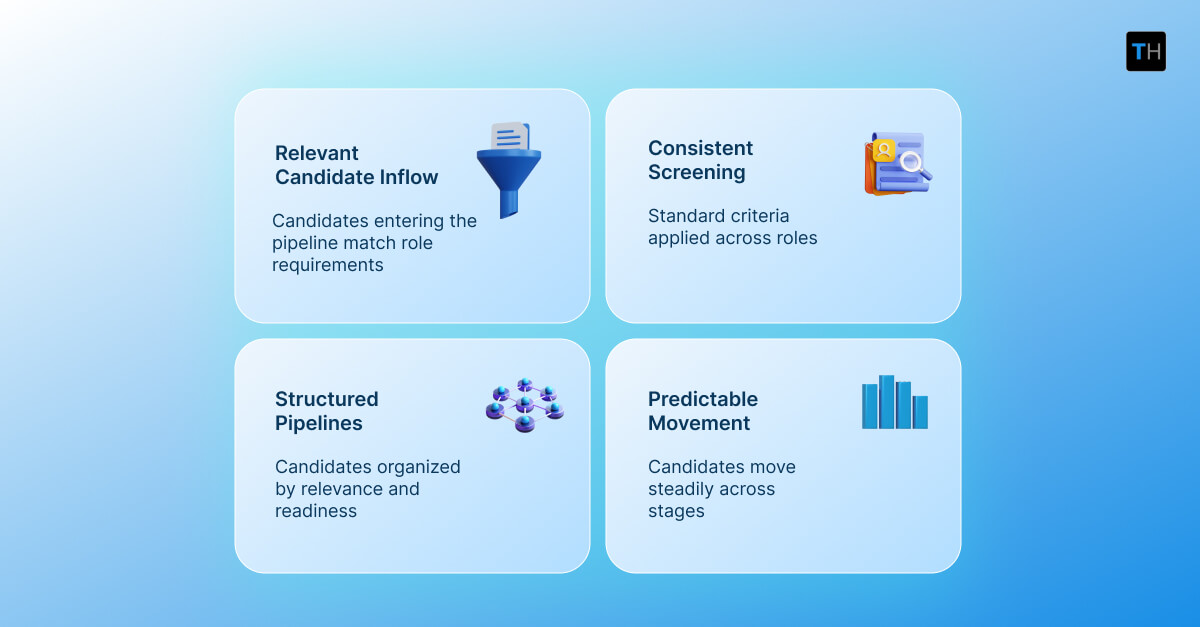
An effective recruitment process ensures:
- Candidate inflow remains relevant
- Screening follows consistent criteria
- Pipelines remain structured across roles
- Movement between stages is predictable
Recruitment becomes effective when it maintains flow, not just activity.
Why Recruitment Process Design Directly Impacts Hiring Outcomes
Recruitment determines the quality of inputs that hiring teams receive. Organizations that lack a standardized process are 5x more likely to make a bad hire. It can cost up to 30% of that employee’s first-year salary in lost productivity and turnover costs.
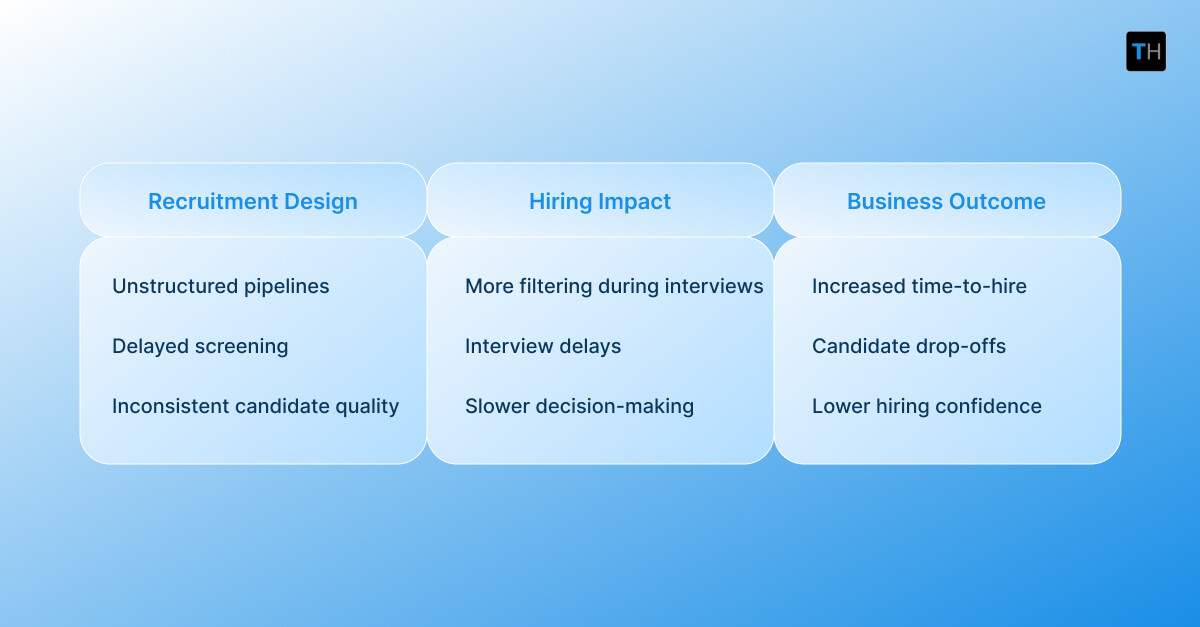
Hiring teams receive inconsistent candidates due to unstructured pipelines. More time is spent filtering profiles rather than evaluating capabilities. Interviews become less efficient, and decision-making takes longer.
Delays at the recruitment stage also propagate forward. When screening takes longer, candidates reach interviews later. Strong candidates may disengage before entering evaluation. Nearly 60% of job seekers will abandon an application if the process feels too cumbersome, and over 50% of candidates report that a slow recruitment process is the primary reason they decline an offer.
Conversely, when recruitment pipelines are structured, hiring teams receive relevant candidates consistently. Screening starts to move in a predictable way. Interviews are easier to schedule because everyone is better aligned. Decisions also feel more straightforward, as they are based on consistent inputs.
Recruitment does not operate independently from hiring. It determines how efficiently the hiring functions.
Core Principles of a Strong Recruitment Process
A recruitment process improves hiring outcomes when its structure supports consistency, alignment, and flow.
1. Align Candidate Inflow with Screening Capacity
Recruitment pipelines must be designed with screening capacity in mind.
Uncontrolled inflow leads to screening overload. Recruiters are forced to process large volumes of applications, which reduces the time available for evaluating each candidate. Prioritization becomes inconsistent.
Aligning inflow with capacity ensures that recruiters can evaluate candidates without delays. Pipeline volume remains manageable, and candidate quality is maintained.
2. Define Role Requirements Clearly at the Start
Recruitment begins with role clarity.
Vague role definitions lead to a broad screening process. Hiring managers modify expectations during interviews. Candidates are evaluated against shifting criteria, which leads to inconsistency.
Clear role definitions create a strong starting point. Recruiters have a better sense of which profiles to focus on. Screening becomes more focused, and the overall quality of candidates improves even before they enter the hiring process.
3. Structure Candidate Pipelines
Candidate pipelines should not be treated as a single pool.
Segmenting candidates based on role alignment, experience level, and readiness improves pipeline management. Recruiters can identify strong candidates more easily and avoid losing visibility within large volumes.
A structured pipeline ensures that candidate flow remains organized rather than reactive.
4. Standardize Screening Criteria
Screening is the first stage where candidate quality is determined.
Recruiters may evaluate candidates differently across roles without consistent criteria. Some candidates may progress due to incomplete filtering, while others may be overlooked.
Standardized screening ensures that candidates are assessed against the same baseline requirements. This improves consistency and makes downstream evaluation more reliable.
5. Establish Clear Coordination Workflows
Recruitment involves multiple stakeholders. Recruiters, hiring managers, and business teams all participate in different stages.
Follow-ups increase when coordination is informal. Communication becomes fragmented. As a result, candidate movement slows.
Defined workflows make it clear who is responsible at each stage. Recruiters have a better sense of when to move candidates forward, and hiring managers understand when their input is needed. This reduces back-and-forth and helps candidates progress through the pipeline without avoidable delays.
6. Build Visibility Into Recruitment Stages
Visibility is essential for maintaining recruitment performance.
Teams need to understand how candidates move through the pipeline. Without visibility, delays remain hidden. Bottlenecks are identified late.
Tracking recruitment metrics such as screening time, pipeline conversion, and drop-offs provides early signals. Teams can address issues before they affect hiring timelines. While 80% of recruitment leaders cite ‘quality of hire’ as their top priority, only one-third of organizations feel they have the visibility required to measure it effectively without a structured system.
Designing the Recruitment Process as a System
Recruitment operates as a system where multiple activities occur simultaneously.
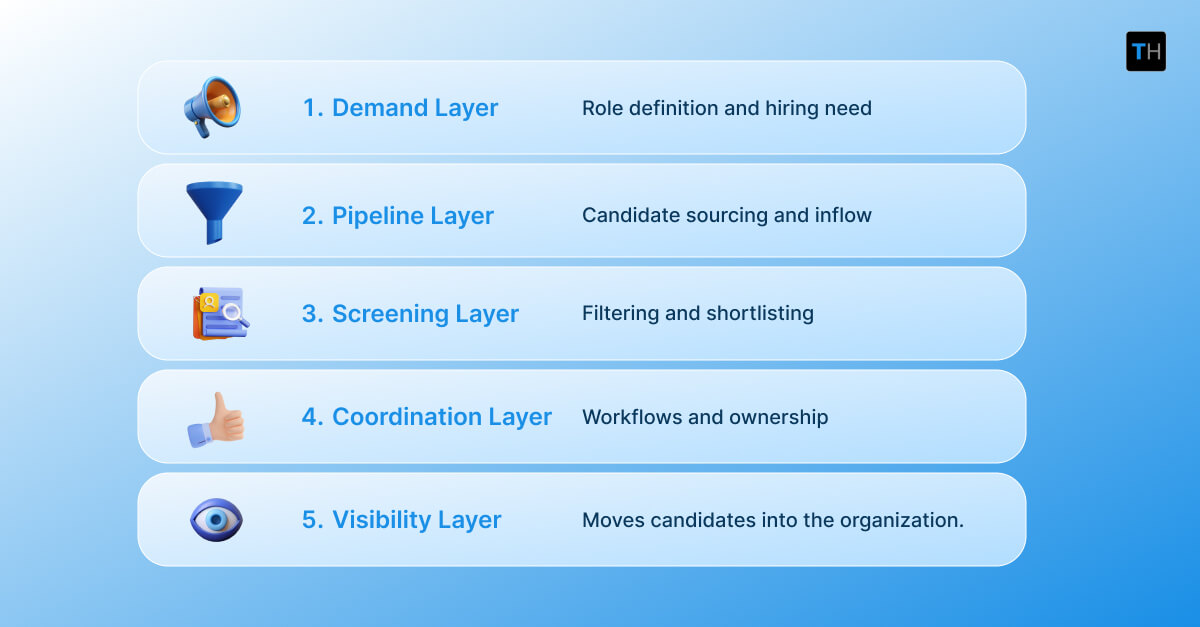
A structured recruitment process can be understood through five interconnected layers.
1. Demand Layer
Workforce planning and role definitions establish hiring requirements. Clear demand signals ensure that recruitment aligns with business needs.
2. Pipeline Layer
This layer governs how candidates enter the system.
Sourcing channels, referrals, and talent pools contribute to candidate inflow. Pipeline quality determines how efficiently candidates can be screened.
3. Screening Layer
This layer filters candidates before they enter the hiring process.
Structured screening ensures that only relevant candidates progress forward. It maintains quality across the pipeline.
4. Coordination Layer
This layer manages how work moves between stakeholders.
Workflows define ownership, timelines, and communication. Effective coordination ensures that candidates move steadily through recruitment stages.
5. Visibility Layer
This layer provides insight into recruitment performance.
Metrics track pipeline health, screening efficiency, and conversion rates. Visibility allows teams to identify and resolve issues early.
When these layers operate in alignment, recruitment remains stable even as hiring volume increases.
How This Improves Hiring Outcomes
A structured recruitment process improves hiring outcomes in several ways.
- Relevant pipelines reduce the need for filtering during interviews. Hiring teams can focus on evaluating candidate capabilities rather than sorting through large volumes of profiles.
- Consistent screening improves comparability between candidates. Decisions are based on structured inputs rather than inconsistent evaluations.
- Predictable candidate movement reduces delays. Interviews are scheduled on time. Decision-making becomes faster.
- Clear coordination reduces dependency on follow-ups. Hiring teams receive candidates in a steady flow.
- Recruitment strengthens hiring not by increasing activity, but by improving how candidates move through the system.
Common Mistakes to Avoid in the Recruitment Process
Here are the common mistakes to avoid in your recruitment process.
- Attempting to improve recruitment by increasing effort rather than improving structure.
- Expanding sourcing channels without controlling inflow leads to pipeline overload.
- Relying on manual coordination increases delays as volume grows.
- Inconsistent screening criteria reduce candidate quality.
- Lack of visibility prevents early identification of bottlenecks.
These approaches increase activity but do not improve outcomes.
Role of Technology in Recruitment Process Design
Technology supports recruitment by improving coordination and visibility.
Modern recruitment platforms enable organizations to:
- Centralize candidate pipelines
- Automate workflows
- Standardize screening processes
- Track recruitment metrics
Building a Scalable Recruitment Process with TurboHire
TurboHire enables organizations to design recruitment processes that remain stable as hiring demand increases.
The platform supports:
- Structured requisition management
- AI-assisted candidate sourcing
- Automated screening workflows
- Centralized pipeline visibility
- Real-time recruitment analytics
These capabilities allow recruitment teams to manage pipelines efficiently, maintain consistency in screening, and coordinate across stakeholders.
TurboHire helps organizations move from fragmented recruitment activities to structured recruitment systems.
Conclusion
Recruitment processes influence hiring outcomes more than is often recognized.
When recruitment is unstructured, pipelines become inconsistent, screening slows down, and hiring outcomes become unpredictable.
When recruitment is designed as a system, candidate inflow aligns with screening capacity, coordination becomes structured, and visibility improves.
Hiring outcomes improve as a result of this alignment.
Recruitment becomes effective not when activity increases, but when structure supports consistent candidate movement across the pipeline. TurboHire helps organizations design structured recruitment processes that maintain pipeline quality, improve coordination, and deliver consistent hiring outcomes at scale.
Frequently Asked Questions (FAQs)
1. How does a recruitment process impact hiring outcomes?
The recruitment process determines the quality of candidates entering the hiring pipeline. When pipelines are well-structured and screening is consistent, hiring teams receive relevant candidates, which improves evaluation efficiency and decision-making. Poor recruitment processes lead to delays, inconsistent candidate quality, and weaker hiring outcomes.
2. What makes a recruitment process effective?
An effective recruitment process ensures that candidate inflow is aligned with screening capacity, pipelines are structured, and screening follows consistent criteria. It focuses on maintaining steady candidate movement across stages rather than increasing activity or application volume.
3. How can organizations improve their recruitment process?
Organizations can improve their recruitment process by introducing structure across key areas such as role definition, pipeline management, screening criteria, and coordination workflows. Visibility into recruitment metrics also helps identify bottlenecks early and ensures that candidate movement remains consistent as hiring demand increases.