

The recruitment process works well when hiring demand is limited. A few roles open, recruiters source candidates, applications come in, and screening moves at a manageable pace. Coordination between recruiters and hiring managers remains relatively simple because the number of moving parts is low.
Things go topsy-turvy once recruitment is done at scale.
The floodgates of high-volume hiring openings mean the expansion of sourcing channels, candidate pipelines, and screening volume.
The recruitment process does not break immediately under these conditions. Initially, the cracks are so negligible that they go unnoticed before breaking down the whole process itself.
Recruitment does not fail because effort is reduced. It fails because the process was not designed to handle scale.
Why Recruitment Processes Break Under Scale
Recruitment breakdown is not random. It follows a set of structural patterns that appear consistently as hiring volume increases.
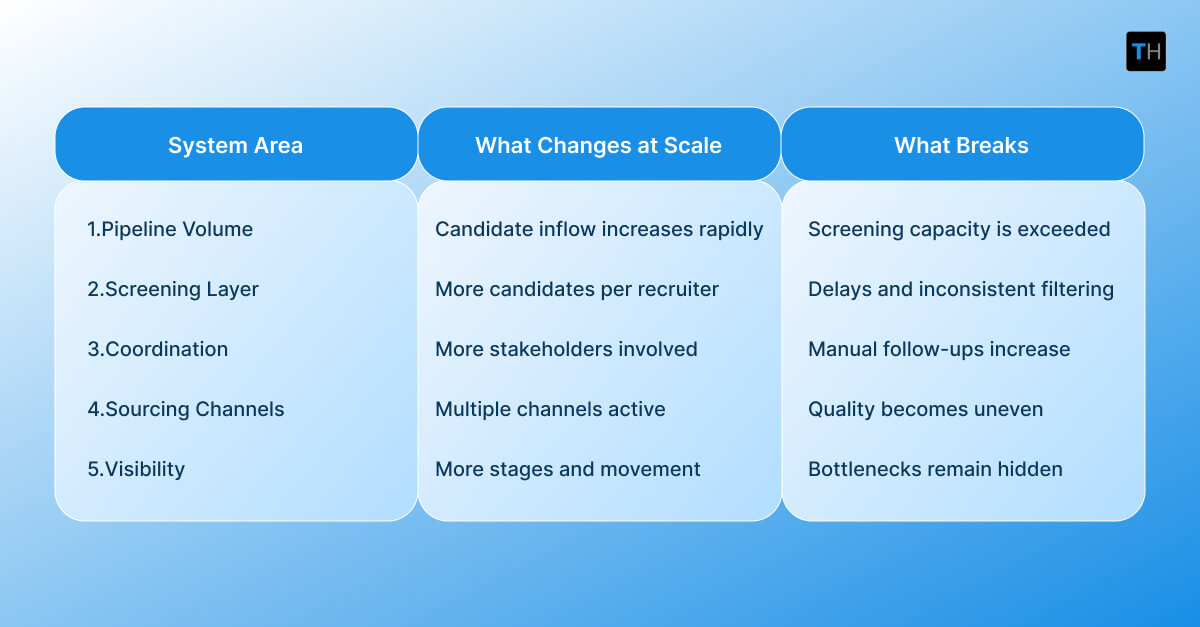
1. Candidate Pipelines Grow Faster Than Screening Capacity
Modern sourcing channels make it easier to generate candidate pipelines at scale.
Job boards, referral programs, outbound sourcing, and employer branding initiatives all contribute to a steady inflow of applications. As hiring demand grows, organizations often expand these channels further to ensure coverage across roles.
However, screening capacity does not scale at the same pace.
Recruiters still need to review resumes, assess relevance, and conduct initial conversations. The effort required to evaluate each candidate remains relatively constant even as volume increases.
Pipelines expand quickly, but screening cannot keep up. Recruiters spend more time filtering applications instead of identifying strong candidates. Qualified candidates may wait longer for responses, while less relevant profiles move forward due to inconsistent prioritization.
2. Screening Becomes the Primary Bottleneck
Screening sits between sourcing and hiring. Every candidate must pass through this stage before entering the hiring process.
When screening slows down, the entire recruitment process slows down with it.
At scale, recruiters manage multiple roles and large volumes of applications simultaneously. Resume reviews are delayed, and initial screening calls are pushed out. Candidate prioritization is done on a whim rather than carried out in a structured manner.
Strong candidates may remain in the pipeline without timely engagement. Others may move forward without consistent filtering. Screening becomes a point of congestion rather than a point of filtering.
3. Coordination Relies on Manual Workflows
Many recruitment processes still depend on manual coordination.
Recruiters manage outreach through email threads. Candidate progress is tracked across spreadsheets or disconnected systems. Screening notes and updates are captured in separate tools, without a unified view of the pipeline.
This approach works when volume is low.
As candidate inflow increases, manual coordination becomes difficult to sustain. Recruiters follow up with candidates and stakeholders repeatedly. Communication becomes fragmented. Tracking candidate status requires constant effort.
Instead of focusing on candidate quality, recruiters spend time ensuring that communication continues and tasks are completed.
4. Recruitment Channels Create Pipeline Imbalance
Organizations rely on multiple sourcing channels to build candidate pipelines.
Each channel produces different types of candidates. Some generate high volumes with lower relevance. Others produce fewer but more relevant candidates.
Without structured control, these channels create imbalance.
Recruiters receive large volumes of applications that are difficult to process efficiently. High-quality candidates may be hidden within the pipeline due to overall volume pressure.
Screening effort increases, but candidate quality does not improve proportionally.
5. Lack of Visibility Into Recruitment Performance
At scale, recruitment requires visibility into how candidates move through the pipeline.
In many organizations, this visibility is limited.
Teams often do not have clear answers to:
- How long does screening take
- Where candidates drop off
- Which roles experience delays
- Which sourcing channels are effective
Without these signals, recruitment problems remain hidden.
Teams often respond by increasing activity. However, the underlying issues remain unchanged. These inefficiencies compound across stages. The average time to hire has reached approximately 44 days globally, reflecting how extended hiring cycles have become.
What Recruitment Looks Like When It Breaks
- Candidate pipelines expand but do not convert efficiently: A higher number of applications enter the system, but a smaller proportion progresses meaningfully through screening.
- Screening delays begin to increase across roles: Recruiters are unable to review and respond to candidates within expected timelines as volumes grow.
- Candidate communication becomes inconsistent: Follow-ups, updates, and responses vary across candidates depending on workload and coordination gaps.
- Recruiters spend more time coordinating than evaluating: A significant portion of effort shifts toward scheduling, tracking, and follow-ups instead of assessing candidate quality.
- More candidates are being sourced and processed: The system appears active as sourcing channels and application volumes continue to increase.
- Candidates wait longer between stages: Movement across the pipeline slows down due to delays in screening and coordination.
- Shortlists take longer to form: Recruiters require more time to filter and identify relevant candidates from larger pools.
- Hiring teams receive inconsistent candidate quality: The lack of structured screening leads to variability in the quality of candidates entering evaluation stages.
- Activity increases, but flow becomes unstable: Despite higher levels of effort and output, the recruitment process loses consistency in candidate movement.
Recruitment Becomes a System Problem
At this stage, recruitment is no longer just a sourcing activity.
It becomes a system-level problem.
Multiple activities occur simultaneously:
- Candidates enter through different channels
- Pipelines expand across roles
- Screening happens in parallel
- Recruiters coordinate across stakeholders
The outcome depends on how these activities are aligned. When coordination weakens, the system becomes unstable.
Recruitment cannot be improved by increasing activity alone. It requires structural alignment across pipelines, screening, and coordination. Recruitment inefficiencies have direct financial implications. The average cost per hire is approximately $4,683, which increases further when pipelines are poorly structured.
Moving From Recruitment Activity to Recruitment Systems
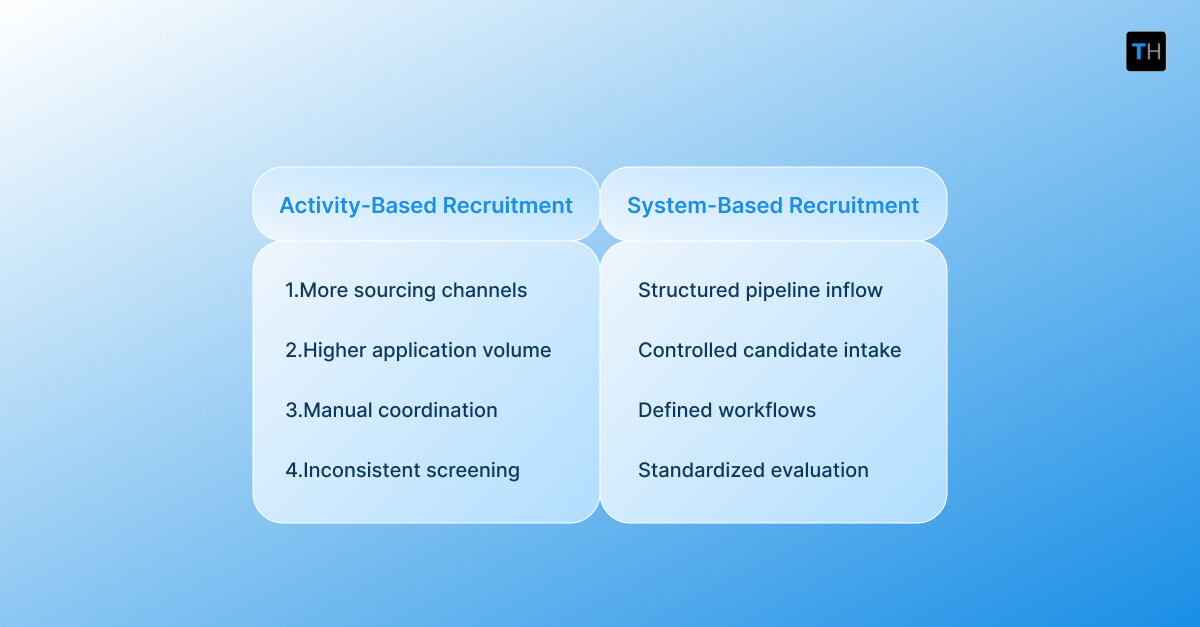
Properties of Activity-Based Recruitment
- Organizations often respond to recruitment challenges by increasing effort
Teams attempt to solve delays and inconsistencies by doing more rather than changing how the process is structured. - Sourcing channels are expanded to increase candidate inflow
Additional channels are introduced to generate more candidates without addressing the screening capacity. - More tools are added to manage recruitment activities
Different tools are used for sourcing, tracking, and communication, which often increases fragmentation. - Additional steps are introduced to improve control
Extra checks, approvals, or screening layers are added in an attempt to improve decision quality. - These actions increase activity but do not resolve the underlying problem
The volume of work increases, but coordination, consistency, and flow remain unchanged.
Properties of System-Based Recruitment
- Recruitment stabilizes when it is designed as a system
The focus shifts from individual tasks to how pipelines, screening, and coordination operate together. - Pipelines must be structured to align candidate inflow with screening capacity
Candidate volume is controlled so that recruiters can evaluate profiles without delays. - Screening must follow consistent criteria to maintain quality
Standardized filtering ensures that candidates are assessed uniformly across roles. - Coordination must move from manual tracking to structured workflows
Communication, tracking, and follow-ups are managed within defined systems rather than individual effort. - Visibility must exist across all stages to identify delays early
Recruitment teams need clear insights into where candidates slow down or drop off. - When these elements are aligned, recruitment becomes predictable at scale
Candidate movement stabilizes, and the process remains consistent even at higher volumes.
Conclusion
Recruitment processes do not fail because teams stop working hard. They fail because the process was designed for lower complexity and cannot handle increased scale.
As hiring demand grows, pipelines expand, screening slows, coordination becomes harder, and visibility reduces. These factors combine to create instability across the recruitment process.
Organizations that treat recruitment as a structured system maintain stable pipelines and consistent candidate flow.
Those who treat it as a set of isolated tasks experience delays, inconsistency, and reduced hiring velocity as they scale. Recruitment stability is not achieved through increased activity. It is achieved through structured system design. Turbohire ensures that organizations implement an end-to-end recruitment process without breakdowns at scale. It is built keeping the challenges of modern-day high-volume hiring in mind.
Frequently Asked Questions (FAQs)
1. Why do recruitment processes fail at scale?
Recruitment processes fail at scale because they are often designed for lower hiring volumes. As candidate pipelines grow and more stakeholders get involved, screening capacity, coordination, and visibility do not scale at the same pace. This leads to delays, inconsistent candidate quality, and unstable pipelines.
2. What are the most common recruitment process challenges?
Common recruitment process challenges include pipeline overload, slow screening, manual coordination, and lack of visibility into recruitment performance. These issues make it difficult for recruiters to manage candidate flow effectively and maintain consistency across roles.
3. How does recruitment impact hiring velocity?
Recruitment directly affects hiring velocity by determining how candidates enter the hiring pipeline. When recruitment pipelines are inconsistent or delayed, candidates reach the hiring stages at irregular intervals. This slows down interviews, decision-making, and overall time-to-hire.