

The recruitment process is a critical operational function. No two ways about it. Organizations today compete for talent in increasingly complex labor markets. Teams expand across geographies, skill requirements evolve quickly, and hiring demand fluctuates as businesses scale.
Recruitment determines how candidates enter the talent pipeline in these tricky situations. Organizations often underestimate the scale of recruitment pipelines. Employers received an average of 180 applicants for every hire, highlighting how large candidate pipelines have become in modern recruiting.
It governs how organizations attract, engage, and filter potential candidates before the formal evaluation process begins. A poorly structured recruitment process has a negative impact on candidate pipelines, screening, and the selection of qualified candidates.
A structured recruitment process addresses these challenges by ensuring that organizations consistently attract relevant candidates and maintain stable talent pipelines.
What Is the Recruitment Process?
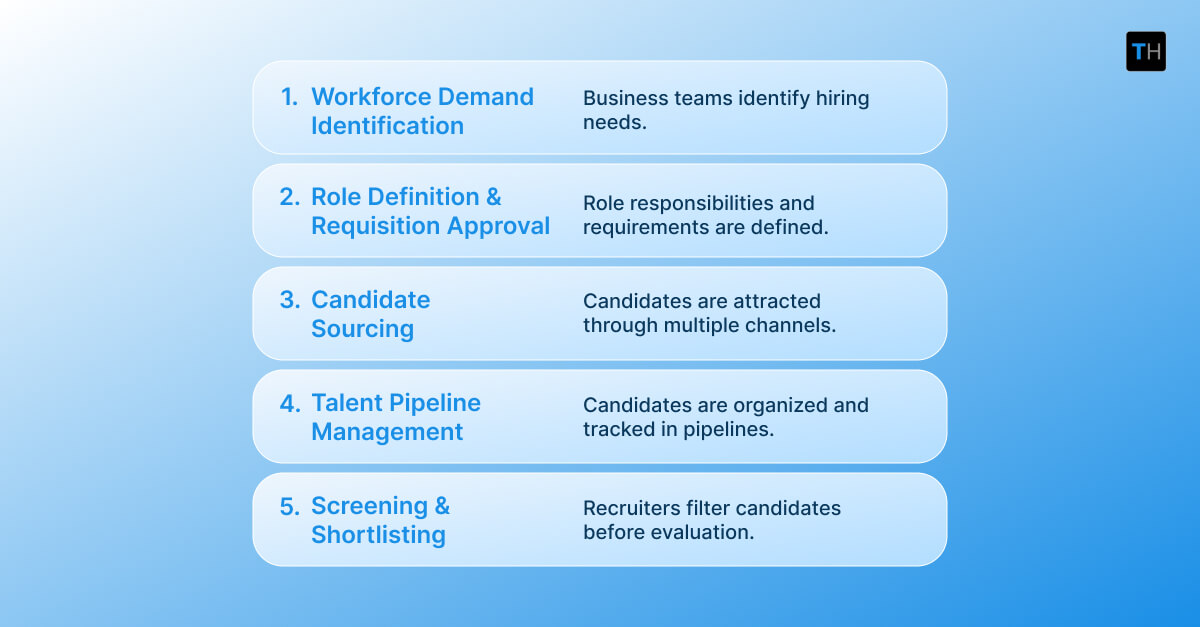
The recruitment process is the structured system organizations use to identify, attract, and engage potential candidates for open roles.
Recruitment governs how candidates enter the hiring pipeline before formal evaluation begins. Its primary purpose is to build a pool of candidates who meet the basic requirements for a role.
Recruitment activities typically include:
- Identifying workforce demand
- Defining the role and creating job requisitions
- Sourcing candidates across multiple channels
- Building and managing talent pipelines
- Conducting initial screening and shortlisting
Recruitment acts as the entry layer of the broader talent acquisition system. It prepares candidate pipelines so that hiring teams can focus on evaluating qualified candidates rather than filtering large volumes of unsuitable profiles.
Recruitment Process vs Hiring Process
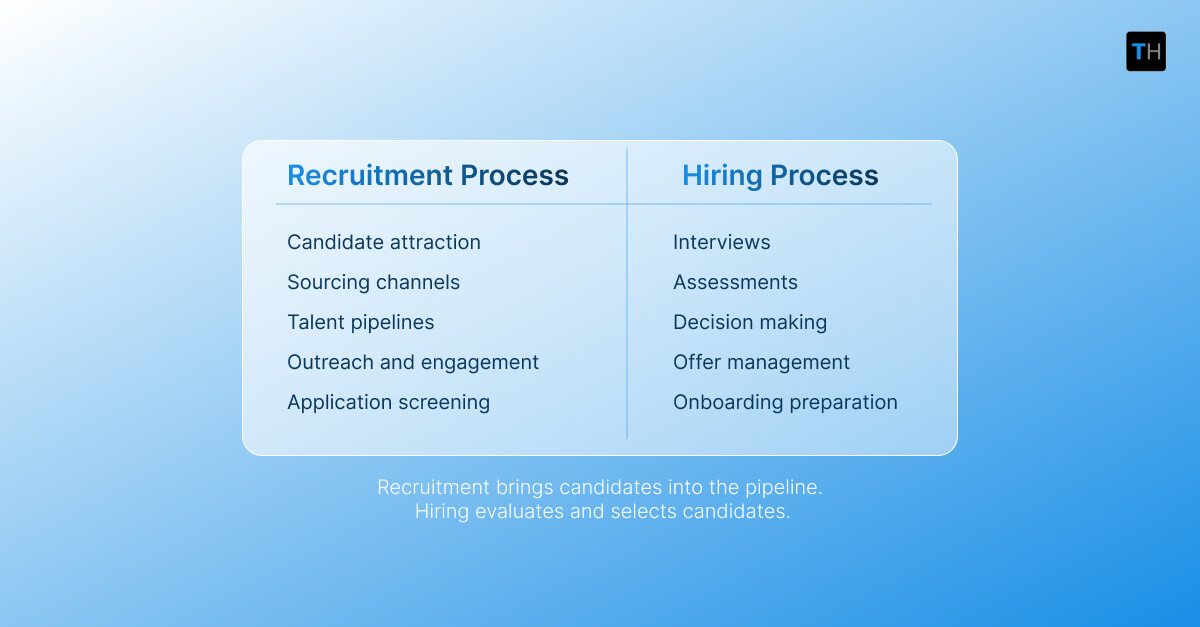
The recruitment process and the hiring process are closely related but serve different functions within the talent acquisition system.
Recruitment focuses on attracting and bringing candidates into the pipeline.
Typical recruitment activities include:
- Employer branding and job promotion
- Candidate sourcing
- Outreach and engagement
- Collecting applications
- Early-stage screening
The hiring process begins once candidates move into formal evaluation stages.
Hiring activities include:
- Structured interviews
- Candidate assessments
- Decision-making and approvals
- Offer management
- Onboarding preparation
In simple terms:
- Recruitment builds the candidate pipeline.
- Hiring selects candidates from that pipeline.
Both processes work together within the talent acquisition system. Recruitment ensures that qualified candidates enter the pipeline, while hiring ensures that the most suitable candidates are selected.
Why Recruitment Processes Break as Organizations Scale
Recruitment processes that work effectively in small organizations often struggle when hiring demand increases.
As organizations grow, recruitment must support multiple roles, teams, and hiring managers simultaneously. Several structural challenges begin to appear.
1. Coordination Complexity Increases
Recruitment involves coordination between multiple stakeholders. Recruiters must communicate with hiring managers, business leaders, and sometimes external partners.
Each new role introduces additional sourcing requirements and communication channels. Recruiters spend significant time managing logistics rather than engaging candidates when coordination is handled informally.
Coordination becomes harder to sustain as hiring demand grows.
2. Candidate Pipelines Grow Rapidly
Modern sourcing tools make it easier than ever to attract candidates. Job boards, professional networks, referral programs, and sourcing platforms can generate large numbers of applications quickly.
However, larger pipelines do not automatically produce better hiring outcomes. Recruiters spend more time filtering applications rather than identifying strong candidates if pipelines contain large volumes of unqualified candidates.
The result is screening overload.
3. Manual Recruitment Workflows Create Delays
Many recruitment activities still rely on manual processes.
Recruiters often track candidates through spreadsheets or fragmented systems. Outreach may be managed through email threads, and candidate communication may occur across multiple tools.
Manual coordination remains a major challenge for recruiting teams. Recruiters spend around 42% of their time scheduling interviews and coordinating logistics rather than evaluating candidates.
These workflows become increasingly difficult to manage as candidate volumes grow. Recruiters spend more time coordinating tasks and less time engaging with candidates.
4. Lack of Recruitment Visibility
Organizations frequently lack clear visibility into recruitment performance.
Without recruitment metrics, teams struggle to answer important questions such as:
- Which sourcing channels produce strong candidates?
- Where do candidates drop off in the recruitment pipeline?
- How long does screening take for each role?
- Which roles experience sourcing difficulties?
When these signals remain hidden, recruitment teams find it difficult to improve their processes.
The End-to-End Recruitment Process Explained
A structured recruitment process typically follows several interconnected stages.
1. Workforce Demand Identification
Recruitment begins when organizations identify a need for talent.
Business leaders and hiring managers determine which roles must be filled based on team capacity, growth plans, or operational requirements.
Workforce planning ensures that recruitment supports broader business objectives.
2. Role Definition and Requisition Approval
Hiring managers define the role once hiring demand is identified.
Responsibilities, required skills, and success criteria are documented in the job requisition. The requisition is then reviewed and approved internally before recruitment activities begin.
Clear role definitions help recruiters focus on relevant candidate profiles.
3. Candidate Sourcing and Attraction
Recruiters attract candidates through multiple sourcing channels.
Common sources include:
- Employee referrals
- Internal mobility programs
- Job boards
- Company career sites
- Professional networks
Organizations may also maintain talent pools that include previous applicants or passive candidates.
The goal of this stage is to build a pipeline of candidates who match the role’s requirements.
4. Talent Pipeline Management
Recruitment pipelines require continuous management.
Recruiters organize candidates based on role alignment, experience level, and engagement status. A well-managed pipeline ensures that strong candidates remain visible and engaged throughout the recruitment process.
Pipeline management also helps recruiters maintain a steady supply of candidates for open roles.
5. Application Screening and Shortlisting
Screening reduces the candidate pool to a shortlist of relevant candidates.
Recruiters review resumes, verify role alignment, and conduct initial conversations to confirm key details such as:
- Relevant experience
- Salary expectations
- Availability
- Location preferences
This stage ensures that candidates entering the hiring process meet the role’s basic requirements.
Key Recruitment Metrics to Track in the Recruitment Process
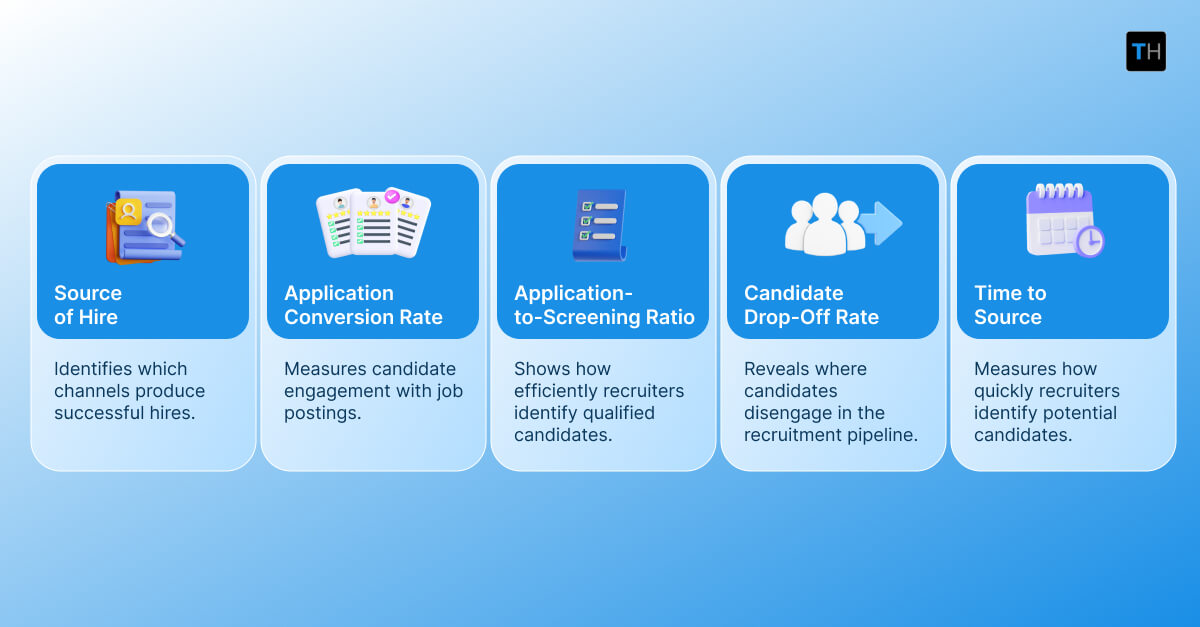
Recruitment processes improve when organizations measure performance using relevant metrics.
These metrics provide visibility into pipeline health and sourcing effectiveness.
1. Sourcing Metrics
- Source of hire
Identifies which recruitment channels produce successful hires. - Application conversion rate
Measures the percentage of candidates who apply after seeing a job posting or outreach.
2. Pipeline Metrics
- Application-to-screening ratio
Indicates how efficiently recruiters identify qualified candidates. - Candidate drop-off rate
Shows where candidates disengage during recruitment stages.
3. Efficiency Metrics
- Time to source
Measures how long it takes to identify potential candidates for a role. - Time to screen
Tracks the duration between application submission and the initial screening conversation.
Monitoring these metrics helps organizations understand where recruitment processes require improvement.
How the Recruitment Process Supports Hiring Outcomes
Recruitment quality directly influences hiring outcomes. Recruitment decisions have direct financial implications. The average cost-per-hire globally is about $4,683, demonstrating how inefficient recruitment processes can increase organizational costs.
When recruitment pipelines contain relevant candidates, hiring teams can evaluate candidates efficiently. Interview panels spend less time filtering unsuitable profiles and more time assessing candidate capabilities.
Strong recruitment processes therefore improve:
- Hiring velocity
- Candidate experience
- Decision confidence
Conversely, weak recruitment pipelines introduce noise into the hiring process. Hiring teams must evaluate large numbers of unsuitable candidates, which slows down hiring decisions.
Recruitment, therefore, forms the foundation of the hiring system.
Technology's Role in Modern Recruitment Processes
Technology has become an important component of modern recruitment systems.
Recruitment platforms enable organizations to:
- Centralize candidate pipelines
- Automate sourcing workflows
- Manage candidate communication
- Track recruitment performance metrics
Recruitment automation reduces manual coordination and improves visibility into recruitment activity.
AI-enabled recruitment tools can also assist with candidate matching, helping recruiters identify relevant profiles more quickly.
These technologies allow recruitment teams to spend more time engaging candidates and less time managing administrative tasks.
Building a Scalable Recruitment Process with TurboHire
TurboHire enables organizations to manage recruitment activity within a unified platform.
The platform supports:
- Structured requisition management
- AI-assisted candidate sourcing
- Automated screening workflows
- Centralized pipeline management
- Recruitment analytics and reporting
These capabilities allow recruitment teams to manage large candidate pipelines while maintaining visibility across roles and hiring stages.
TurboHire helps organizations design recruitment processes that scale with hiring demand.
Conclusion
Recruitment plays a critical role in the talent acquisition lifecycle.
Organizations that treat recruitment as a structured system rather than a collection of isolated tasks attract stronger candidates and maintain healthier pipelines.
As hiring demand increases, recruitment processes must support coordination across multiple sourcing channels, roles, and stakeholders.
Structured recruitment systems create stable candidate pipelines and prepare hiring teams with qualified candidates for evaluation.
Organizations that invest in scalable recruitment processes position themselves to compete more effectively for talent and maintain consistent hiring outcomes.
Frequently Asked Questions (FAQs)
1. What is the recruitment process?
The recruitment process is the structured method organizations use to identify, attract, and engage potential candidates for open roles. It includes activities such as workforce demand identification, role definition, candidate sourcing, talent pipeline management, and application screening. The recruitment process ensures that qualified candidates enter the hiring pipeline before formal evaluation begins.
2. What are the main steps in the recruitment process?
While recruitment processes may vary across organizations, the core stages typically include:
- Identifying workforce demand
- Defining the role and approving the requisition
- Sourcing candidates across multiple channels
- Building and managing talent pipelines
- Screening applications and shortlisting candidates
These steps ensure that relevant candidates enter the hiring process for further evaluation.
3. What is the difference between the recruitment process and the hiring process?
The recruitment process focuses on attracting and sourcing candidates, while the hiring process focuses on evaluating and selecting candidates.
Recruitment activities include sourcing, outreach, and screening. Hiring activities include interviews, assessments, decision-making, and offer management. Both processes work together within the broader talent acquisition system.
4. Why is the recruitment process important for organizations?
The recruitment process determines the quality of the candidate pipeline entering the hiring process. A well-structured recruitment process helps organizations attract relevant candidates, reduce screening effort, and improve hiring efficiency. Strong recruitment pipelines allow hiring teams to evaluate qualified candidates faster and make better hiring decisions.
5. How can organizations improve their recruitment process?
Organizations can improve their recruitment process by introducing structured sourcing strategies, maintaining organized talent pipelines, and using recruitment metrics to monitor performance. Recruitment technology and automation tools also help streamline sourcing workflows, improve candidate communication, and provide visibility into recruitment performance.