

A hiring process working like clockwork when organizations hire occasionally is no big deal. A few roles open, recruiters source candidates, interviews are scheduled, and decisions are made. Coordination remains manageable because there are limited stakeholders involved.
However, the story takes a sharp turn when companies expand and venture into high-volume hiring. The global average time to hire has risen to about 44 days, reflecting the growing coordination required across interviewers, stakeholders, and approval stages.
Candidates’ pipelines grow at a rapid pace, interviewers’ panels struggle to juggle the plethora of interviews, and obviously, feedback takes time as there are more stakeholders involved in the hiring process. It becomes the recruiters’ second nature to keep following up just to keep the process moving.
These problems show up gradually as hiring complexity increases. Organizations often respond by adding more interviews, more approval steps, or more tools. Unfortunately, these additions rarely solve the problem.
Read eBook: What Actually Determines Hiring Speed
The real issue lies in how the hiring process is designed.
Many organizations treat the hiring process as a sequence of tasks. In reality, hiring operates more like a coordinated system where multiple activities occur simultaneously. Candidates are sourced, screened, evaluated, and approved across several teams and stakeholders.
Designing a hiring process that scales requires understanding how these moving parts interact.
Why Hiring Processes Break Under Scale
Hiring processes seldom collapse suddenly. They weaken gradually as organizations grow and hiring activity expands.
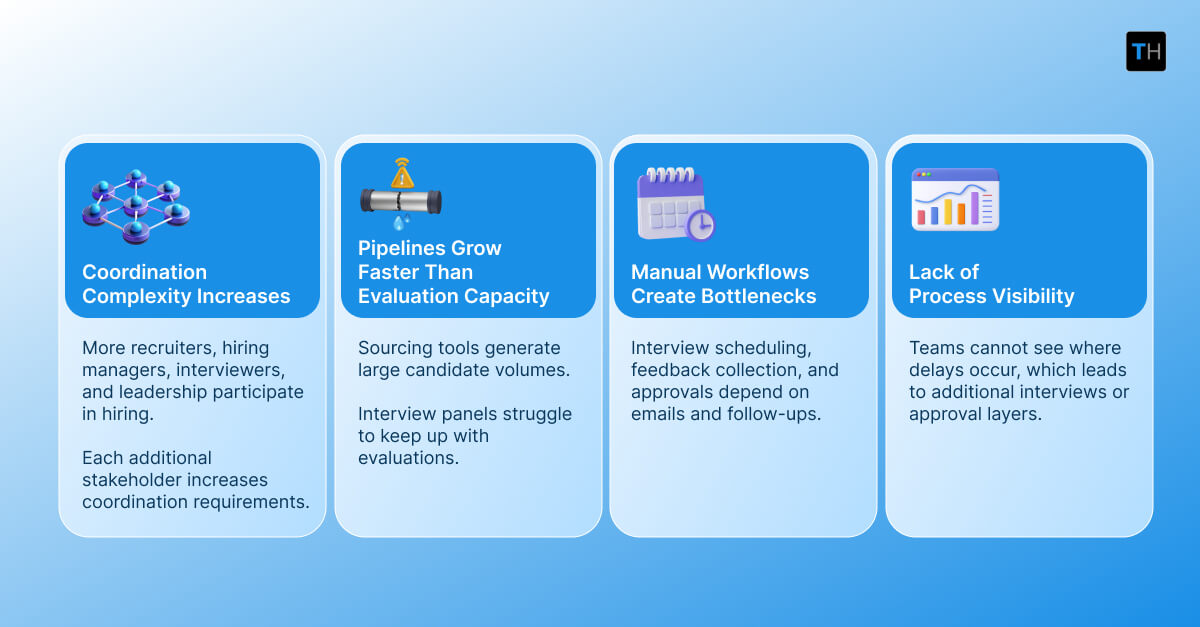
Here’s why hiring processes break under scale:
1. Coordination Complexity Increases
Hiring involves more stakeholders as organizations grow. Recruiters, hiring managers, interview panels, and leadership teams all participate in the hiring process. Each additional participant introduces new coordination requirements.
2. Candidate Pipelines Bloat Faster Than Evaluation Capacity
Modern sourcing tools and recruitment channels allow organizations to attract large numbers of candidates quickly. However, the number of interviewers and decision-makers usually remains the same.
This imbalance creates pressure within the hiring process. Candidates move quickly through early screening stages but experience delays once interviews begin.
3. Manual Workflows Create Bottlenecks
Recruiters still rely on emails to schedule interviews. While interviewers depend on docs, sheets, or messages to submit feedback. Then, hiring managers follow up manually with stakeholders to get their decisions.
These manual workflows create delays in the case of high-volume hiring. Recruiters spend more time coordinating logistics than evaluating candidates.
4. Lack of Process Visibility
Teams often respond by adding more interviews or approval steps in an attempt to improve hiring confidence. Ironically, these additional steps make the process heavier without resolving the underlying coordination issues. As many as 92% of candidates disengage at some point in the application process.
Viewing the Hiring Process as a System
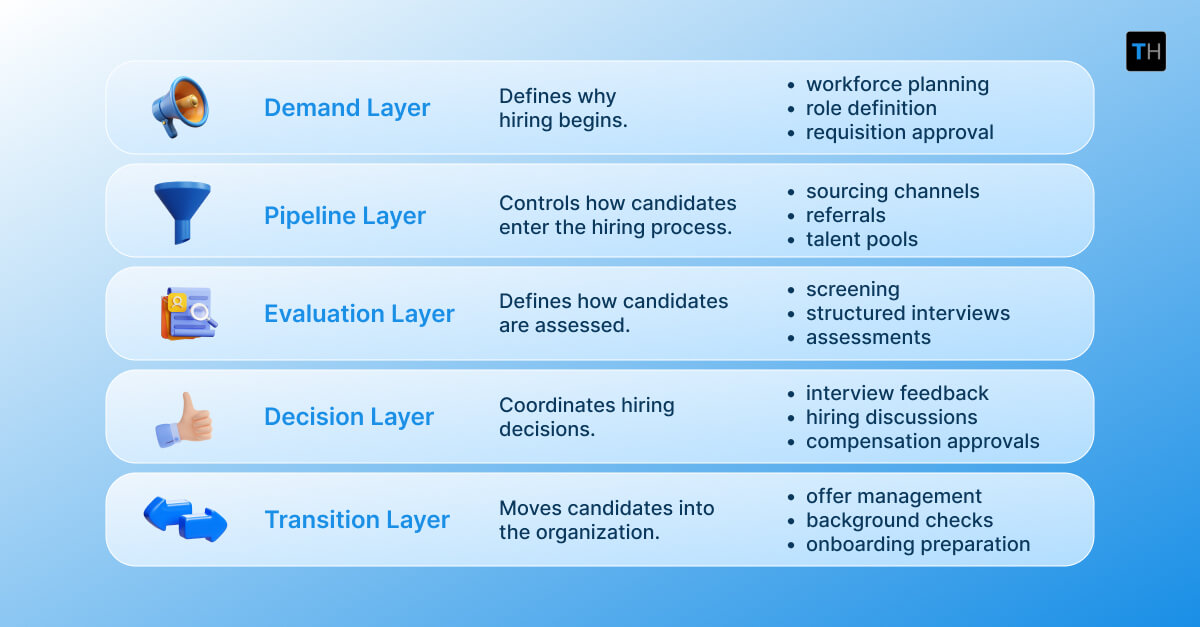
Hiring is often described as a sequence of steps. In reality, hiring operates as a system where several activities occur in parallel.
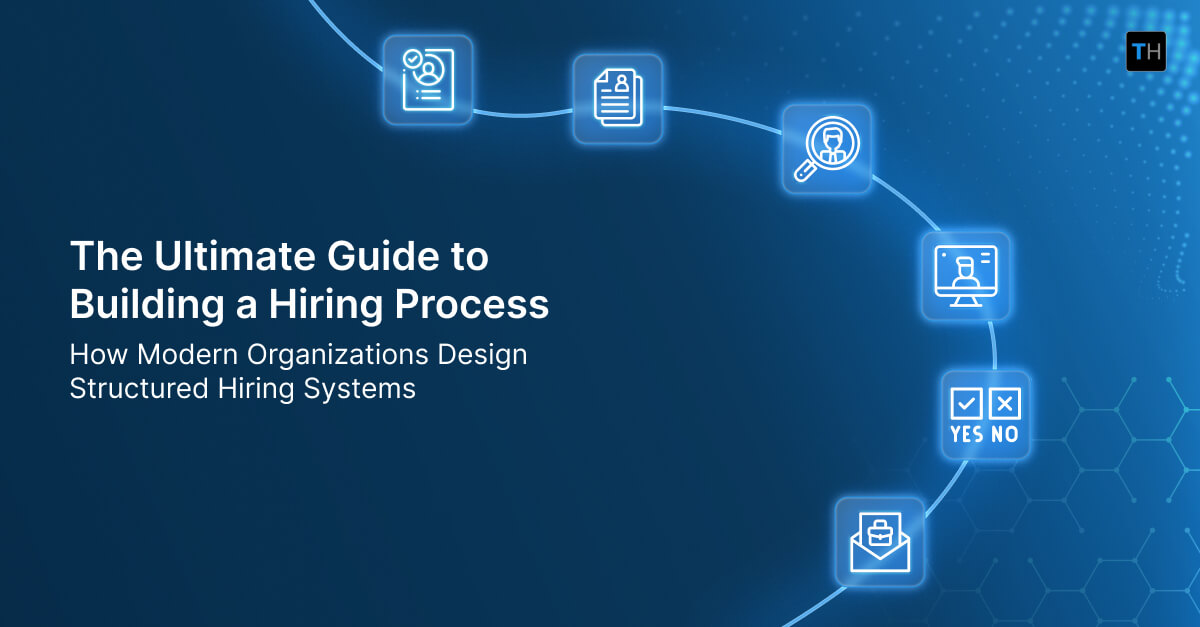
A scalable hiring process typically operates across five core layers.
Each layer performs a specific function within the hiring system.
Layer 1: Demand Layer
Defining Why Hiring Begins
The hiring process begins long before candidates enter the pipeline.
Organizations first identify a hiring need. This need may arise from team expansion, business growth, or a recently vacated role. Workforce planning helps determine which roles must be filled and when.
Next, hiring managers define the responsibilities and capabilities required for the role. These details form the basis of the job requisition.
Clear role definitions are critical at this stage.
When roles are poorly defined, recruiters screen candidates based on broad criteria. Hiring managers then refine expectations during interviews, causing confusion and repetition in later stages of the hiring process.
A well-defined demand layer ensures that everyone involved in hiring understands the purpose of the role and the capabilities required for success.
This clarity stabilizes the rest of the hiring process.
Layer 2: Pipeline Layer
Managing How Candidates Enter the Hiring Process
Recruiters attract candidates through several sourcing channels. These may include employee referrals, internal mobility programs, job boards, career sites, and direct outreach through professional networks.
Some organizations also maintain talent pools or candidate relationship management systems that track previous applicants and potential candidates.
The pipeline layer determines how candidates enter the hiring process.
Recruiters may receive large volumes of applications that are difficult to evaluate efficiently due to poorly structured pipelines. High volumes of unqualified candidates can overwhelm screening efforts.
A well-managed pipeline focuses on attracting candidates who match the role’s requirements.
This improves screening efficiency and ensures interview time is spent on relevant profiles.
Layer 3: Evaluation Layer
Assessing Candidates Consistently
The evaluation layer determines how candidates are assessed once they enter the hiring process.
This stage typically includes resume screening, structured interviews, and skills assessments.
Evaluation frameworks are particularly important here.
Without shared criteria, interviewers may evaluate candidates using different standards. One interviewer may prioritize technical expertise, while another focuses on communication or team fit.
These perspectives are valuable individually but difficult to compare when they are not anchored to shared evaluation signals.
Structured interview frameworks help solve this problem.
Interviewers assess candidates against predefined competencies and role expectations. Feedback becomes easier to compare, and hiring decisions rely more on evidence than subjective impressions.
Consistent evaluation frameworks strengthen both hiring quality and decision confidence.
Layer 4: Decision Layer
Coordinating Hiring Decisions
Once interviews are completed, the hiring process moves into the decision stage.
The interview feedback and candidate performance comparison is done by hiring teams. The decision-makers evaluate the candidates’ alignment with the role and organization. This stage is crowded with notable delays.
Interviewers fail to coordinate the timing of the feedback, and the hiring managers require more discussions before making their decisions. The compensation approvals require the nod from the leadership team. Decision cycles end up stretching because there is a lack of defined ownership.
A structured decision layer clarifies who owns the final hiring decision and how approvals are handled.
This clarity helps maintain hiring velocity and prevents unnecessary delays.
Layer 5: Transition Layer
Moving Candidates Into the Organization
The organization prepares a job offer once a candidate is selected. The offer typically includes compensation details, benefits information, start dates, and other employment terms.
Background verification checks and reference checks may also occur at this stage. The transition layer plays a significant role in candidate experience.
Delays or unclear communication during the offer stage can damage candidate confidence, especially if candidates are evaluating multiple offers simultaneously. A well-structured transition layer ensures that offers are created, approved, and communicated efficiently.
Conclusion
Hiring processes rarely fail because recruiting teams stop working hard. They fail because the system supporting the hiring process struggles to manage increasing complexity.
As organizations grow, candidate pipelines expand, stakeholders multiply, and coordination requirements increase. Hiring processes designed for smaller environments begin to strain under this pressure.
Organizations that treat hiring as operational infrastructure maintain hiring velocity while improving hiring quality.
Platforms like TurboHire helps operationalize these systems by coordinating workflows, interviews, and hiring decisions across the entire hiring process.
Frequently Asked Questions (FAQs)
1. What is a scalable hiring process?
A scalable hiring process is a structured hiring system designed to handle increasing hiring volume without slowing down candidate movement. It includes clear role definitions, structured evaluation frameworks, coordinated decision workflows, and visibility into hiring metrics.
2. Why do hiring processes slow down as organizations grow?
Hiring processes often slow down because more stakeholders participate in hiring decisions, pipelines expand rapidly, and manual coordination becomes harder. Without structured workflows and clear ownership, delays accumulate across interview scheduling, feedback collection, and final approvals.
3. How can organizations improve hiring velocity without compromising hiring quality?
Organizations can improve hiring velocity by introducing structure into the hiring process. Clear role intake, consistent evaluation frameworks, defined decision ownership, and centralized hiring metrics help candidates move steadily through evaluation stages while maintaining high hiring quality.