

It is common knowledge that the hiring process can make or break an organization. No wonder organizations invest so much time and resources in hiring. They recruit manpower, intricate processes, and cutting-edge tools to consolidate their hiring process. Sometimes, by being too fixated on the larger picture, companies miss the fundamentals of hiring.
Hiring was once confined to roles opened, reviewing resumes, scheduling interviews, and making decisions. The limited number of stakeholders meant that coordination was manageable. However, in today’s times, modern organizations operate under different circumstances.
Hiring takes place across multiple teams, locations, and functions. Modern organizations, at least at mid-enterprise and enterprise levels, are constantly resorting to high-volume hiring.
This means that the pipelines are overflowing with excessive candidates, and interviews struggle to make way across the calendars of busy stakeholders. Feedback needs to pass through several checks before a decision is finalized. In fact, 60% of candidates report having a poor hiring experience, and 72% of those candidates share that negative experience publicly or with others.
In these tumultuous conditions, hiring turns into an operational burden rather than being a recruitment activity.
Sooner or later, organizations realize that they need a structured hiring process that provides the framework to keep the system moving. It structures the entry of candidates into the pipeline, their evaluation, and the decision-making done by the stakeholders.
The terms hiring process and recruitment process are often used interchangeably. However, it would be a disservice to both if they are clubbed under one umbrella without acknowledging their differences as they address different parts of the broader talent acquisition system.
The fundamental difference is simple. Recruitment focuses primarily on attracting candidates. The hiring process governs how those candidates are evaluated and selected. However, it is important to acknowledge that both overlap across almost all their stages.
This guide’s primary focus is on the hiring process itself while touching upon the recruitment process to provide further context.
What Is a Hiring Process?
A hiring process is the structured system organizations use to evaluate, select, and onboard candidates for open roles.
It defines how candidates move from initial screening to final hiring decisions while ensuring that evaluations remain consistent across interviewers and stakeholders.
A typical hiring process includes:
- role definition and requisition approval
- candidate screening
- structured interviews and assessments
- hiring decisions and approvals
- offer management
- onboarding transition
Each stage supports a different part of the evaluation journey right from the onset. Recruiters need to filter candidate pipelines to pass through the next stage. The Interviewers assess capability and role alignment. The final decision makers are the hiring leaders who review the candidate’s performance before signing the dotted lines.
An effective hiring process balances three priorities simultaneously:
- Evaluation quality: Hiring competent candidates who can succeed in the role is a cornerstone of hiring. 75% of employees say their decision to accept a job was influenced by the candidate experience during hiring.It is important to have clear evaluation criteria to help interviewers frame their interviews and assessments accordingly. Decision making should be based on documented evidence rather than personal interpretations.
- Hiring velocity: so roles do not remain open longer than necessary. Defined stages and ownership ensure that candidates move steadily through the process without unnecessary delays. Faster decisions allow teams to maintain momentum without compromising evaluation discipline.
- Candidate experience: Roles being open for too long go hand-in-hand with a poor candidate experience. It is important to have a defined stage and ownership to ensure that candidates go through the process smoothly and steadily.
Let’s compare and contrast the hiring process and the recruitment process to get a clearer picture of the former.
Hiring Process vs Recruitment Process
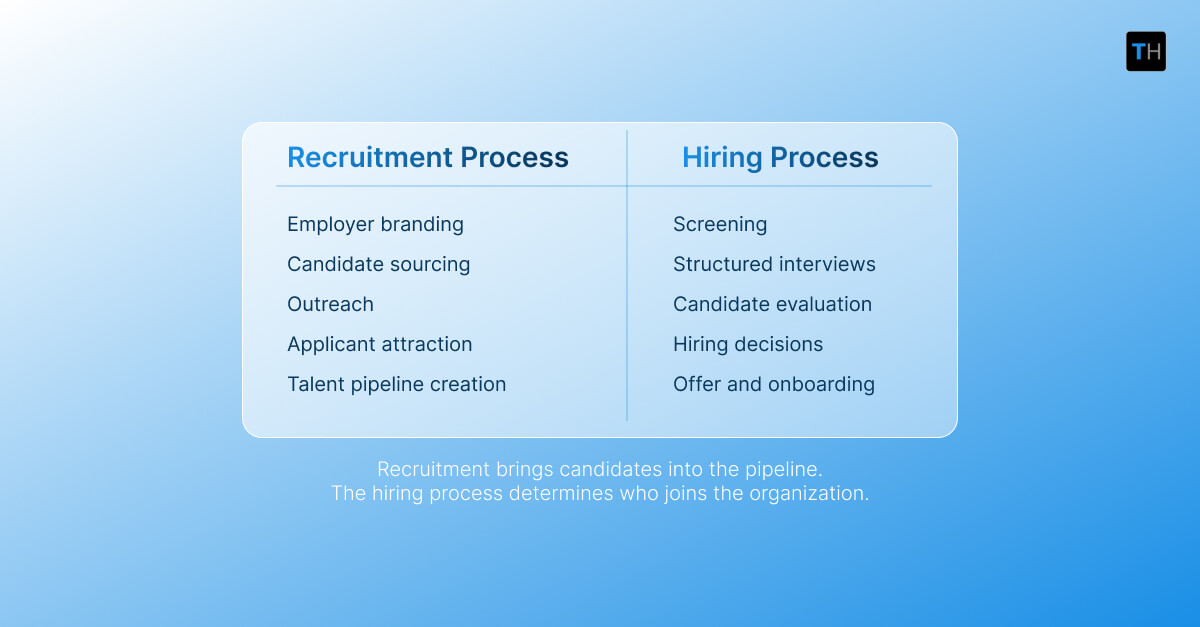
The terms hiring process and recruitment process are used synonymously. However, they describe different scopes within talent acquisition.
The hiring process begins once candidates move into the evaluation stages. It governs how candidates are assessed and how final decisions are made. Hiring activities include:
- screening and shortlisting
- structured interviews and assessments
- hiring decisions
- offer creation and acceptance
- onboarding preparation
Recruitment focuses primarily on building the candidate pipeline. Activities in recruitment typically include:
- employer branding
- sourcing candidates
- outreach and engagement
- attracting applicants through job postings and referrals
These activities determine how candidates enter the talent pipeline.
Modern organizations use both processes under a unified talent acquisition system.
Why Hiring Processes Break as Organizations Scale
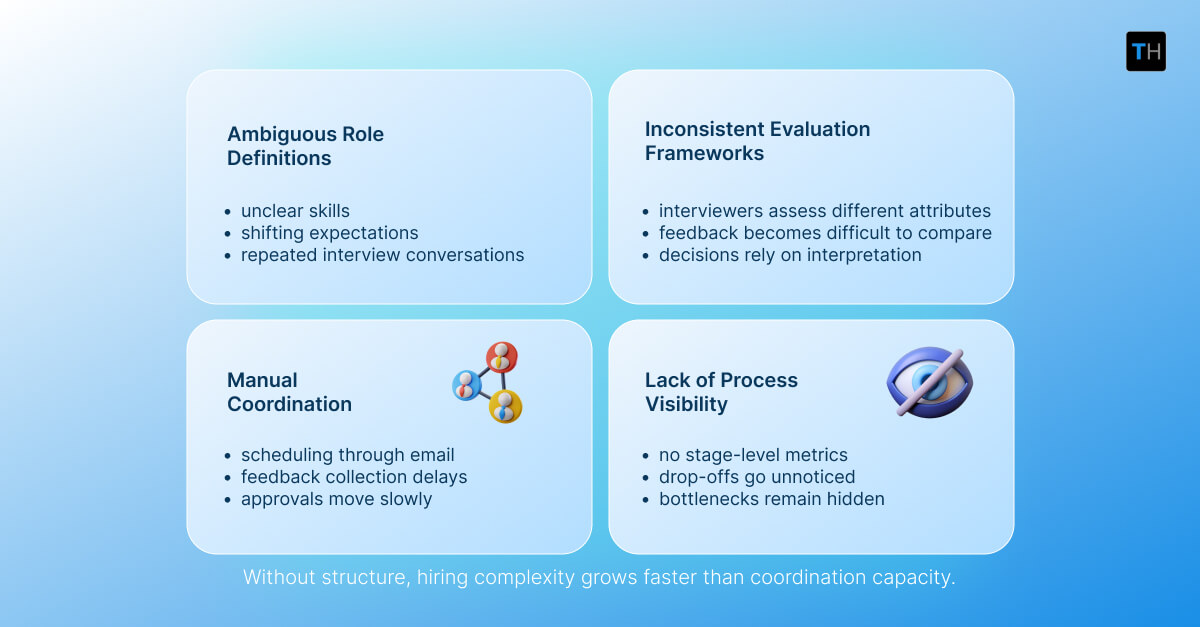
Hiring processes that work smoothly in small organizations often struggle when hiring volume increases. Coordination becomes an uphill battle as organizations deal with more open roles simultaneously. Structural issues start popping up in hordes.
1. Ambiguous Role Definitions
A well-defined role description is one of the starting points of hiring. However, many organizations go ahead without defining the proper skills required for the role. Most of the job descriptions are broad without focusing on the competencies required for the role.
Recruiters follow the same pattern as they screen candidates broadly, while hiring managers refine expectations during interviews. Interviewers end up revisiting similar questions as stakeholders attempt to clarify the role. It is akin to being stuck in a vicious circle, as candidates experience repeated conversations rather than focused evaluation.
2. Inconsistent Evaluation Frameworks
The absence of structured criteria results in interviews approaching evaluations with a subjective lens. One interviewer may prioritize technical expertise while another evaluates communication style or cultural alignment.
Feedback becomes difficult to compare, and hiring discussions shift towards subjective outlooks rather than being based on evidence. Having structured evaluation frameworks prevents these inconsistencies.
3. Manual Coordination Across Stages
Many hiring processes depend on email threads, reminders, and manual follow-ups.
Recruiters spend considerable time coordinating interview schedules, collecting feedback, and confirming approvals. As hiring volume grows, these coordination tasks consume increasing attention, and the chances of human errors increase as well.
4. Lack of Visibility Into Process Health
Organizations often lack clear data on where hiring delays occur. They are bereft of a single source of truth to provide visibility.
Candidate drop-offs, feedback delays, and approval bottlenecks remain hidden without stage-level metrics. In response, hiring teams respond by adding extra counter-productive steps or interviews in an attempt to improve decision confidence. This makes the process bulkier without improving hiring outcomes.
The End-to-End Hiring Process Explained
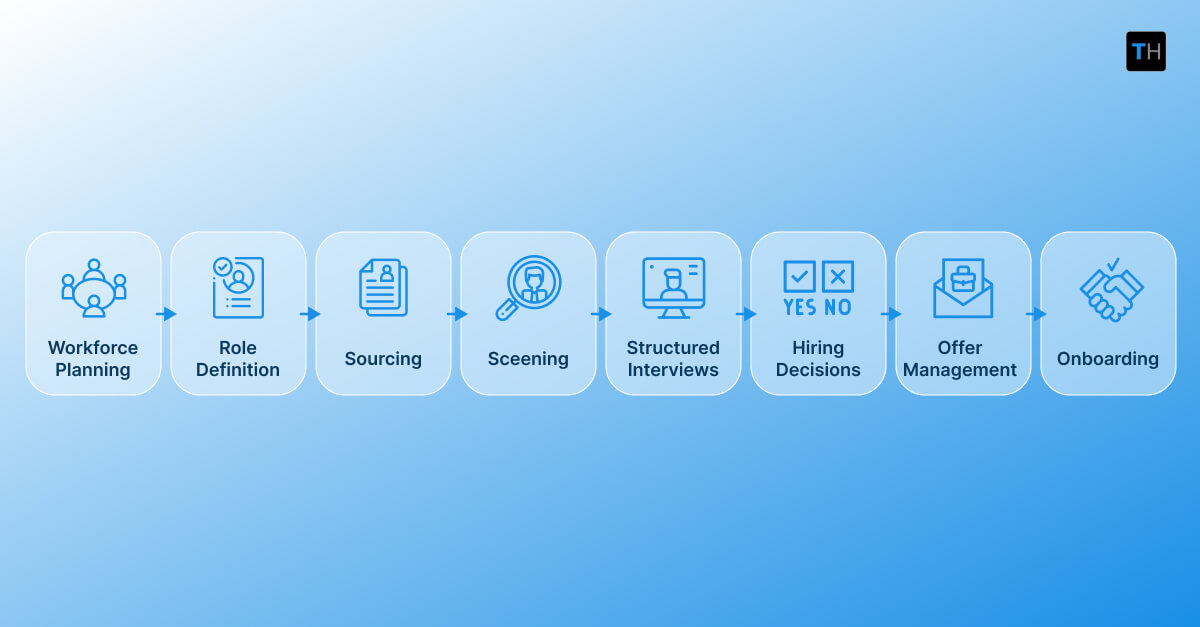
A structured hiring process moves candidates through defined stages that maintain clarity and evaluation discipline.
Each stage contributes to the final hiring decision.
Stage 1: Workforce Planning and Hiring Demand
Hiring begins when business leaders identify capability gaps within teams.
Workforce planning aligns hiring priorities with business objectives such as product development, market expansion, or operational growth. Organizations determine which roles must be filled, when those hires are required, and which capabilities are already available internally.
This stage ensures that hiring activity supports strategic priorities rather than reacting to immediate shortages.
Stage 2: Role Definition and Requisition Approval
Hiring managers clarify responsibilities, required skills, reporting structure, and success criteria. The details form the basis of job requisitions, subject to internal approval before the role opens.
Clear role definitions stabilize the rest of the hiring process. Recruiters understand which profiles to prioritize, and interviewers know what capabilities they must evaluate.
Stage 3: Candidate Sourcing and Pipeline Creation
Recruiters attract candidates through multiple sourcing channels. Common sources include employee referrals, internal mobility programs, job boards, and direct outreach to passive candidates. The goal of this stage is to build a pipeline of candidates who align with the role’s requirements.
The quality of this pipeline significantly influences screening efficiency.
Stage 4: Screening and Shortlisting
Screening reduces the candidate pool to a shortlist of strong candidates.
Recruiters review resumes and conduct initial conversations to verify experience, skills, and role alignment. Structured screening criteria help recruiters identify candidates who match the role’s core requirements.
This stage ensures that the interview time focuses on the most relevant profiles.
Stage 5: Structured Interviews and Assessments
Interviews provide a deeper evaluation of a candidate’s capabilities.
Organizations often use structured frameworks to maintain consistency across interviewers. Interviewers assess candidates against predefined competencies, technical requirements, and role expectations.
Structured interviews improve comparability between candidates and strengthen hiring decisions.
Stage 6: Hiring Decisions and Approvals
Hiring teams review feedback and discuss candidates after interviews conclude.
Decision-makers examine evaluation notes, compare candidate strengths, and confirm alignment with role requirements. Clear decision ownership helps maintain momentum at this stage.
Hiring processes slow significantly when accountability for final decisions remains unclear.
Stage 7: Offer Management
The selected candidate receives an offer once the hiring decision is confirmed.
Offer management includes compensation approvals, documentation preparation, and communication with the candidate. Transparent timelines and clear communication improve the likelihood of offer acceptance.
Stage 8: Onboarding and Early Engagement
The hiring process concludes when candidates transition into their new roles.
Onboarding helps new employees integrate into teams, understand expectations, and begin contributing effectively. Early engagement supports faster ramp-up and strengthens employee retention.
Hiring Process Architecture: How the System Operates
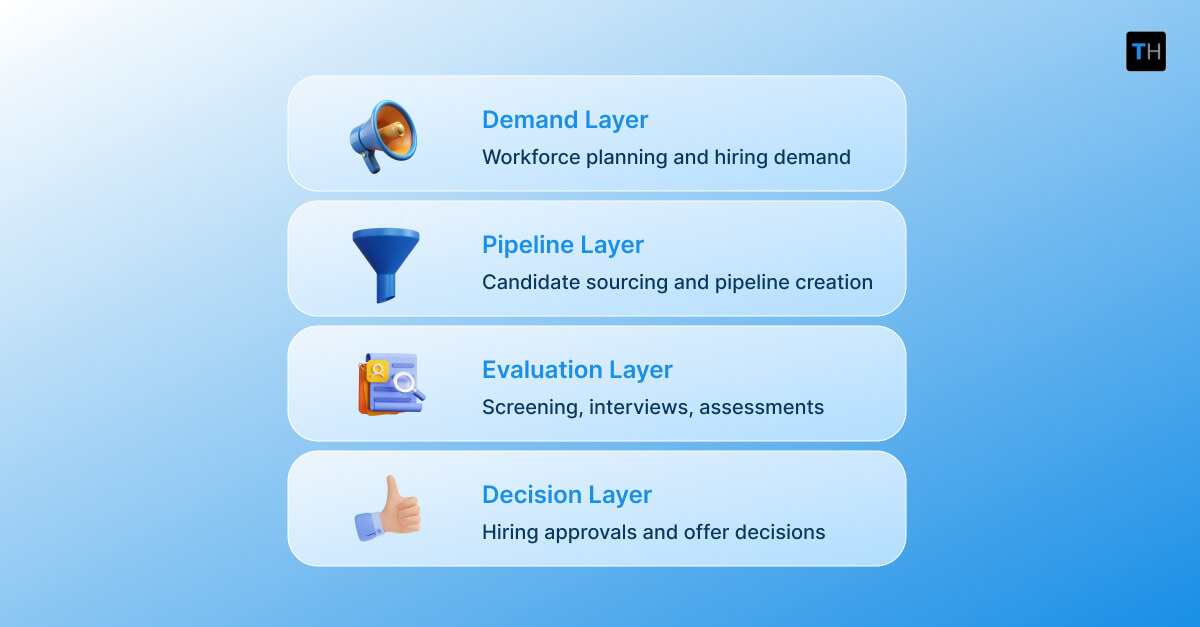
A hiring process consists of more than sequential stages. It operates through interconnected layers that coordinate hiring activity across the organization.
Four structural layers shape this system.
1. Demand Layer
The demand layer defines why hiring begins.
Workforce planning and business priorities determine which roles must be filled and when. Clear demand signals ensure that hiring supports organizational strategy.
2. Pipeline Layer
This layer governs how candidates enter the system.
Recruiters build candidate pipelines through sourcing channels, referrals, and talent communities. Pipeline quality influences how efficiently candidates move through screening and interviews.
3. Evaluation Layer
The evaluation layer defines how candidates are assessed.
Structured screening frameworks, interview guidelines, and standardized feedback forms ensure that interviewers evaluate candidates consistently.
Evaluation discipline strengthens decision confidence.
4. Decision Layer
The decision layer governs approvals and final hiring outcomes.
Hiring committees, leadership reviews, and compensation approvals ensure alignment with organizational priorities. Defined ownership helps decisions move forward without unnecessary delays.
When these layers operate in alignment, hiring processes maintain steady momentum.
Key Hiring Metrics That Show Hiring Process' Health
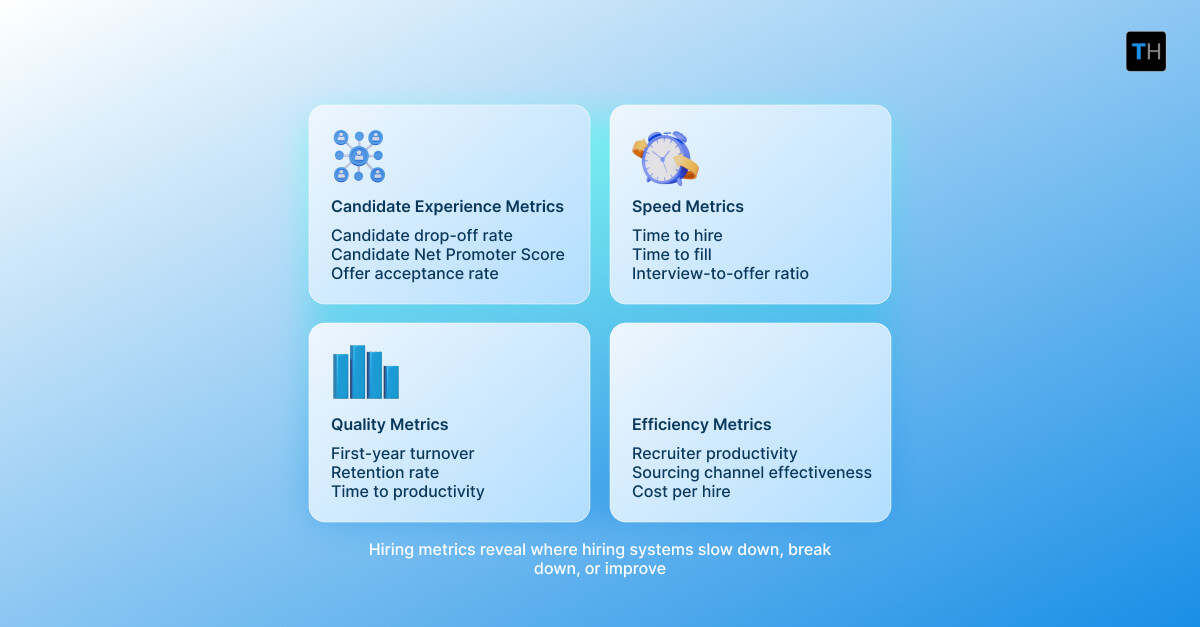
Hiring processes improve when organizations measure outcomes rather than activity alone.
Several metrics provide insight into hiring system performance.
1. Candidate experience metrics
- Candidate drop-off rate reveals where candidates disengage from the process.
- Candidate Net Promoter Score measures how candidates perceive the hiring journey.
- Offer acceptance rate indicates how well candidate expectations align with final offers.
2. Speed metrics
- Time to hire measures the number of days between candidate entry and offer acceptance.
- Time to fill reflects how quickly open roles are closed.
- Interview-to-offer ratio indicates how effectively screening identifies qualified candidates.
3. Quality metrics
- First-year turnover highlights early attrition caused by poor role fit.
- Retention rate measures how successfully the organization retains employees.
- Time to productivity tracks how quickly new hires begin contributing to team performance.
4. Efficiency metrics
- Recruiter productivity measures the number of hires supported by each recruiter.
- Sourcing channel effectiveness reveals which channels produce the strongest candidates.
- Cost per hire reflects the overall investment required to fill roles.
These metrics help organizations identify bottlenecks and refine hiring systems continuously.
Technology's Role in Modern Hiring Processes
Technology strengthens hiring processes by improving coordination between stages.
Modern hiring platforms enable organizations to:
- Standardize hiring workflows
- Automate interview scheduling
- Centralize candidate feedback
- Track hiring metrics across stages
Recruitment automation reduces manual coordination tasks and improves visibility into hiring activity.
Technology reinforces process discipline while allowing recruiters and hiring managers to focus on evaluation and decision-making.
Designing a Hiring Process That Maintains Velocity
Structured role intake ensures that recruiters and hiring managers share the same expectations from the beginning. Interview frameworks guide evaluators toward consistent assessments.
Clear decision ownership reduces delays during approvals. Centralized hiring metrics provide visibility into process performance.
Recruitment automation supports coordination between stakeholders and reduces manual follow-ups.
On the whole, these elements create hiring systems that maintain both clarity and speed.
Building a Hiring Process and System With TurboHire
TurboHire enables organizations to manage the entire hiring lifecycle within a unified platform.
The platform supports:
- structured requisition management
- AI-assisted screening and candidate matching
- automated interview scheduling
- centralized candidate evaluation
- real-time hiring analytics
TurboHire helps organizations coordinate hiring activity across recruiters, hiring managers, and leadership teams.
Candidates move through clearly defined stages while hiring teams maintain visibility into progress and outcomes.
Conclusion: Hiring Process as Organizational Infrastructure
Hiring processes influence how organizations grow. Relying on informal coordinations leads to stretched times and inconsistent decisions. Scaling of hiring exacerbates these gaps and causes long-term problems for organizations.
In contrast, structured hiring systems provide clarity at every stage of the hiring process. Recruiters and interviewers using shared frameworks to screen and evaluate candidates help decision-makers use documented evidence to make decisions. As a result, candidates experience a process that moves steadily and transparently.
Organizations that treat hiring as operational infrastructure build stronger teams and sustain growth more effectively.
Frequently Asked Questions (FAQs)
1. What are the steps in a hiring process?
A hiring process typically includes workforce planning, role definition, candidate sourcing, screening, structured interviews, hiring decisions, offer management, and onboarding.
2. What is the difference between recruitment and hiring?
Recruitment focuses on attracting candidates and building the pipeline, while hiring focuses on evaluating candidates and making final employment decisions.
3. How long should a hiring process take?
The timeline varies depending on role complexity and hiring volume, but organizations aim to balance thorough evaluation with efficient decision-making.
4. What metrics measure hiring process performance?
Key metrics include time to hire, offer acceptance rate, candidate drop-off rate, first-year turnover, and time to productivity.
5. How does technology improve hiring processes?
Technology improves hiring processes by automating coordination tasks, centralizing candidate evaluation data, and providing visibility into hiring metrics across stages.