

High-volume hiring puts stress on hiring systems in ways that are easy to underestimate. Demand does not flow linearly. Roles flood the system. Timelines are chaotic to say the least. Despite all this, steady output is expected under these turbulent conditions.
Traditional recruitment processes were built for predictable demand and sequential work. However, high-volume hiring goes hand in hand with unforeseen circumstances popping up. There are delays on the loop. Recruiters stay busy while progress slows.
This is not a question of effort or intent. It is a question of system design.
What High-Volume Hiring Really Means in Practice
High-volume hiring is not defined by speed alone. It is defined by concurrency, repetition, and sustained pressure on the system.
1. Hiring demand arrives in parallel: In high-volume environments, roles open simultaneously across teams, locations, or shifts. Each role introduces its own intake, screening, interview, and approval requirements. Handling these steps in isolation results in too many moving elements. The system spends more time managing overlap than moving candidates forward.
2. Application volume increases faster than screening capacity: High-volume roles attract large numbers of applicants in short periods. Manual screening struggles to keep pace without sacrificing consistency. Qualified candidates wait longer at the top of the funnel, while weaker profiles move forward simply because they were reviewed earlier.
3. Candidate expectations change under volume: Candidates in high-demand markets do not expect perfection, but they do expect movement. They lose confidence when updates slow or timelines stretch.
4. Small inefficiencies repeat at scale: A vague intake, a delayed feedback loop, or a missed update may feel manageable once. Across dozens of roles, the same issue compounds.
Why Time to Hire Expands in High-Volume Hiring
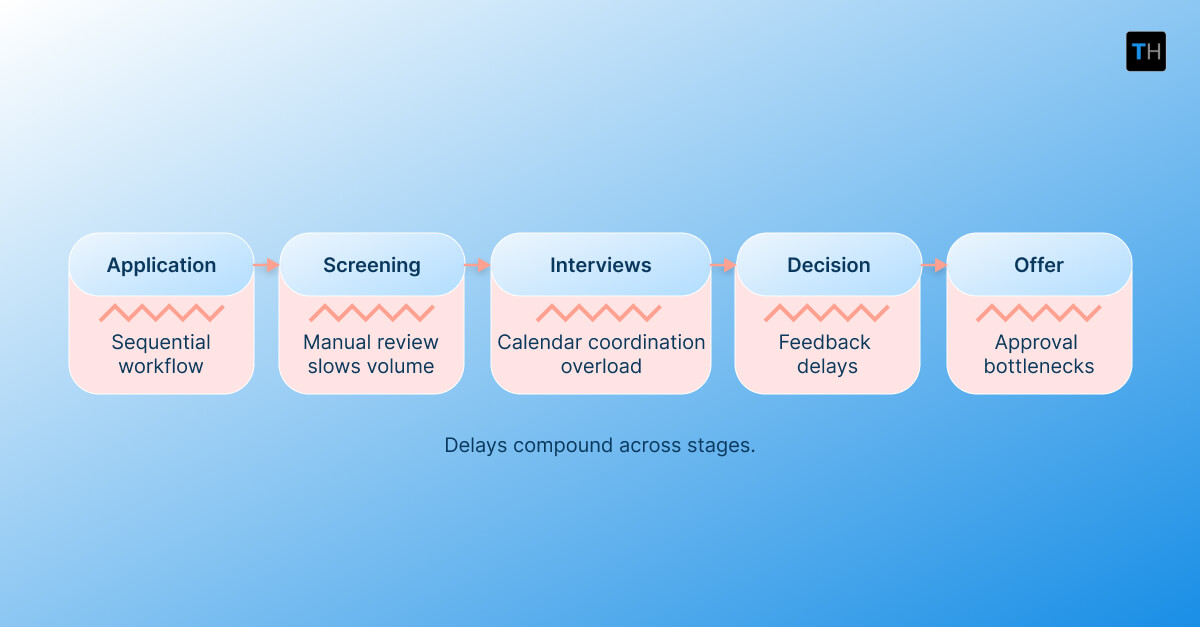
Time to hire is often the first metric to deteriorate when volume increases. Across markets, the average time to hire has stretched from roughly one month to a month and a half in just a couple of years, underscoring how quickly complexity overtakes traditional processes. The reasons are structural, not personal.
1. Coordination work grows faster than decision work: As volume rises, recruiters spend more time scheduling interviews, aligning stakeholders, and tracking progress. These tasks keep the process moving but do not improve decision quality. Over time, coordination consumes the day while evaluation gets compressed.
2. Delays stack across stages: A short delay at screening carries forward into interviews, approvals, and offers. The system rarely recovers lost time once candidates slow down.
3. Hiring managers face context overload: Managers interview more candidates across more roles. Feedback takes longer as volume increases. Decisions get delayed not because managers are disengaged, but because attention is spread thin.
4. Candidate momentum breaks: Uncertainty grows when candidates wait between stages. The drop-off rates rise. Multiple studies show that once processes stretch beyond three to four weeks without clear movement, more than half of candidates either disengage or accept competing offers. Offer acceptance declines as timelines stretch and alternatives appear.
Time to hire expands because the system cannot maintain flow under sustained demand.
Where Traditional Hiring Processes Break Down
Traditional recruitment workflows depend heavily on manual coordination and individual follow-through. These approaches struggle under scale.
1. Manual resume screening does not scale: Recruiters cannot review large volumes consistently without fatigue. Screening quality varies based on time pressure and context. Strong candidates may advance late, while weaker ones progress simply because they were seen first.
2. Interview scheduling becomes a bottleneck: Coordinating calendars across recruiters, managers, and candidates adds friction at every step. Reschedules introduce further delays. At volume, scheduling alone can stall the funnel.
3. Feedback lacks structure and ownership: Candidates start stalling when feedback is optional or loosely defined. Decisions slow even when interviews are complete.
4. Tools fragment context: When sourcing, screening, scheduling, and feedback live in separate systems, information gets lost. Recruiters get stuck in a loop to restore context. As a result, organizations fail to arrive at a decision.
Read eBook: Hiring in the Age of AI: What Actually Determines Hiring Speed
These failures reflect systems that depend on human intervention to compensate for missing structure.
The Hidden Cost of Delayed Hiring in High-Volume Roles
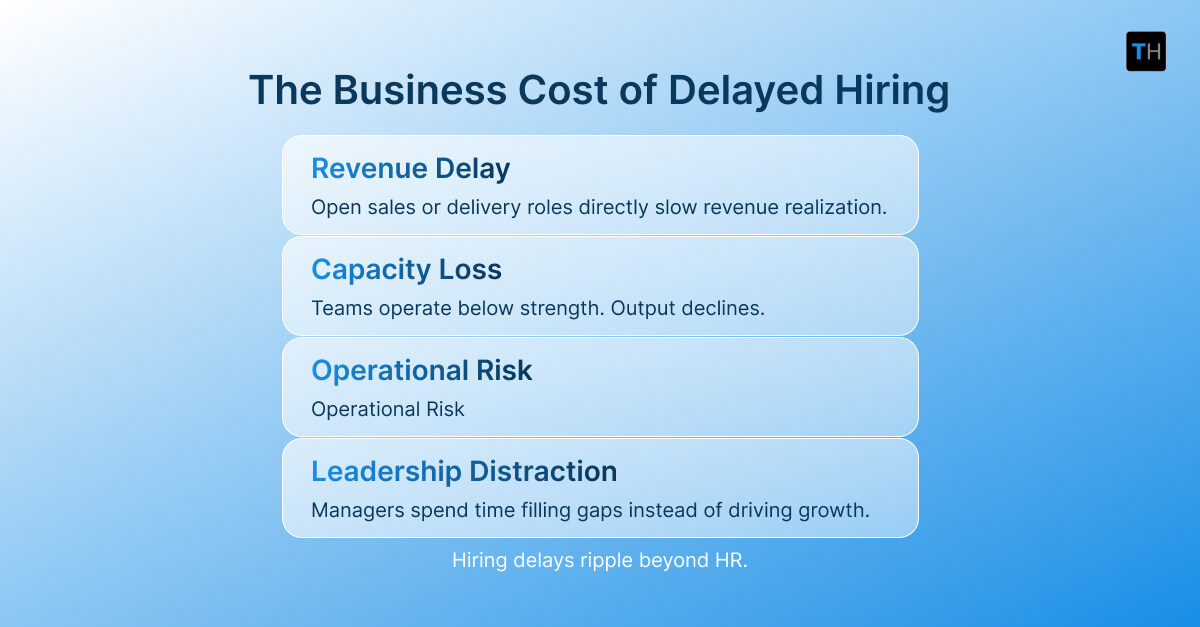
Delays in high-volume hiring affect more than open requisitions.
1. Team productivity declines: Unfilled roles increase workload on existing employees. Fatigue spreads beyond the hiring team into delivery and operations.
2. Recruiter burnout increases: Recruiters absorb coordination friction. Days fill with follow-ups, rework, and manual tracking. Decision quality suffers as cognitive load rises.
3. Candidate experience weakens: Delayed updates and unclear timelines erode trust. Candidates disengage without notice, leaving pipelines thinner than expected.
4. Negative business impact: Delayed hiring has a cascading effect on the whole business. Open roles delay revenue when sales, delivery, or support capacity stays unfilled. Teams operating below capacity slow down execution across functions. Managers spend more time compensating for gaps instead of focusing on growth or improvement. Over time, leadership attention shifts from strategy to firefighting.
Why Adding More Recruiters or Tools Rarely Solves the Problem
Scaling headcount or tools without redesign has limits.
1. More recruiters increase activity: Without clear ownership and orchestration, added headcount spreads coordination work across more people.
2. New tools improve steps, not systems: Point solutions speed up individual tasks but do not fix handoffs.
3. Pressure accelerates burnout: Attrition risk grows among recruiters and candidates alike.
Sustainable scale requires systematic change, and not just incremental pressure.
What Scalable High-Volume Hiring Requires
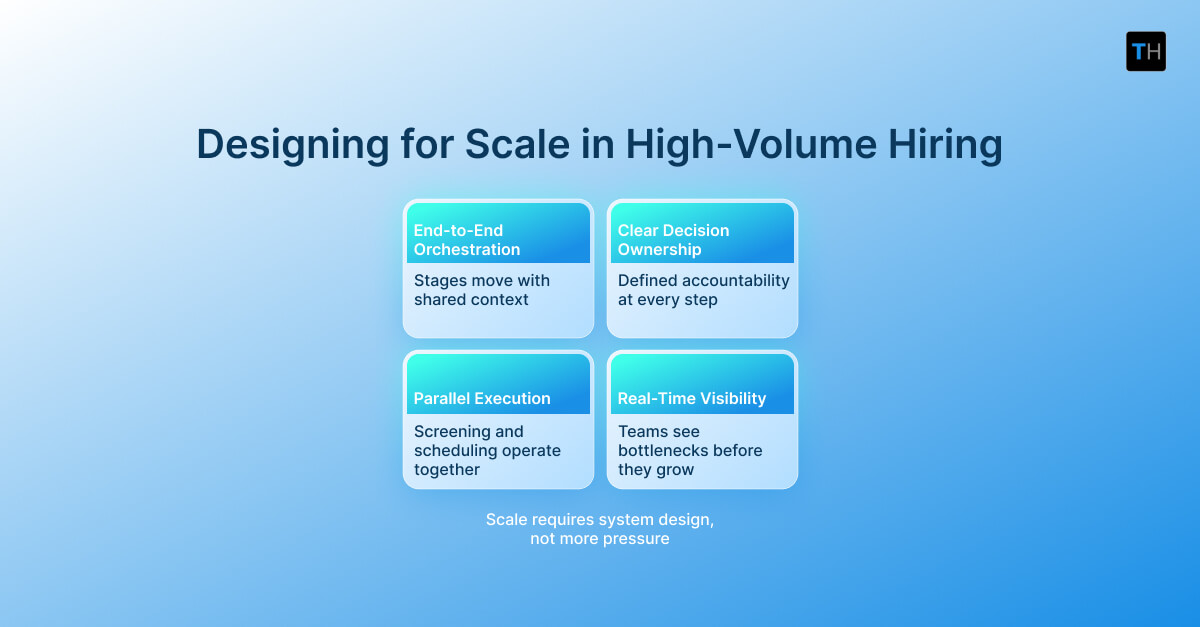
Organizations that handle high-volume hiring consistently design their systems for flow.
1. End-to-end orchestration: Hiring stages function as part of a single system. Context, expectations, and ownership move forward with the candidate. Re-alignment at each step becomes unnecessary.
2. Clear decision ownership: Every transition has a defined owner. Decisions move forward because responsibility is explicit, not because someone follows up repeatedly.
3. Parallel execution: Screening, scheduling, and feedback should operate concurrently. The system absorbs volume without extending cycle time.
4. Real-time visibility: Teams see where candidates are waiting and why. Early signals allow intervention before delays harden into patterns.
The Role of Technology in High-Volume Hiring Systems
Technology supports scale when it removes friction and preserves context.
1. Automating coordination work: Scheduling, reminders, approvals, and updates create delay but do not require judgment.
2. Supporting human decisions: Evaluation and final decisions remain human responsibilities. Technology should only act as supporting cast to reduce noise and manual effort around them.
3. Connecting stages end to end: Automation improves throughput only when tools share context across stages. Fragmented automation increases activity without improving outcomes.
QR Codes and Mobile Access in High-Volume Hiring
Entry-point friction matters at scale.
1. Faster candidate entry: QR codes allow candidates to apply instantly at job fairs, walk-ins, and on-site drives. This removes manual data capture and reduces early drop-off.
2. Mobile-first workflows: Candidates expect to apply and respond on their phones. Mobile access improves completion rates and response speed.
3. Stronger pipeline continuity: Candidates are more likely to stay engaged later in the funnel if the access is easy.
Measuring What Matters in High-Volume Hiring
Metrics help diagnose system health.
1. Time to hire shows flow efficiency: Rising time to hire often points to coordination or ownership gaps.
2. Hiring throughput shows capacity limits: Throughput reveals whether the system can meet demand consistently.
3. Offer acceptance reflects trust: Declines often signal delays or misalignment earlier in the process.
Conclusion
High-volume hiring exposes the limits of traditional recruitment processes. You end up shooting in the dark if you think effort alone can compensate for weak system design.
Organizations that scale successfully focus on orchestration, ownership, and visibility. They reduce friction early and treat hiring as a system.
TurboHire supports high-volume hiring by enabling connected workflows that help teams meet demand without breaking under pressure.
Frequently Asked Questions (FAQs)
1. What is high-volume hiring?
High-volume hiring refers to hiring large numbers of candidates within a short period of time. It often happens in roles with repeat demand, seasonal spikes, or rapid business expansion. High-volume hiring stresses traditional recruitment processes because multiple roles move through the hiring system at the same time, increasing coordination and decision complexity.
2. Why does time to hire increase in high-volume hiring?
Time to hire increases in high-volume hiring because coordination work grows faster than decision-making. Screening delays, interview scheduling bottlenecks, slow feedback, and unclear ownership repeat across many roles. These small delays stack, making it harder for the hiring system to maintain a consistent flow.
3. How can organizations scale high-volume hiring without losing quality?
Organizations scale high-volume hiring by treating it as a system problem rather than an execution problem. This includes clear role definition at intake, structured screening, defined decision ownership, parallel workflows, and technology that removes coordination friction. When the system is designed for flow, hiring speed and quality improve together.