

Interview-to-hire ratio remains stubbornly high across many organizations. Despite increased investment in tools, expanded sourcing channels, and growing recruiter effort, teams often find themselves conducting more interviews without improving hiring outcomes. Across a cross‑industry sample of more than 60,000 companies, the average interview‑to‑hire conversion rate in 2024 was about 27%. Roughly, one hire for every four candidates interviewed.
The usual explanations are familiar. The candidates are not good enough. Hiring managers are indecisive. Recruiters are overloaded. While each of these may be partially true, they miss the underlying issue.
Interview-to-hire ratio is not primarily a people problem. It is a system signal. When this metric remains high, it usually indicates that the hiring system is allowing low-quality signals to move too far downstream. Interviews are then used to compensate for the uncertainty that should have been resolved earlier.
This is where automated screening, when applied correctly, plays a meaningful role. Not as a standalone tool, but as part of a connected talent acquisition system designed to improve signal quality before interviews begin.
What Is Interview-to-Hire Ratio
The interview-to-hire ratio measures how many interviews an organization conducts to make a single hire.
It reflects how efficiently the hiring funnel converts evaluated candidates into accepted offers.
For talent acquisition leaders, this metric matters because it directly affects:
- Interviewer workload and availability
- Recruiter capacity and productivity
- Hiring velocity at scale
- Candidate experience during the later stages
Unlike time-based metrics, the interview-to-hire ratio focuses on the quality of flow rather than speed alone. A process can move quickly and still be inefficient if it relies on excessive interviewing to reach decisions.
How to Calculate Interview-to-Hire Ratio
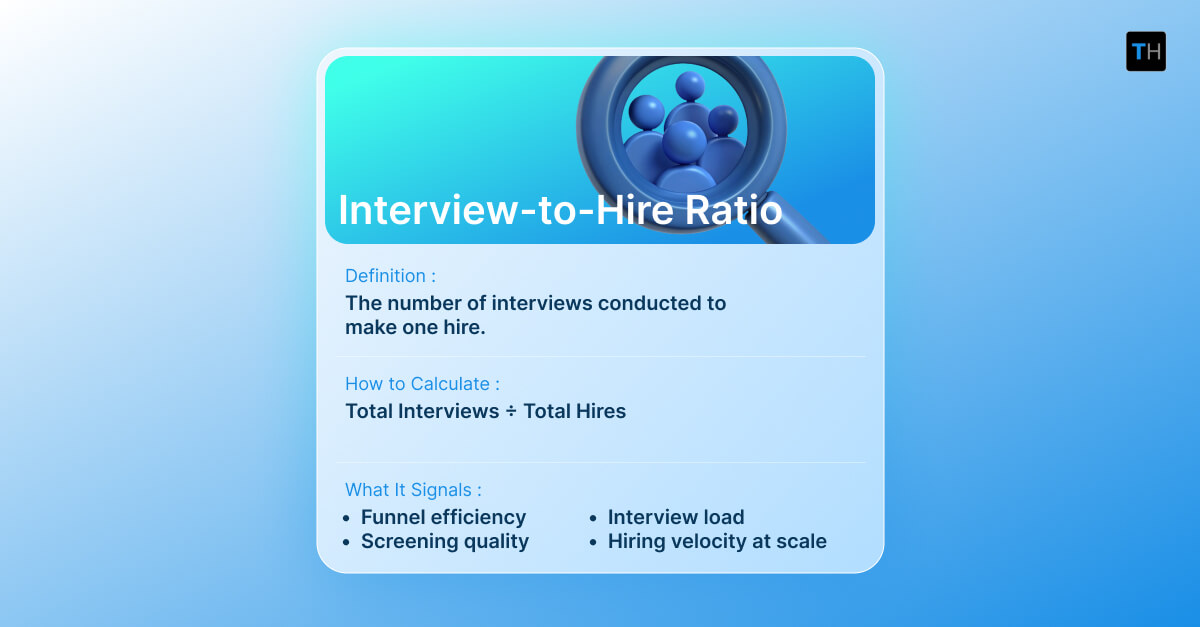
The calculation is straightforward:
Interview-to-Hire Ratio = Interview-to-Hire Ratio = Total Interviews ÷ Total Hires
For example, 60 interviews ÷ 6 hires = 10:1
The number itself is not inherently good or bad. What matters is consistency, trend direction, and context. A rising ratio often signals declining screening quality or misalignment earlier in the funnel.
What Interview-to-Hire Ratio Reveals About Your Hiring System
A high interview-to-hire ratio typically indicates that too many candidates are advancing into interviews without sufficient signal. Interviews are then expected to perform discovery rather than validation. Recent global interview research suggests that around 25% of candidates drop out at the interview stage, making it the single biggest loss point in many hiring funnels, and 39% of companies report that candidates face too many interviews.
This creates several downstream effects:
- Interview loops expand to compensate for uncertainty
- Hiring managers meet more candidates without greater confidence
- Recruiters spend more time coordinating than evaluating
- Decisions slow down despite increased activity
A lower ratio, by contrast, suggests that screening is doing more of the filtering work. Interviews are used to confirm fit, not uncover it.
The metric does not judge recruiter effort. It reflects how well the system generates reliable signals before human time is invested.
Why Interview-to-Hire Ratios Inflate
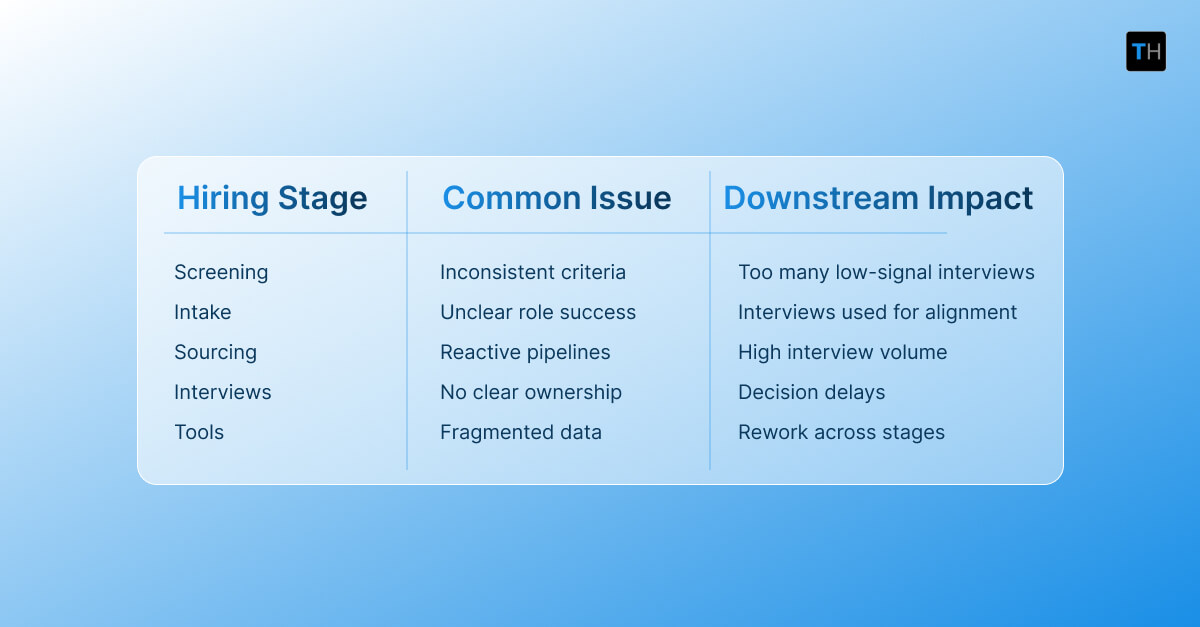
Interview-to-hire ratios rarely inflate for a single reason. They rise when multiple small breakdowns accumulate early in the funnel.
- Weak screening inputs: Resumes are screened using inconsistent criteria, keyword-heavy approaches, or loosely defined role expectations. Candidates advance without a clear understanding of what success looks like.
- Misalignment between recruiters and hiring managers: When intake conversations lack clarity, screening decisions vary by recruiter interpretation. Interviews then become alignment exercises rather than evaluations.
- Ineffective interview design: Interviews attempt to compensate for weak screening. More stakeholders are added, and decisions are delayed as confidence remains low.
- Reactive sourcing: Pipelines built under pressure tend to prioritize volume over relevance. This increases interview load without improving outcomes.
- Fragmented tools and data: Candidate context is lost between screening, interviews, and decisions. Each stage repeats work that should already be resolved.
None of these issues is caused by a lack of effort. They emerge when the hiring system allows uncertainty to travel downstream.
How High Interview-to-Hire Ratios Slow Down Hiring
High interview-to-hire ratios directly affect time to hire, even when teams are working at full capacity.
More interviews require more scheduling. Scheduling requires coordination across calendars. Coordination introduces delays. One recent analysis found that SMBs average 9–11 interviews per hire, while large enterprises may conduct 65–75 interviews for a single role, reflecting how interview volume escalates sharply with scale. As interview loops expand, feedback cycles lengthen, and decisions stall.
Recruiters spend increasing amounts of time managing logistics rather than improving funnel quality. Hiring velocity drops, not because people are slow, but because the system is overloaded with unnecessary work.
Time to hire increases as a consequence, not as a root problem.
The Role of Automated Screening in Improving Interview-to-Hire Ratio
Automated screening improves the interview-to-hire ratio only when it strengthens early signal quality.
At its best, automated screening supports:
- Resume parsing and normalization across formats
- Structured evaluation aligned to role requirements
- Candidate scoring and prioritization
- Reduction of low-signal profiles entering interviews
The goal is not to eliminate judgment. It is to ensure that human judgment is applied where it adds the most value.
Read eBook: Hiring in the Age of AI: What Actually Determines Hiring Speed
When screening generates clearer signals, interviews become more focused, shorter, and more decisive.
Automated Screening as Part of a Talent Acquisition System
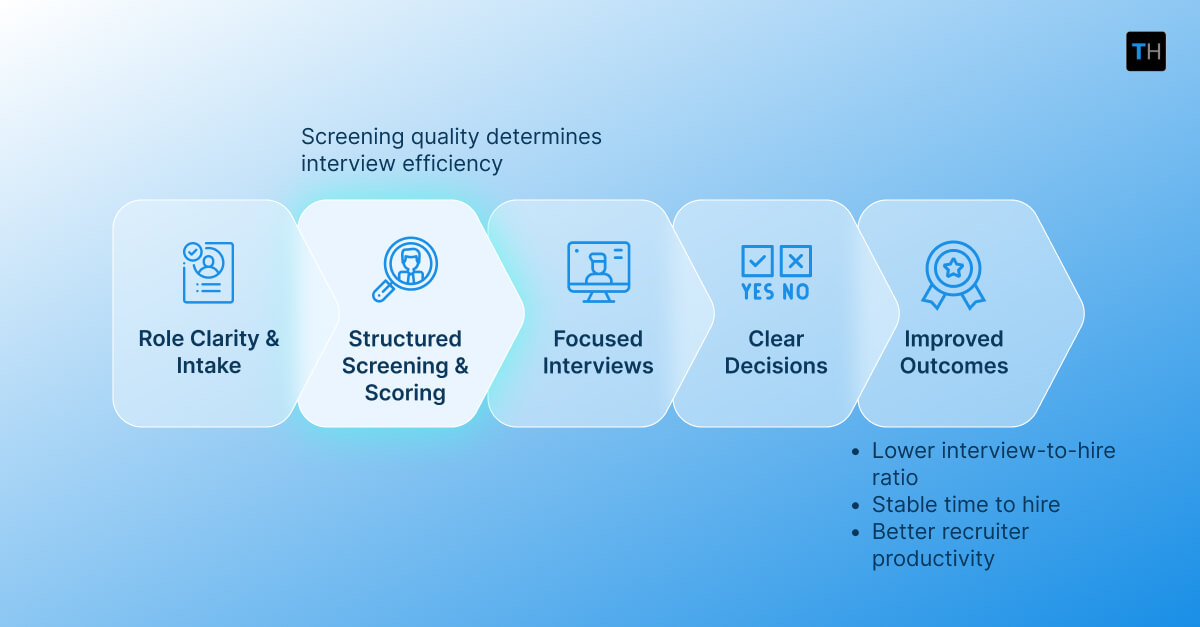
Screening does not operate in isolation. In mature talent acquisition systems, screening intelligence connects directly to:
- Job requisition and role clarity
- Assessments and interview design
- Hiring decisions and approvals
- Quality and performance outcomes
When these connections exist, screening becomes an orchestration layer rather than a gate. Candidates move forward with context, and interviews validate decisions instead of discovering them.
Metrics That Support Funnel Efficiency
Interview-to-hire ratio should be interpreted alongside a small set of supporting metrics:
- Time to hire is a downstream indicator of flow
- Recruiter productivity to understand capacity strain
- Offer acceptance rate as a signal of decision quality and candidate trust
When screening improves, the interview-to-hire ratio declines, time to hire stabilizes, recruiter productivity increases, and offer acceptance remains healthy.
If only one metric improves while others degrade, efficiency is being forced rather than designed.
How to Improve Interview-to-Hire Ratio in Practice
Improving this metric requires upstream changes rather than downstream pressure.
- Clarify role expectations and success criteria at intake
- Use structured screening aligned to those criteria
- Improve consistency in screening decisions before interviews
- Design interviews with a clear purpose and ownership
- Maintain a single source of truth across the funnel
- Use feedback loops to refine screening quality continuously
Conclusion: Interview Efficiency Is a System Outcome
Interview-to-hire ratio does not improve because recruiters work harder or interviewers meet more candidates. It improves when the hiring system produces stronger signals earlier.
Automated screening contributes value when it is embedded into an end-to-end talent acquisition system that prioritizes clarity, consistency, and flow.
TurboHire supports this approach by enabling automated screening as part of a connected hiring system, helping teams reduce unnecessary interviews and improve hiring outcomes without adding friction.
Frequently Asked Questions (FAQs)
1. What is a good interview-to-hire ratio in recruitment?
A good interview-to-hire ratio depends on role complexity and hiring volume, but most organizations aim for a range that allows confident decisions without excessive interviews. Very high ratios often indicate weak screening or misalignment early in the hiring process, while consistently low ratios suggest stronger signal quality before interviews begin. The key is to track trends and stability rather than chase a single benchmark.
2. How does automated screening improve the interview-to-hire ratio?
Automated screening improves the interview-to-hire ratio by strengthening candidate evaluation before interviews start. By parsing resumes, structuring candidate data, and prioritizing profiles aligned to role requirements, automated screening reduces the number of low-signal candidates entering interviews. This allows interviews to focus on validation rather than discovery, leading to fewer interviews per hire.
3. How is the interview-to-hire ratio connected to hiring velocity?
Interview-to-hire ratio directly affects hiring velocity because every additional interview adds coordination, scheduling, and decision time. When too many candidates enter interviews, pipelines slow down, and recruiter capacity is strained. Improving the interview-to-hire ratio through better screening helps maintain hiring velocity without increasing recruiter workload or compromising candidate experience.