

Reducing time to hire has become a central focus for talent acquisition leaders. As hiring demand increases, open roles take longer to close, business teams expect faster outcomes, and candidates disengage when processes feel uncertain or slow. Hiring velocity is no longer just an operational concern. It is a business risk.
In response, many organizations apply pressure at the execution layer. Recruiters are asked to handle more requisitions, work within tighter timelines, and push pipelines harder. The expectation is that more effort will produce faster results.
What usually follows is a different outcome. Recruiter burnout rises, productivity declines, candidate experience weakens, and hiring quality becomes inconsistent.
This pattern is not accidental. It signals a deeper issue in how hiring systems are designed.
Time to hire and recruiter burnout are closely linked through the structure of the talent acquisition system. When the system depends on human effort to compensate for coordination gaps, speed becomes unsustainable. Improving time to hire without addressing burnout is not possible because both are consequences of the same design choices.
Why Time to Hire and Recruiter Burnout Are Connected
Time to hire rarely increases because recruiters are moving slowly. It increases because the volume of coordination work grows faster than the system’s ability to support decisions. 52% prioritize getting more candidates per role over quality. It is the first time quality has been deprioritized in two years.
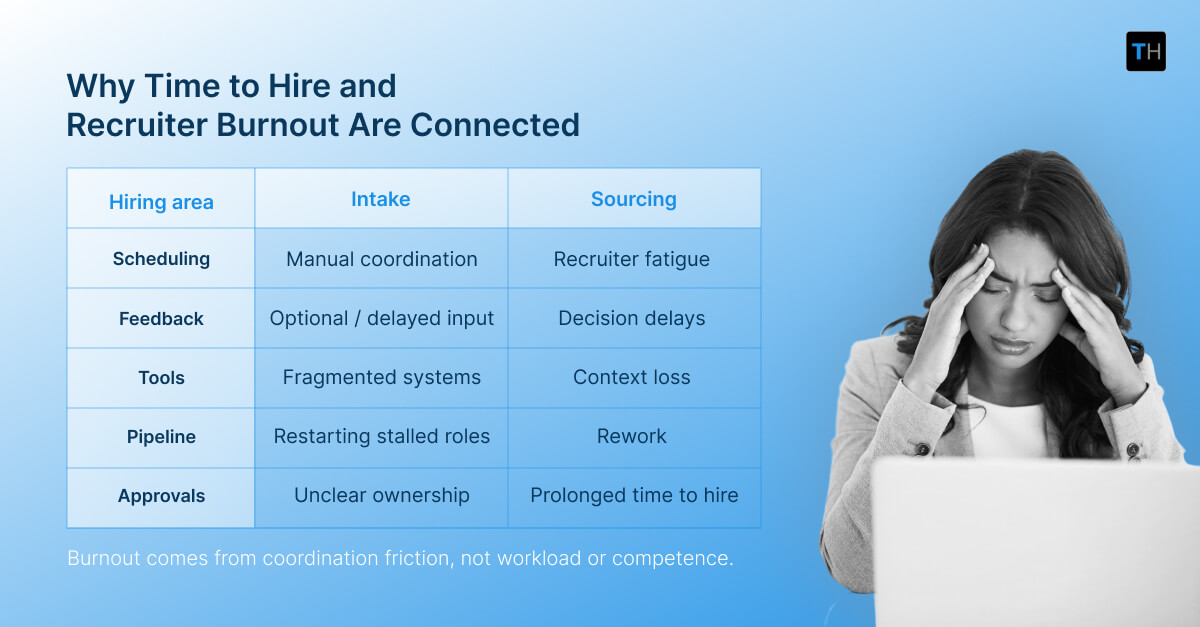
As hiring volume grows, recruiters spend a growing share of their time on work that does not improve hiring quality:
- Scheduling interviews across multiple stakeholders
- Chasing feedback and approvals
- Manually updating systems and stakeholders
- Reconciling candidate data across tools
- Restarting stalled pipelines
This work is repetitive, reactive, and invisible in most metrics. It keeps the process alive but does not move it forward.
When coordination load rises, recruiter productivity drops even though effort increases. Recruiters feel busy but ineffective. The gap between effort and outcome widens.
This gap is what leads to burnout.
Burnout is not caused by hiring being complex. It is caused by working inside a talent acquisition system where the flow depends on constant human intervention. In such systems, reducing time to hire means asking recruiters to absorb more friction, which accelerates burnout rather than solving the problem.
Recruiter Burnout Is a Talent Acquisition System Failure
Organizations often treat recruiter burnout as an individual issue. They increase manpower and encourage better prioritization. These responses fail because burnout is structural in the organization’s talent acquisition system.
When recruiters burn out, measurable business outcomes suffer:
- Screening becomes rushed or inconsistent
- Feedback cycles slow down
- Candidate communication weakens
- Offer acceptance rates decline
- Early attrition increases
None of this is caused by a lack of effort. It is caused by talent acquisition systems that rely on manual coordination to function.
A burned-out recruiter is not the root problem. They are the visible symptom of a system that does not scale.
Why Reducing Time to Hire Requires a System Lens
Time to hire is often treated as a recruiter KPI. In reality, it is a system-level outcome.
It reflects how well the talent acquisition system supports:
- Clear role definition at intake
- Predictable movement between stages
- Timely decision-making
- Ownership at handoffs
- Minimal coordination overhead
In fragmented systems, improvements to time to hire are usually driven by urgency. Recruiters push harder. Interviews are compressed. Follow-ups increase. While this can produce short-term gains, it also raises cognitive load, increases error rates, and accelerates burnout.
In well-designed talent acquisition systems, time to hire improves because friction is removed:
- Intake clarity reduces rework
- Structured workflows reduce handoffs
- Automation removes coordination tasks
- Decisions are designed into the process
Speed becomes an outcome of flow, not effort. 70% of recruiters report increased hiring year-over-year, with most expecting momentum to continue into 2026.
You cannot sustainably reduce time to hire without redesigning how work moves through the system.
What to Automate to Reduce Time to Hire Without Burning Out Recruiters
Automation helps only when it supports the talent acquisition system. Used correctly, it reduces coordination load and protects recruiter judgment. 42% of recruiters say automation already cuts stress.
Key capabilities include:
- Structured job requisition and intake — Clear intake prevents misalignment that slows screening and interviews later.
- Resume parsing and screening support — Early-stage noise is reduced so recruiters spend time evaluating, not filtering.
- Candidate scoring and prioritization — Recruiter effort is focused on the most relevant profiles.
- Role-aligned assessments — Decisions become clearer without extending interview cycles.
- Automated interview scheduling — One of the largest sources of recruiter burnout is removed.
- Consistent candidate communication — Follow-ups happen without manual chasing or loss of trust.
- Streamlined offer creation and acceptance — Momentum is preserved at the most fragile stage of hiring.
The principle is simple. Tools must connect stages and reduce handoffs. Automation that creates more alerts, dashboards, or manual reconciliation increases burnout rather than productivity.
Metrics That Signal Sustainable Speed
Time to Hire
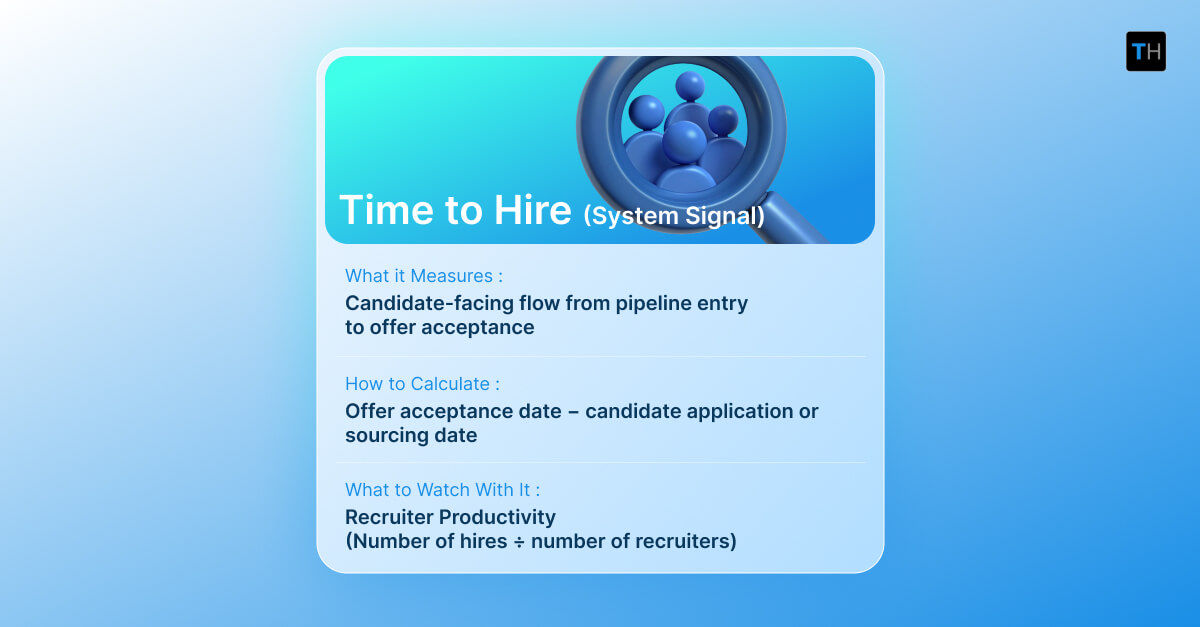
What it measures:
The number of days from when a candidate enters the pipeline to offer acceptance.
How to calculate:
Offer acceptance date − candidate application or sourcing date
What it signals:
Candidate-facing flow and coordination efficiency once hiring begins.
Recruiter Productivity
What it measures:
Hiring output relative to recruiter capacity.
How to calculate:
Number of hires completed ÷ number of recruiters (over a defined period)
What it signals:
Whether recruiters are spending time on decisions or coordination.
Guardrail Metrics
Time to hire should always be viewed alongside:
- Offer acceptance rate
- Candidate drop-off rate
If time to hire improves while recruiter productivity declines or offer acceptance falls, speed is being forced. Sustainable systems show improvement across all three.
Metrics should diagnose system health instead of applying pressure on recruiters and other users.
What This Means for Talent Acquisition Leaders
Recruiter burnout and slow time to hire are not separate problems. They emerge from the same system design flaws.
Reducing time to hire sustainably requires:
- Fewer manual handoffs
- Clear ownership at every stage
- Automation that removes coordination, not judgment
- Metrics used for diagnosis, not enforcement
High-performing teams do not rely on heroics. They build talent acquisition systems where recruiter productivity and hiring speed improve together.
Conclusion: Speed Without Burnout Is a System Outcome
Recruiter burnout is not inevitable. It is the result of talent acquisition systems that rely on human effort to compensate for poor flow.
Time to hire improves sustainably when coordination is automated, decisions are designed into the process, and recruiters are allowed to focus on judgment rather than logistics.
TurboHire supports this by enabling end-to-end talent acquisition systems that reduce coordination load and restore flow, allowing teams to move faster without burning out the people who make hiring possible.
Frequently Asked Questions (FAQs)
1. How are time to hire and recruiter burnout connected?
Time to hire and recruiter burnout are connected through the design of the talent acquisition system. When hiring relies heavily on manual coordination, recruiters absorb the friction created by unclear ownership, fragmented tools, and slow decision-making. As time to hire increases, recruiters spend more effort maintaining momentum rather than evaluating candidates, which leads to declining productivity and burnout. Sustainable improvements in time to hire require reducing coordination load, not increasing recruiter effort.
2. Can organizations reduce time to hire without increasing recruiter workload?
Yes, but only by redesigning the hiring system rather than pushing recruiters to work faster. Organizations reduce time to hire sustainably by improving role clarity at intake, automating coordination-heavy tasks like scheduling and follow-ups, and creating clear decision ownership across stages. When the system supports flow, recruiter productivity improves, and burnout decreases, even as hiring speed increases.
3. What metrics indicate sustainable hiring speed instead of forced velocity?
Sustainable hiring speed is indicated when time to hire improves alongside stable or increasing recruiter productivity and healthy guardrail metrics such as offer acceptance rate or candidate drop-off. If time to hire decreases but recruiter workload increases or candidate trust declines, speed is being forced rather than designed. High-performing talent acquisition systems use these metrics diagnostically to improve flow, not to apply pressure.