

Quality of hire, hiring velocity, and Time-to-Hire are often treated as competing priorities. In many organizations, improving one is assumed to weaken another. When quality concerns rise, teams add more interviews and more checks. About 91% of hiring managers report difficulty finding qualified candidates, underscoring why quality of hire is both a priority and a stress point for recruiting teams who also need to maintain pace.
This tension feels real in many organizations. Yet the tradeoff usually signals something else. It reflects how the hiring process is designed.
When evaluation signals are clear, and hiring flow is structured, quality and velocity strengthen together.
What Is Hiring Velocity?
Hiring velocity reflects how efficiently candidates move through the hiring process from intake to offer acceptance.
It is not simply about speed. It measures flow. It indicates how smoothly roles are defined, candidates are evaluated, and decisions are made.
Time-to-hire is one expression of hiring velocity. Throughput and decision consistency are others. A process may move quickly but produce inconsistent hires. That is not a strong velocity. True hiring velocity combines pace with clarity.
In well-designed talent acquisition systems, velocity reflects alignment across stages rather than pressure applied to recruiters.
How Hiring Velocity Is Measured
Hiring velocity is typically observed through a combination of metrics.
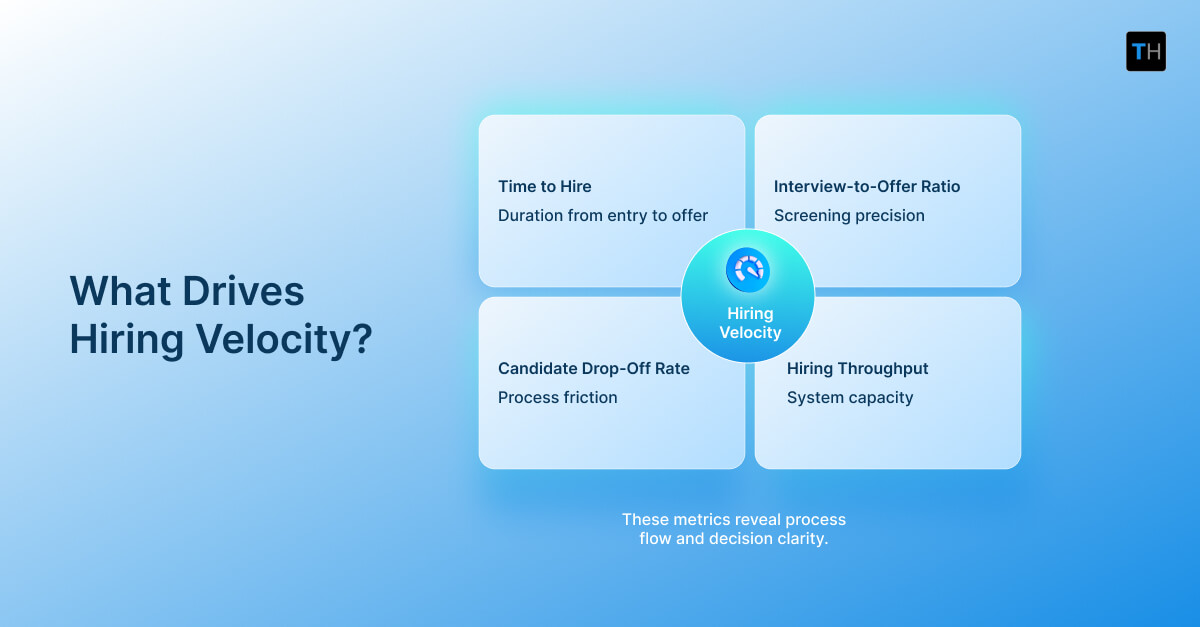
- Time to hire
Measures the number of days between candidate entry and offer acceptance. Prolonged timelines often signal evaluation ambiguity or decision friction.
Read eBook: What Actually Determines Hiring Speed - Interview-to-offer ratio
Indicates screening precision. A high ratio suggests weak filtering or unclear role definition. - Candidate drop-off rate
Highlights friction within stages. Drop-offs may indicate delays, unclear communication, or misaligned expectations. 92% of candidates exited the process at some point, with 43% of companies reporting the application stage as the point of most drop-offs. - Hiring throughput
Tracks how many roles move from open to filled within a defined period. It reflects overall system capacity.
These metrics are diagnostic. They reveal how the process behaves under pressure.
Why Organizations Sacrifice One Metric for Another
When Time-to-Hire rises, leadership often responds by compressing interview stages or pushing for faster feedback.
When Quality of Hire declines, organizations add additional safeguards:
- Extra interview rounds
- More stakeholder involvement
- Expanded evaluation criteria
Both responses address visible symptoms. Neither resolves the structural issue.
Most tradeoffs emerge from:
- Ambiguous role definitions
- Inconsistent evaluation standards
- Poor visibility into process bottlenecks
The tradeoff emerges from weak orchestration.
What Actually Slows Hiring Velocity
Hiring slows down when clarity is missing.
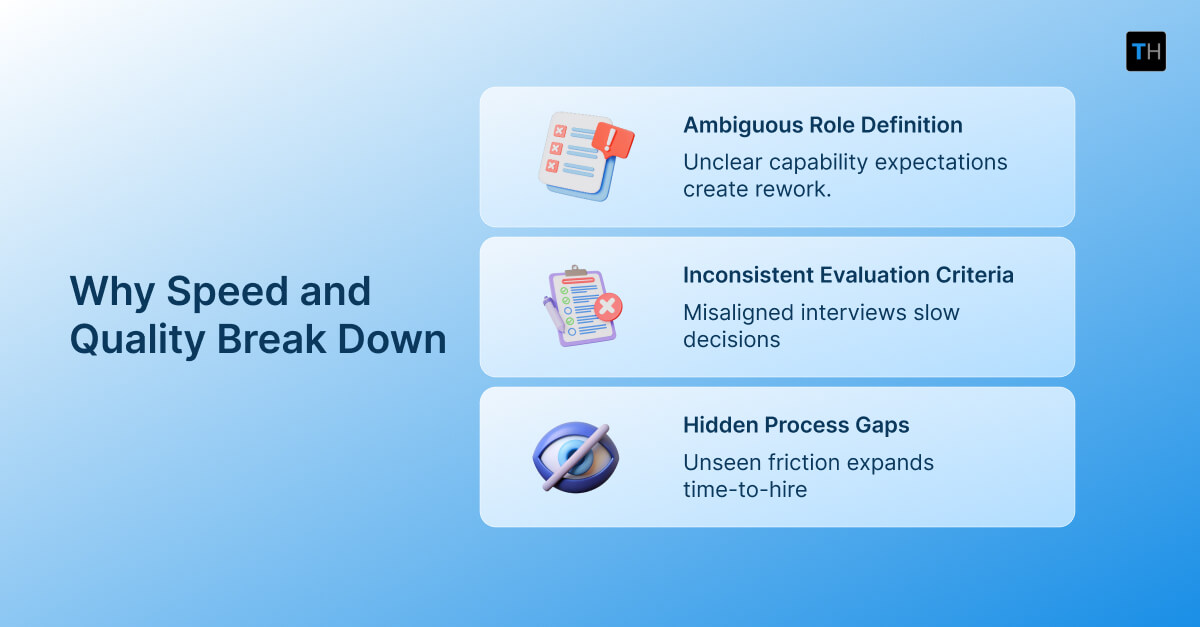
- Ambiguous role definition
When required capabilities are not clearly articulated, recruiters screen broadly. Hiring managers recalibrate mid-process. Shortlists shift repeatedly.This creates unnecessary back-and-forth between recruiters and hiring managers. Candidates who initially seemed aligned may no longer fit once expectations evolve, forcing the process to restart. - Inconsistent evaluation criteria
Different interviewers assess different attributes. Conversations overlap. Decisions are revisited. Final decisions take longer because stakeholders debate interpretation rather than evidence. - Hidden process gaps
Without data, friction points remain invisible. Candidate drop-offs increase. Interview stages expand. Time-to-hire lengthens.Teams often respond by adding more steps instead of addressing the root cause. Over time, the process becomes heavier, yet outcomes do not improve proportionately.
These are system inefficiencies. They are not consequences of pursuing quality.
How to Improve Hiring Velocity Without Compromising Quality
1. Identify Gaps in the Hiring Process
Map the flow from intake to offer. Identify where decisions stall. Determine whether delays are caused by unclear role expectations, overloaded stakeholders, or screening misalignment.
Velocity improves when friction is diagnosed rather than accelerated.
2. Use Data to Identify Candidate Drop-Offs
Analyze where candidates exit the process. Drop-offs may indicate slow communication, unclear role scope, or inconsistent evaluation standards.
Data turns anecdotal concerns into measurable improvement opportunities.
3. Strengthen Capability Definition
Clear capability mapping improves both screening precision and decision confidence. When skills are defined in measurable terms, recruiters filter more accurately and interview panels focus on validation rather than exploration.
This reduces rework. Reduced rework increases throughput.
4. Expand Sourcing Thoughtfully
Posting on multiple job boards may increase applicant volume, but volume alone does not improve velocity. Broader sourcing is effective only when paired with structured screening logic.
Without defined capability criteria, increased volume adds noise rather than speed.
Velocity improves when pipeline breadth is matched with evaluation clarity.
Aligning Quality of Hire and Hiring Velocity
Quality of hire reflects how well new employees perform, adapt, and sustain contribution.
Hiring velocity reflects how efficiently candidates move through the process.
Both depend on signal clarity.
When capability definitions are consistent:
- Screening becomes precise
- Interview stages are purposeful
- Decision-making accelerates
- Early performance stability improves
Speed increases because ambiguity decreases. Quality improves because validation becomes structured.
In this sense, hiring velocity and quality of hire are aligned indicators of system health.
Designing for System-Level Optimization
Improving both outcomes requires coordinated design across stages.
- Standardized capability intake
- Structured screening workflows
- Consistent evaluation criteria
- Centralized visibility into hiring metrics
These elements reduce friction without reducing rigor.
When hiring infrastructure supports structured capability evaluation and aligned workflows, organizations no longer need to trade speed for quality.
For CHROs evaluating hiring performance, the question is not whether to prioritize speed or quality. The question is whether the hiring system is designed to support both.
TurboHire is built to enable this orchestration. By supporting structured skill capture, intelligent matching, and consistent evaluation visibility, it helps teams optimize flow while strengthening quality signals.
Frequently Asked Questions (FAQs)
1. Does improving Quality of hire slow down hiring velocity?
No. When evaluation criteria are clearly defined and consistently applied, both quality of hire and hiring velocity improve together.
2. How can organizations improve hiring velocity without sacrificing quality?
By identifying process gaps, using data to detect friction points, and aligning screening and interviews to clearly defined capabilities.
3. What metrics should CHROs track to balance speed and quality?
Time to hire, interview-to-offer ratio, candidate drop-off rate, hiring throughput, and quality-of-hire indicators such as retention and performance ratings.